Rafferty Miriam R, Schmidt Peter N, Luo Sheng T, Li Kan, Marras Connie, Davis Thomas L, Guttman Mark, Cubillos Fernando, Simuni Tanya
Center for Education in Health Sciences Northwestern University, Chicago, IL, USA.
National Parkinson Foundation, Miami, FL, USA.
J Parkinsons Dis. 2017;7(1):193-202. doi: 10.3233/JPD-160912.
Research-based exercise interventions improve health-related quality of life (HRQL) and mobility in people with Parkinson's disease (PD).
To examine whether exercise habits were associated with changes in HRQL and mobility over two years.
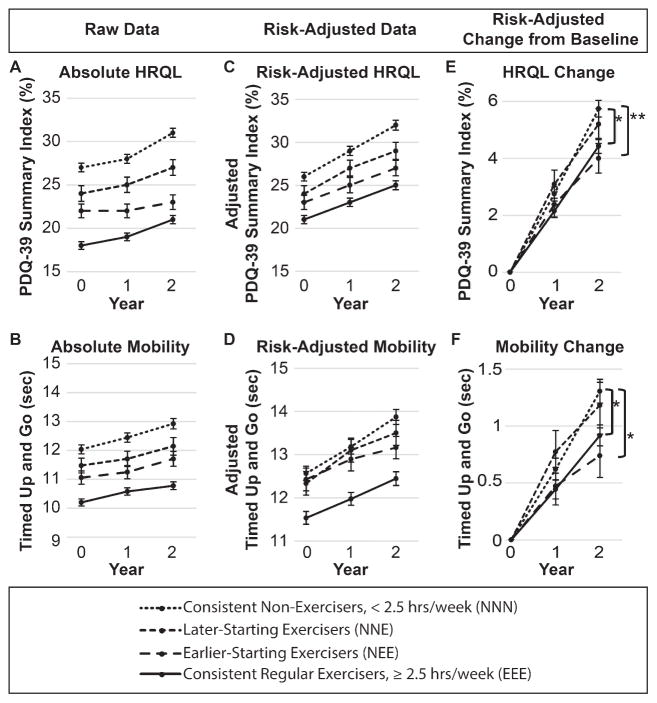
We identified a cohort of National Parkinson Foundation Quality Improvement Initiative (NPF-QII) participants with three visits. HRQL and mobility were measured with the Parkinson's Disease Questionnaire (PDQ-39) and Timed Up and Go (TUG). We compared self-reported regular exercisers (≥2.5 hours/week) with people who did not exercise 2.5 hours/week. Then we quantified changes in HRQL and mobility associated with 30-minute increases in exercise, across PD severity, using mixed effects regression models.
Participants with three observational study visits (n = 3408) were younger, with milder PD, than participants with fewer visits. After 2 years, consistent exercisers and people who started to exercise regularly after their baseline visit had smaller declines in HRQL and mobility than non-exercisers (p < 0.05). Non-exercisers worsened by 1.37 points on the PDQ-39 and a 0.47 seconds on the TUG per year. Increasing exercise by 30 minutes/week was associated with slower declines in HRQL (-0.16 points) and mobility (-0.04 sec). The benefit of exercise on HRQL was greater in advanced PD (-0.41 points) than mild PD (-0.14 points; p < 0.02).
Consistently exercising and starting regular exercise after baseline were associated with small but significant positive effects on HRQL and mobility changes over two years. The greater association of exercise with HRQL in advanced PD supports improving encouragement and facilitation of exercise in advanced PD.
基于研究的运动干预可改善帕金森病(PD)患者的健康相关生活质量(HRQL)和运动能力。
探讨运动习惯与两年内HRQL和运动能力变化之间是否存在关联。
我们确定了一组参加过三次全国帕金森基金会质量改进计划(NPF-QII)访视的参与者。使用帕金森病问卷(PDQ-39)和定时起立行走测试(TUG)来测量HRQL和运动能力。我们将自我报告的经常锻炼者(每周≥2.5小时)与每周锻炼时间不足2.5小时的人进行比较。然后,我们使用混合效应回归模型,在PD严重程度范围内,量化与运动增加30分钟相关的HRQL和运动能力变化。
进行了三次观察性研究访视的参与者(n = 3408)比访视次数较少的参与者更年轻,PD病情更轻。两年后,持续锻炼者和在基线访视后开始定期锻炼的人在HRQL和运动能力方面的下降幅度小于不锻炼者(p < 0.05)。不锻炼者每年在PDQ-39上恶化1.37分,在TUG上恶化0.47秒。每周增加30分钟的运动与HRQL(-0.16分)和运动能力(-0.04秒)下降较慢相关。运动对HRQL的益处在晚期PD患者中(-0.41分)大于轻度PD患者(-0.14分;p < 0.02)。
持续锻炼以及在基线后开始定期锻炼与两年内HRQL和运动能力变化的微小但显著的积极影响相关。运动与晚期PD患者的HRQL关联更大,这支持在晚期PD患者中加强对运动的鼓励和促进。