Yano Shuya, Takehara Kiyoto, Kishimoto Hiroyuki, Tazawa Hiroshi, Urata Yasuo, Kagawa Shunsuke, Bouvet Michael, Fujiwara Toshiyoshi, Hoffman Robert M
AntiCancer, Inc., San Diego, CA, USA.
Department of Surgery, University of California San Diego, CA, USA.
Oncotarget. 2016 Dec 20;7(51):85273-85282. doi: 10.18632/oncotarget.13296.
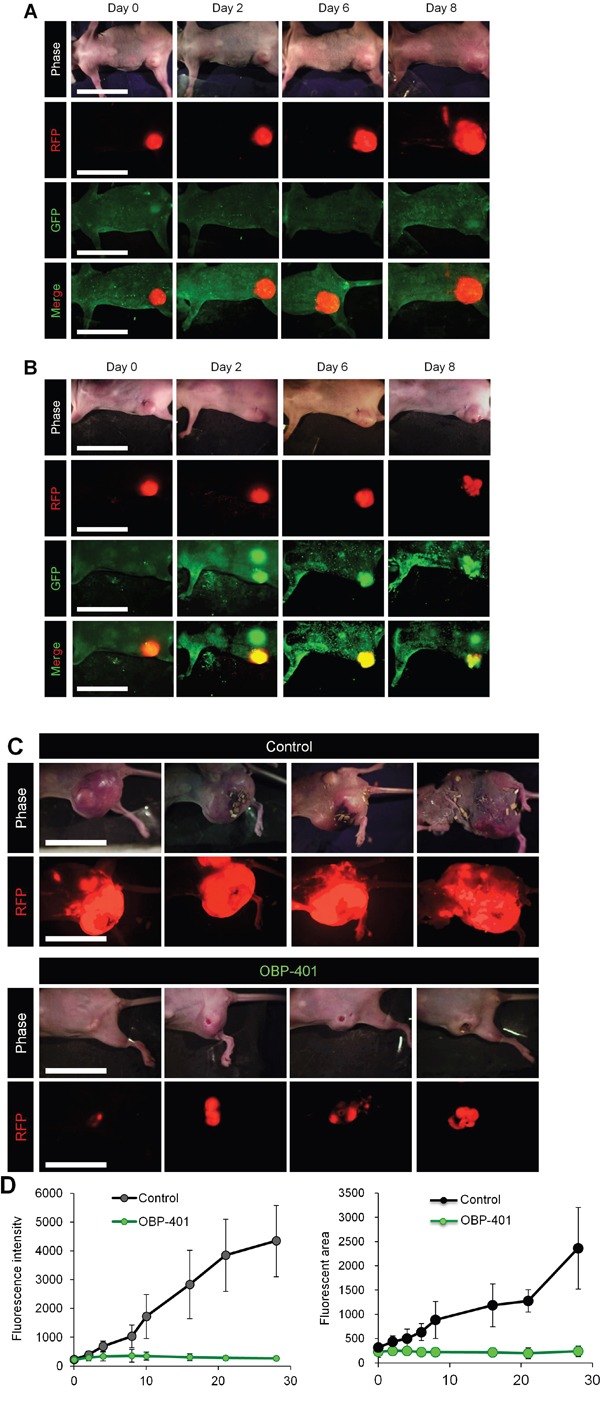
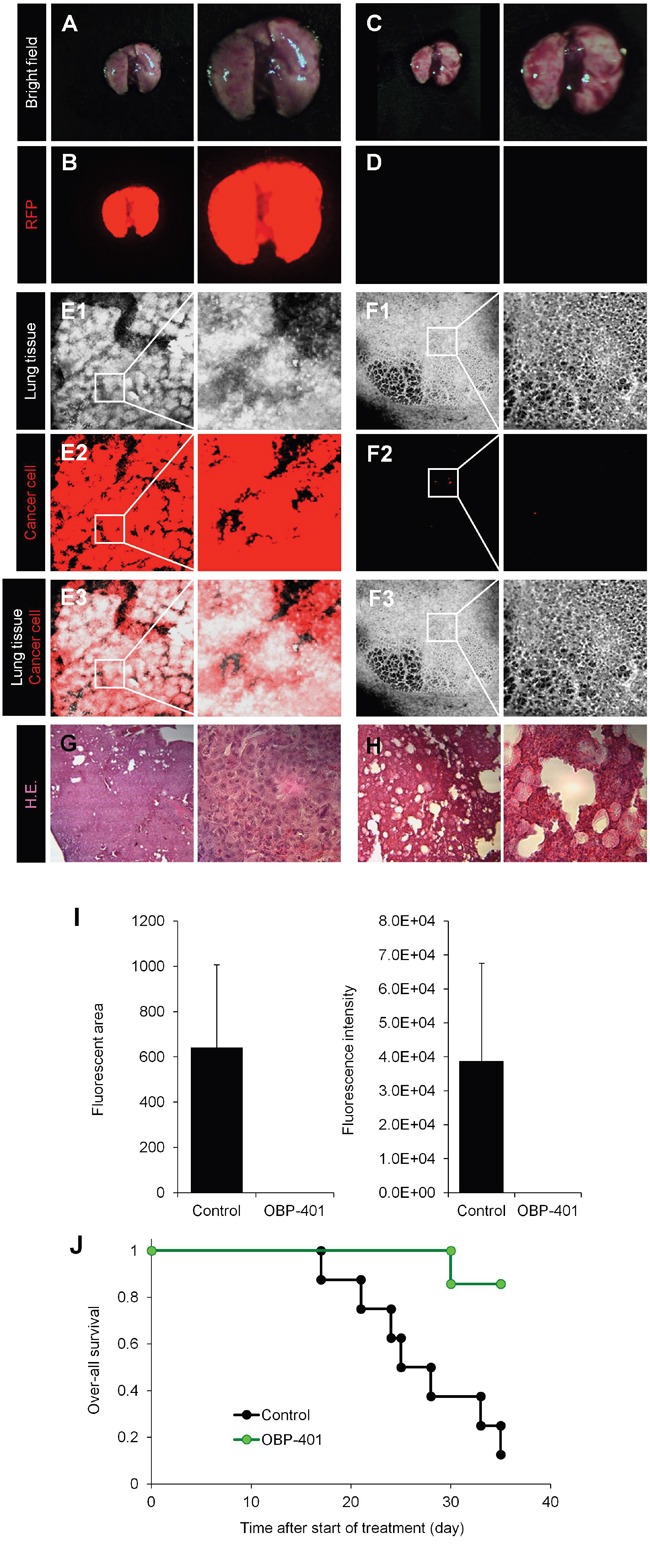
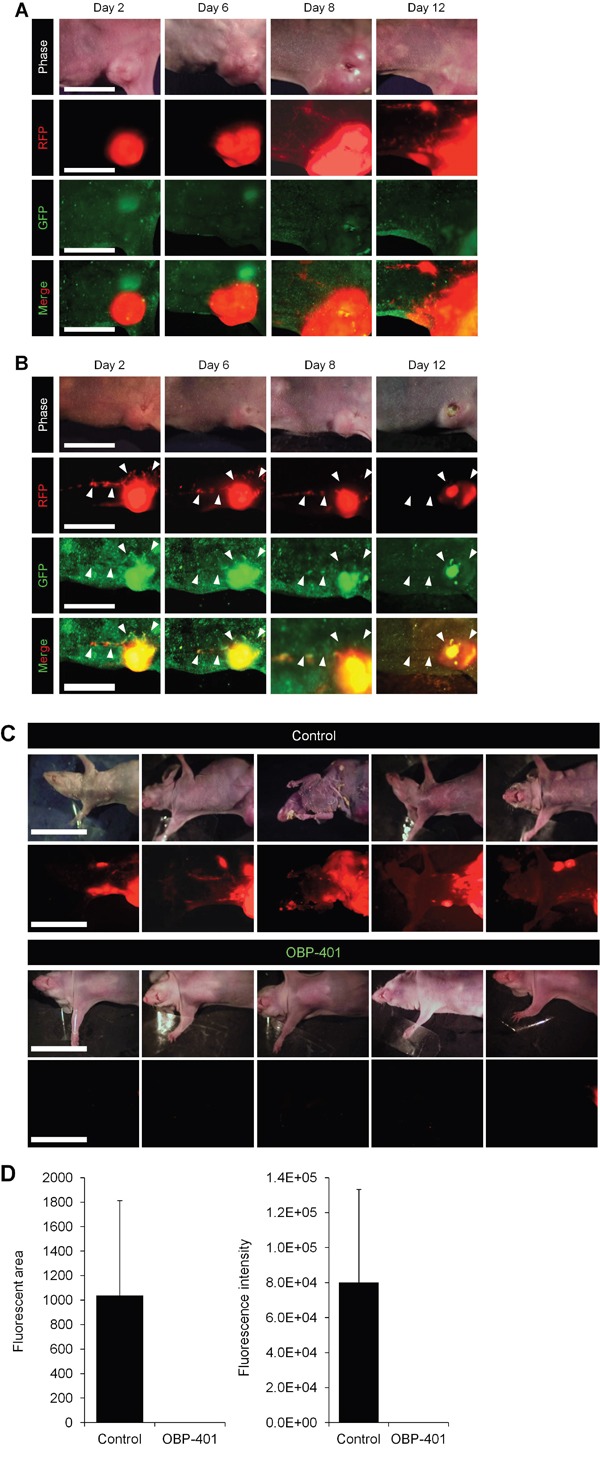
Our laboratory previously developed a highly-invasive, triple-negative breast cancer (TNBC) variant using serial orthotopic implantation of the human MDA-MB-231 cell line in nude mice. The isolated variant was highly-invasive in the mammary gland and lymphatic channels and metastasized to lymph nodes in 10 of 12 mice compared to 2 of 12 of the parental cell line. In the present study, the tumor-selective telomerase dependent OBP-401 adenovirus was injected intratumorally (i.t.) (1 × 10⁸ PFU) when the high-metastatic MDA-MB-231 primary tumor expressing red fluorescent protein (MDA-MB-231-RFP) reached approximately 500 mm3 (diameter; 10 mm). The mock-infected orthotopic primary tumor grew rapidly. After i.t. OBP-401 injection, the growth of the orthotopic tumors was arrested. Six weeks after implantation, the fluorescent area and fluorescence intensity showed no increase from the beginning of treatment. OBP-401 was then injected into high-metastatic MDA-MB-231-RFP primary orthotopic tumor growing in mice which already had developed metastasis within lymphatic ducts. All 7 of 7 control mice subsequently developed lymph node metastasis. In contrast, none of 7 mice which received OBP-401 had lymph node metastasis. Seven of 7 control mice also had gross lung metastasis. In contrast, none of the 7 mice which received OBP-401 had gross lung metastasis. Confocal laser microscopy imaging demonstrated that all control mice had diffuse lung metastases. In contrast, all 7 mice which received OBP-401 only had a few metastatic cells in the lung. OBP-401 treatment significantly extended survival of the treated mice.
我们实验室先前通过在裸鼠体内连续原位植入人MDA-MB-231细胞系,培育出了一种具有高度侵袭性的三阴性乳腺癌(TNBC)变体。与亲代细胞系的12只小鼠中有2只发生淋巴结转移相比,分离出的变体在乳腺和淋巴管中具有高度侵袭性,12只小鼠中有10只发生了淋巴结转移。在本研究中,当表达红色荧光蛋白的高转移性MDA-MB-231原发性肿瘤(MDA-MB-231-RFP)达到约500 mm³(直径10 mm)时,将肿瘤选择性端粒酶依赖性OBP-401腺病毒瘤内注射(i.t.)(1×10⁸ PFU)。模拟感染的原位原发性肿瘤生长迅速。注射OBP-401后,原位肿瘤的生长停止。植入后六周,荧光区域和荧光强度自治疗开始后未增加。然后将OBP-401注射到已在淋巴管内发生转移的小鼠体内生长的高转移性MDA-MB-231-RFP原发性原位肿瘤中。7只对照小鼠随后均发生了淋巴结转移。相比之下,接受OBP-401治疗的7只小鼠中无一发生淋巴结转移。7只对照小鼠中有7只也出现了明显的肺转移。相比之下,接受OBP-治疗的7只小鼠中无一出现明显的肺转移。共聚焦激光显微镜成像显示,所有对照小鼠均有弥漫性肺转移。相比之下,接受OBP-401治疗的7只小鼠肺部仅有少数转移细胞。OBP-401治疗显著延长了治疗小鼠的生存期。