Morassutti Alessandra L, Rascoe Lisa N, Handali Sukwan, DA Silva Alexandre J, Wilkins Patricia P, Graeff-Teixeira Carlos
Laboratório de Biologia Parasitária da Faculdade de Biociências e Laboratório de Parasitologia Molecular do Instituto de Pesquisas Biomédicas da Pontifícia Universidade Católica do Rio Grande do Sul (PUCRS),Av Ipiranga 6690,90690-900 Porto Alegre RS,Brasil.
Division of Parasitic Diseases and Malaria,Center for Global Health, Centers for Disease Control and Prevention,1600 Clifton Road NE, Atlanta, Georgia 30329,USA.
Parasitology. 2017 Apr;144(4):459-463. doi: 10.1017/S0031182016001918. Epub 2016 Nov 21.
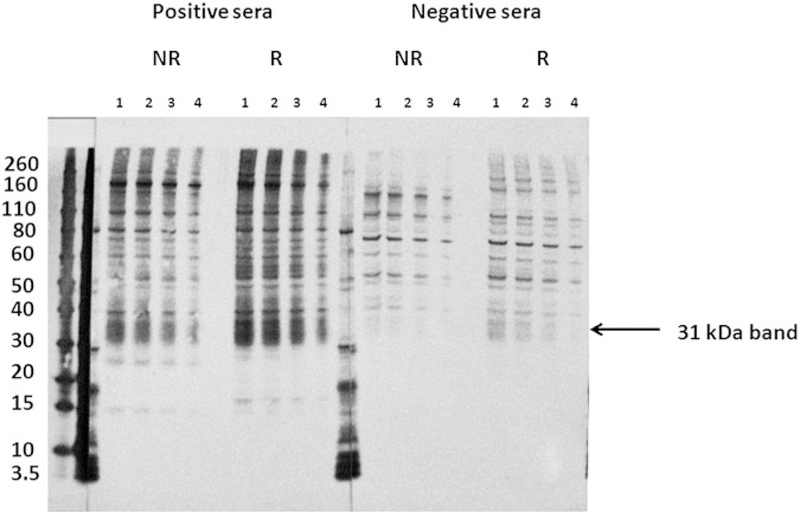
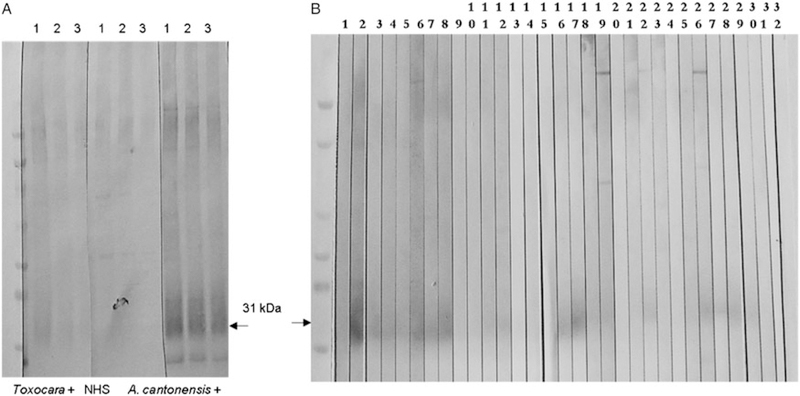
The primary causative agent of eosinophilic meningoencephalitis (EoM) in endemic regions is the nematode Angiostrongylus cantonensis. The occurrence of EoM was previously restricted to countries in Southeast Asia and the Pacific Islands; however, more recently, it has been reported from other regions, including Brazil. The commonly used diagnosis is detection of specific antibody reactivity to the 31 kDa antigen, which is derived from female worm somatic extracts. Here we report the occurrence of cross-reactivity to this antigen in sera from other parasitic infections, especially those that may cause EoM, such as gnathostomiasis, toxocariasis, hydatidosis and strongyloidiasis. We also demonstrated that the cross-reactivity, in part, is dependent of the concentration of antigen used in Western blot assays. We discuss the importance of these findings on the interpretation of this test.
在流行地区,嗜酸性粒细胞性脑膜炎(EoM)的主要病原体是广州管圆线虫。EoM的发病曾局限于东南亚和太平洋岛屿国家;然而,最近在包括巴西在内的其他地区也有报道。常用的诊断方法是检测对源自雌虫体提取物的31 kDa抗原的特异性抗体反应性。在此,我们报告了在其他寄生虫感染患者血清中对该抗原存在交叉反应,尤其是那些可能导致EoM的感染,如颚口线虫病、弓蛔虫病、包虫病和粪类圆线虫病。我们还证明,这种交叉反应部分取决于蛋白质印迹分析中所用抗原的浓度。我们讨论了这些发现对该检测结果解读的重要性。