Department of Urology, Zhongshan Hospital, Fudan University, Shanghai, China; Shanghai Key Laboratory of Organ Transplantation, Shanghai, China.
Shanghai Key Laboratory of Organ Transplantation, Shanghai, China; Department of Plastic Surgery, Zhongshan Hospital, Fudan University, Shanghai, China.
J Immunol Res. 2016;2016:4986797. doi: 10.1155/2016/4986797. Epub 2016 Oct 27.
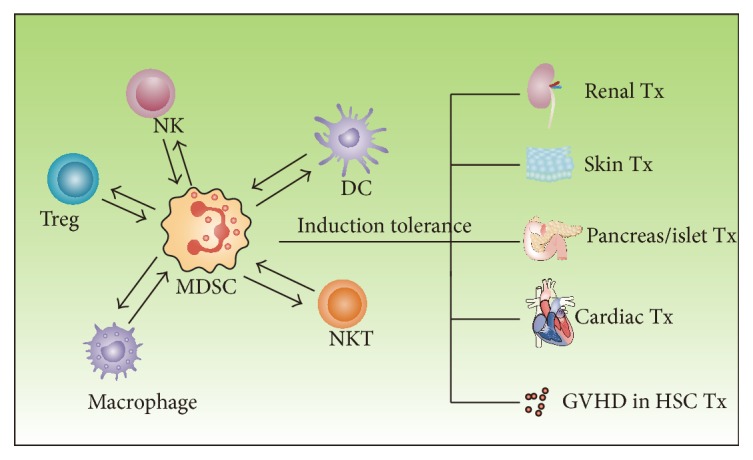
Myeloid derived suppressor cells (MDSCs) are a heterogeneous population of myeloid precursor and progenitor cells and endowed with a robust immunosuppressive activity in multiple pathophysiological conditions. Recent studies have uncovered the crosstalk between MDSCs and immune cells (i.e., natural killer cells, dendritic cells, macrophages, natural killer T cells, and regulatory T cells) and its role in the establishment and maintenance of immune tolerant microenvironment in transplantation. Considering their strong immunosuppressive capability, MDSCs could become a prospective clinical regimen during transplantation tolerance induction, resulting in long-term graft survival with decreased or without immunosuppressive drugs. The review summarized recent research advances in this field and looked ahead at the research directions in the future.
髓系来源的抑制细胞(MDSCs)是一群异质性的髓系前体细胞和祖细胞,在多种病理生理条件下具有强大的免疫抑制活性。最近的研究揭示了 MDSCs 与免疫细胞(即自然杀伤细胞、树突状细胞、巨噬细胞、自然杀伤 T 细胞和调节性 T 细胞)之间的相互作用及其在移植中免疫耐受微环境的建立和维持中的作用。鉴于其强大的免疫抑制能力,MDSCs 可能成为移植耐受诱导过程中的一种有前途的临床方案,导致移植物长期存活,减少或无需免疫抑制药物。本文综述了该领域的最新研究进展,并展望了未来的研究方向。