Qurashi Inti, Chu Simon, Husain Nusrat, Drake Richard J, Chaudhry Imran, Deakin J F W
Ashworth Research Centre, Mersey Care NHS Foundation Trust, Liverpool, UK.
Institute of Mind, Brain and Behaviour, University of Manchester, Manchester, UK.
Trials. 2016 Nov 21;17(1):553. doi: 10.1186/s13063-016-1678-5.
Clozapine is the only medication licensed for the treatment of resistant schizophrenia in the UK. Although efficacious, a common and unpopular side effect of clozapine treatment is clozapine-induced hypersalivation (CIH), which can contribute to non-adherence. The standard treatment for CIH in the UK is hyoscine hydrobromide but this may aggravate cognitive deficits in patients with schizophrenia while glycopyrrolate may be an effective alternative with a more tolerable side effect profile. There is currently no convincing evidence for hyoscine, or any other medication, as an effective treatment for CIH.
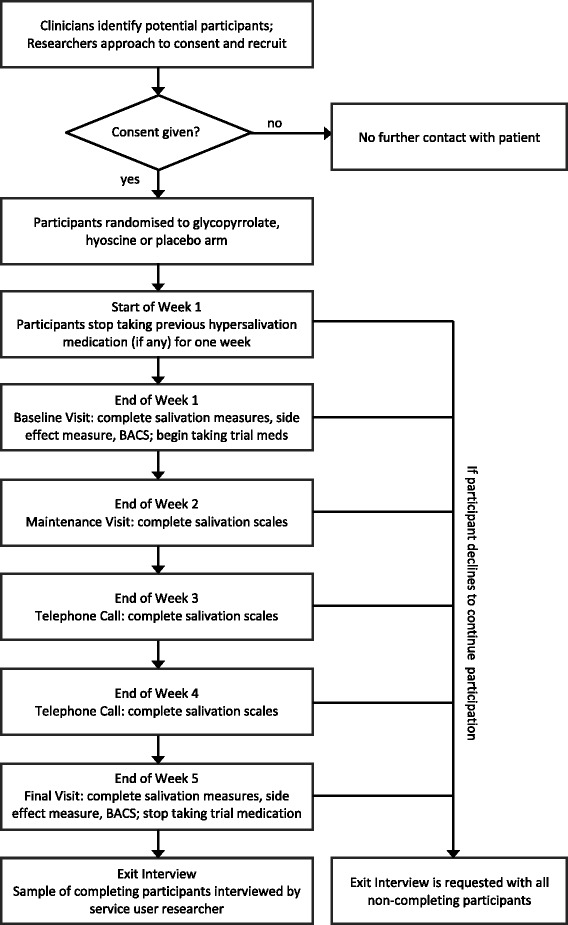
METHODS/DESIGN: This is a multicentre randomised, double-blind, placebo-controlled feasibility study of glycopyrronium bromide (glycopyrrolate) and hyoscine hydrobromide (hyoscine) in patients with clozapine-induced hypersalivation. We aim to recruit 42 patients who have been prescribed clozapine and are experiencing hypersalivation, and randomise them to one of three study arms (either hyoscine, glycopyrrolate or placebo). The primary outcome measures will be the participant recruitment and attrition rates, and the secondary outcome will be the metrics of the daytime hypersalivation measure. After a 1-week washout period (discontinuing CIH medication, if any), there will be a 4-week treatment period where participants will be titrated up to the maximum tolerated dose of hyoscine, glycopyrrolate or placebo. Measurements of daytime salivation, nocturnal salivation, cognition and side effects will be taken during home visits in week 2 and week 5. Information on salivation and side effects will also be taken through telephone calls in week 3 and week 4. To gather information on the experience of study participants, exit interviews will also be requested with all participants who drop out of the study and a sample of participants who complete the study.
There is currently no convincing evidence for hyoscine, or any other medication, as an effective treatment for CIH. There is promising evidence that glycopyrrolate may be more successful in the treatment of CIH causing fewer cognitive side effects. We propose to conduct a randomised placebo-controlled feasibility study of glycopyrrolate and hyoscine in the treatment of clozapine-induced hypersalivation to inform the design of a future efficacy trial.
Clinicaltrials.gov NCT02613494 , 23 November 2015.
氯氮平是英国唯一获批用于治疗难治性精神分裂症的药物。尽管氯氮平有效,但氯氮平治疗常见且不受欢迎的副作用是氯氮平引起的唾液分泌过多(CIH),这可能导致患者不遵医嘱。在英国,CIH的标准治疗方法是氢溴酸东莨菪碱,但这可能会加重精神分裂症患者的认知缺陷,而格隆溴铵可能是一种有效的替代药物,其副作用更易耐受。目前,没有令人信服的证据表明东莨菪碱或任何其他药物是治疗CIH的有效方法。
方法/设计:这是一项多中心随机、双盲、安慰剂对照的可行性研究,旨在研究格隆溴铵(甘罗溴铵)和氢溴酸东莨菪碱(东莨菪碱)对氯氮平引起的唾液分泌过多患者的治疗效果。我们的目标是招募42名已开具氯氮平处方且出现唾液分泌过多症状的患者,并将他们随机分配到三个研究组之一(东莨菪碱组、格隆溴铵组或安慰剂组)。主要结局指标将是参与者的招募率和流失率,次要结局将是白天唾液分泌过多测量指标。在为期1周的洗脱期(停用CIH药物,如有)后,将有一个为期4周的治疗期,在此期间参与者将逐渐增加剂量至东莨菪碱、格隆溴铵或安慰剂的最大耐受剂量。在第2周和第5周的家访期间,将测量白天唾液分泌、夜间唾液分泌、认知和副作用。在第3周和第4周,还将通过电话收集有关唾液分泌和副作用的信息。为了收集研究参与者的经验信息,还将要求所有退出研究的参与者以及完成研究的部分参与者进行退出访谈。
目前,没有令人信服的证据表明东莨菪碱或任何其他药物是治疗CIH的有效方法。有证据表明,格隆溴铵在治疗CIH方面可能更成功,且引起的认知副作用更少。我们建议进行一项随机安慰剂对照的可行性研究,以研究格隆溴铵和东莨菪碱治疗氯氮平引起的唾液分泌过多的效果,为未来的疗效试验设计提供参考。
Clinicaltrials.gov NCT02613494,2015年11月23日。