Senturk V, Abas M, Dewey M, Berksun O, Stewart R
Department of Psychiatry,Ankara University Faculty of Medicine,Ankara,Turkey.
King's College London, Institute of Psychiatry,London,UK.
Psychol Med. 2017 Mar;47(4):766-775. doi: 10.1017/S0033291716002865. Epub 2016 Nov 22.
In a perinatal cohort of women in urban and rural Turkey, we investigated associations between antenatal depressive symptoms and subsequent changes in perceived quality of key family relationships.
Of 730 women recruited in their third trimester (94.6% participation), 578 (79.2%) were reassessed at a mean of 4.1 (s.d. = 3.3) months after childbirth, 488 (66.8%) were reassessed at 13.7 (s.d. = 2.9) months, and 448 (61.4%) at 20.8 (s.d. = 2.7) months. At all four examinations, self-reported quality of relationship with the husband, mother and mother-in-law was ascertained using the Close Persons Questionnaire with respect to emotional support, practical support and negative aspects of the relationship. Antenatal depressive symptoms were defined using the Edinburgh Postnatal Depression Scale. A range of covariates in mixed models was considered including age, education, number of children, family structure, physical health, past emotional problems and stressful life events.
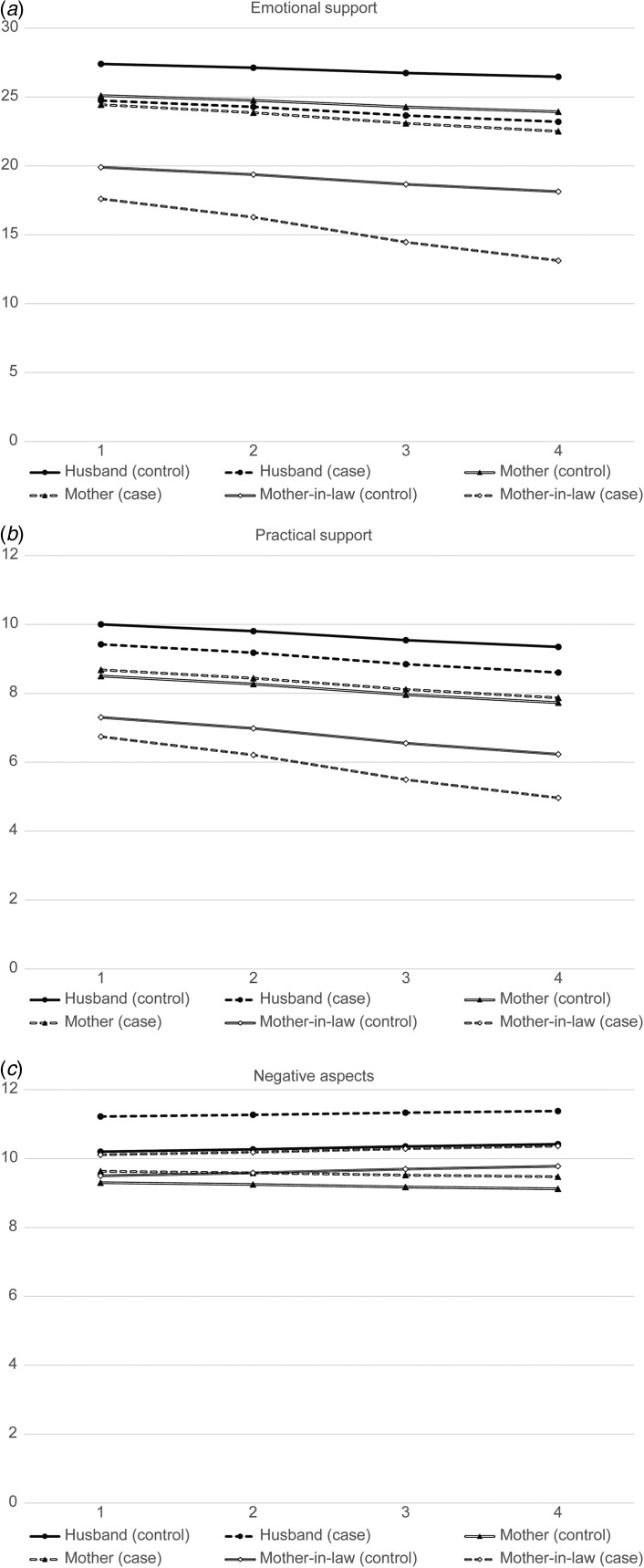
Key findings were as follows: (i) reported emotional and practical support from all three relationships declined over time in the cohort overall; (ii) reported emotional support from the husband, and emotional and practical support from the mother-in-law, declined more strongly in women with antenatal depressive symptoms; (iii) associations between depressive symptoms and worsening spouse relationship were more pronounced in traditional compared with nuclear families.
Antenatal depressive symptoms predicted marked decline in the quality of key relationships over the postnatal period. This may account for some of the contemporaneous associations between depression and worse social support, and may compound the risk of perinatal depression in subsequent pregnancies.
在土耳其城乡围产期女性队列中,我们调查了产前抑郁症状与关键家庭关系感知质量随后变化之间的关联。
在孕晚期招募的730名女性中(参与率94.6%),578名(79.2%)在产后平均4.1(标准差=3.3)个月时接受重新评估,488名(66.8%)在13.7(标准差=2.9)个月时接受重新评估,448名(61.4%)在20.8(标准差=2.7)个月时接受重新评估。在所有四次检查中,使用亲密关系问卷确定与丈夫、母亲和婆婆关系的自我报告质量,涉及情感支持、实际支持以及关系中的负面方面。产前抑郁症状使用爱丁堡产后抑郁量表进行定义。在混合模型中考虑了一系列协变量,包括年龄、教育程度、子女数量、家庭结构、身体健康、过去的情感问题和应激性生活事件。
主要发现如下:(i)总体队列中,来自所有三种关系的报告情感和实际支持随时间下降;(ii)产前有抑郁症状的女性中,来自丈夫的报告情感支持以及来自婆婆的情感和实际支持下降更为明显;(iii)与核心家庭相比,传统家庭中抑郁症状与配偶关系恶化之间的关联更为显著。
产前抑郁症状预示产后关键关系质量会显著下降。这可能解释了抑郁与较差社会支持之间的一些同期关联,并且可能增加后续妊娠中围产期抑郁的风险。