Deribew Amare, Tessema Gizachew Assefa, Deribe Kebede, Melaku Yohannes Adama, Lakew Yihunie, Amare Azmeraw T, Abera Semaw F, Mohammed Mesoud, Hiruye Abiy, Teklay Efrem, Misganaw Awoke, Kassebaum Nicholas
KEMRI-Wellcome Trust Research Programme, Kilifi, Kenya ; Nuffield Department of Clinical Medicine, University of Oxford, Oxford, UK ; St. Paul Millennium Medical College, Addis Ababa, Ethiopia.
School of Public Health, University of Adelaide, Adelaide, Australia ; Department of Reproductive Health, Institute of Public Health, University of Gondar, Gondar, Ethiopia.
Popul Health Metr. 2016 Nov 14;14:42. doi: 10.1186/s12963-016-0112-2. eCollection 2016.
Ethiopia has made remarkable progress in reducing child mortality over the last two decades. However, the under-5 mortality rate in Ethiopia is still higher than the under-5 mortality rates of several low- and middle-income countries (LMIC). On the other hand, the patterns and causes of child mortality have not been well investigated in Ethiopia. The objective of this study was to investigate the mortality trend, causes of death, and risk factors among children under 5 in Ethiopia during 1990-2013.
We used Global Burden of Disease (GBD) 2013 data. Spatiotemporal Gaussian Process Regression (GPR) was applied to generate best estimates of child mortality with 95% uncertainty intervals (UI). Causes of death by age groups, sex, and year were measured using Cause of Death Ensemble modeling (CODEm). For estimation of HIV/AIDS mortality rate, the modified UNAIDS EPP-SPECTRUM suite model was used.
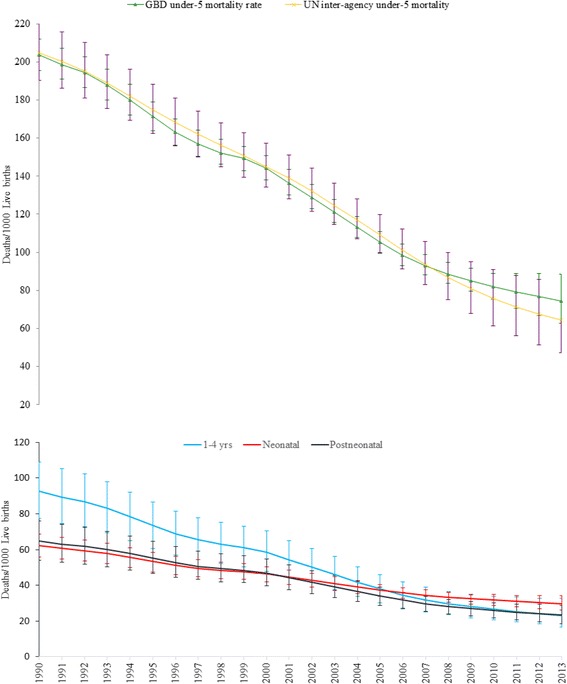
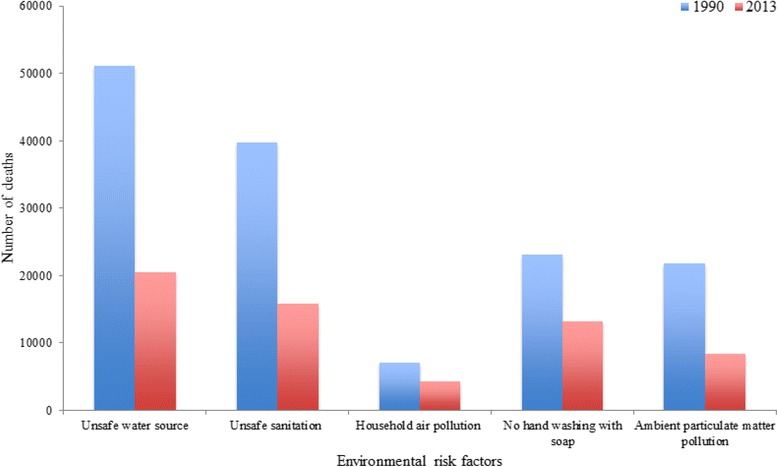
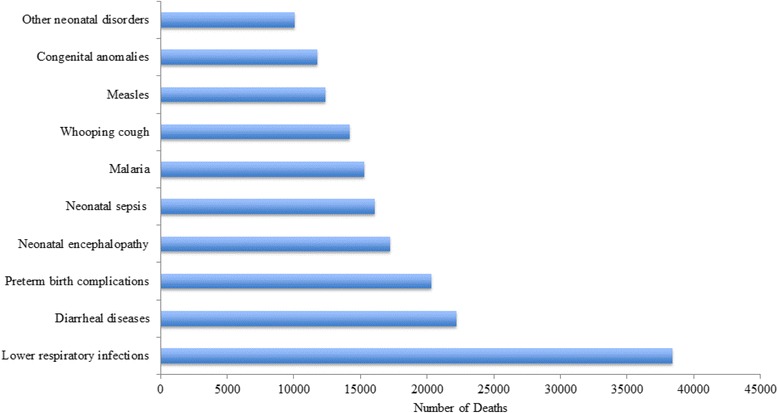
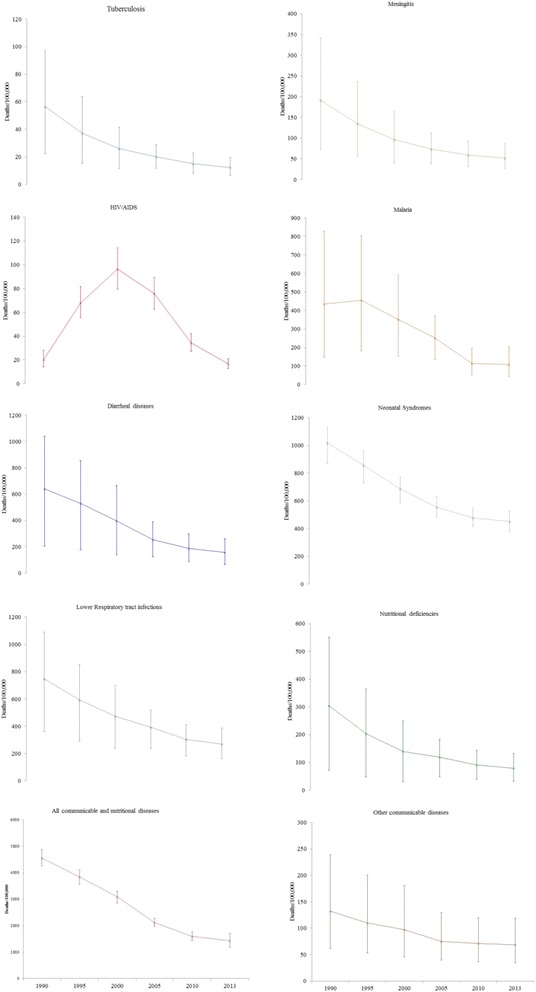
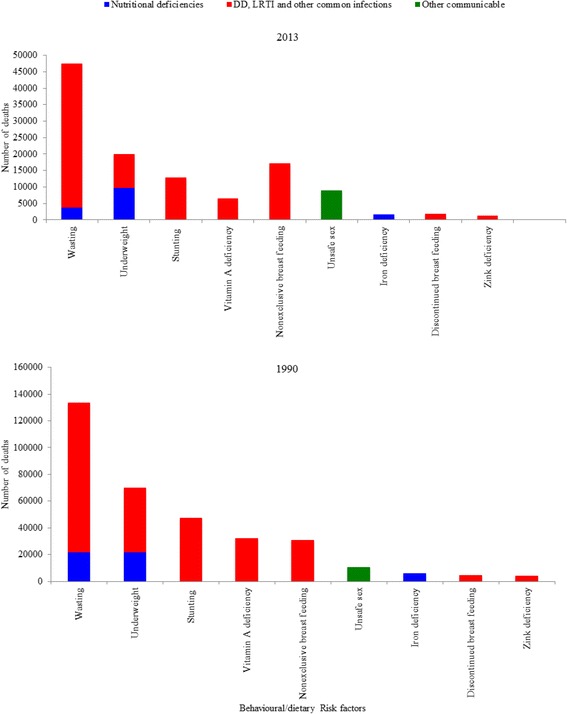
Between 1990 and 2013 the under-5 mortality rate declined from 203.9 deaths/1000 live births to 74.4 deaths/1000 live births with an annual rate of change of 4.6%, yielding a total reduction of 64%. Similarly, child (1-4 years), post-neonatal, and neonatal mortality rates declined by 75%, 64%, and 52%, respectively, between 1990 and 2013. Lower respiratory tract infection (LRI), diarrheal diseases, and neonatal syndromes (preterm birth complications, neonatal encephalopathy, neonatal sepsis, and other neonatal disorders) accounted for 54% of the total under-5 deaths in 2013. Under-5 mortality rates due to measles, diarrhea, malaria, protein-energy malnutrition, and iron-deficiency anemia declined by more than two-thirds between 1990 and 2013. Among the causes of under-5 deaths, neonatal syndromes such as sepsis, preterm birth complications, and birth asphyxia ranked third to fifth in 2013. Of all risk-attributable deaths in 1990, 25% of the total under-5 deaths (112,288/435,962) and 48% (112,288/232,199) of the deaths due to diarrhea, LRI, and other common infections were attributable to childhood wasting. Similarly, 19% (43,759/229,333) of the total under-5 deaths and 45% (43,759/97,963) of the deaths due to diarrhea and LRI were attributable to wasting in 2013. Of the total diarrheal disease- and LRI-related deaths ( = 97,963) in 2013, 59% (57,923/97,963) of them were attributable to unsafe water supply, unsafe sanitation, household air pollution, and no handwashing with soap.
LRI, diarrheal diseases, and neonatal syndromes remain the major causes of under-5 deaths in Ethiopia. These findings call for better-integrated newborn and child survival interventions focusing on the main risk factors.
在过去二十年中,埃塞俄比亚在降低儿童死亡率方面取得了显著进展。然而,埃塞俄比亚的五岁以下儿童死亡率仍高于一些低收入和中等收入国家(LMIC)的五岁以下儿童死亡率。另一方面,埃塞俄比亚儿童死亡的模式和原因尚未得到充分研究。本研究的目的是调查1990 - 2013年期间埃塞俄比亚五岁以下儿童的死亡趋势、死亡原因和风险因素。
我们使用了《2013年全球疾病负担》(GBD 2013)的数据。应用时空高斯过程回归(GPR)来生成儿童死亡率的最佳估计值,并带有95%的不确定性区间(UI)。使用死因综合建模(CODEm)来衡量按年龄组、性别和年份划分的死亡原因。为了估计艾滋病毒/艾滋病死亡率,使用了经修改的联合国艾滋病规划署EPP - SPECTRUM套件模型。
1990年至2013年期间,五岁以下儿童死亡率从每1000例活产203.9例死亡降至每1000例活产74.4例死亡,年变化率为4.6%,总共下降了64%。同样,1990年至2013年期间,儿童(1 - 4岁)、新生儿后期和新生儿死亡率分别下降了75%、64%和52%。2013年,下呼吸道感染(LRI)、腹泻病和新生儿综合征(早产并发症、新生儿脑病、新生儿败血症和其他新生儿疾病)占五岁以下儿童总死亡人数的54%。1990年至2013年期间,麻疹、腹泻、疟疾、蛋白质 - 能量营养不良和缺铁性贫血导致的五岁以下儿童死亡率下降了三分之二以上。在五岁以下儿童死亡原因中,2013年败血症、早产并发症和出生窒息等新生儿综合征排在第三至第五位。在1990年所有可归因风险的死亡中,五岁以下儿童总死亡人数的25%(112,288/435,962)以及腹泻、LRI和其他常见感染导致的死亡人数的48%(112,288/232,199)可归因于儿童消瘦。同样,2013年五岁以下儿童总死亡人数的19%(43,759/229,333)以及腹泻和LRI导致的死亡人数的45%(43,759/97,963)可归因于消瘦。在2013年与腹泻病和LRI相关的总死亡人数(= 97,963)中,其中59%(57,923/97,963)可归因于不安全的供水、不安全的卫生设施、家庭空气污染以及没有用肥皂洗手。
LRI、腹泻病和新生儿综合征仍然是埃塞俄比亚五岁以下儿童死亡的主要原因。这些发现呼吁采取更好地整合的新生儿和儿童生存干预措施,重点关注主要风险因素。