Chan Philip A, Glynn Tiffany R, Oldenburg Catherine E, Montgomery Madeline C, Robinette Ashley E, Almonte Alexi, Raifman Julia, Mena Leandro, Patel Rupa, Mayer Kenneth H, Beauchamps Laura S, Nunn Amy S
From the *Division of Infectious Diseases, The Miriam Hospital, †Department of Behavioral and Social Sciences, Brown University School of Public Health, Providence, RI; ‡Department of Epidemiology, Harvard School of Public Health, Boston, MA; §Department of Epidemiology, Johns Hopkins Bloomberg School of Public Health, Baltimore, MD; ¶Division of Infectious Diseases, University of Mississippi Medical Center, Jackson, MS; ∥Division of Infectious Diseases, Washington University, St. Louis, MO; and **The Fenway Institute, Fenway Health, Beth Israel Deaconess Medical Center, Harvard Medical School, Boston, MA.
Sex Transm Dis. 2016 Nov;43(11):717-723. doi: 10.1097/OLQ.0000000000000514.
Preexposure prophylaxis (PrEP) is efficacious in preventing human immunodeficiency virus (HIV) among men who have sex with men (MSM). We assessed PrEP uptake among MSM presenting for services at a sexually transmitted diseases (STD) clinic.
Men who have sex with men presenting to the Rhode Island STD Clinic between October 2013 and November 2014 were educated about, and offered, PrEP. We categorized PrEP engagement using an implementation cascade to describe gaps in uptake which described MSM who: (1) were educated about PrEP, (2) indicated interest, (3) successfully received follow-up contact, (4) scheduled an appointment, (5) attended an appointment, and (6) initiated PrEP (ie, received a prescription). Bivariate and multivariable logistic regression models were used to examine predictors of PrEP initiation.
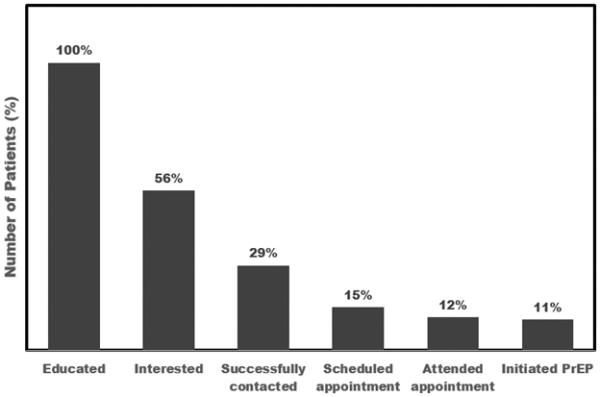
A total of 234 MSM were educated about PrEP; of these, 56% expressed interest. Common reasons for lack of interest were low HIV risk perception (37%), wanting more time to consider (10%), concern about side effects (7%), and financial barriers (3%). Among those interested, 53% followed up. Of those, 51% scheduled an appointment. The most common reason patients did not schedule an appointment was low HIV risk perception (38%). Seventy-seven percent of those with an appointment attended the appointment; of those, 93% initiated PrEP. Patients with higher HIV-risk perception (adjusted odds ratios, 2.17; 95% confidence interval, 1.29-3.64) and a history of sex with an HIV-positive partner (adjusted odds ratios, 7.08; 95% confidence interval, 2.35-21.34) had significantly higher odds of initiating PrEP.
Low HIV-risk perception was the most significant barrier to PrEP uptake among MSM attending a public STD clinic.
暴露前预防(PrEP)在预防男男性行为者(MSM)感染人类免疫缺陷病毒(HIV)方面有效。我们评估了在一家性传播疾病(STD)诊所就诊的MSM中PrEP的接受情况。
2013年10月至2014年11月期间到罗德岛STD诊所就诊的男男性行为者接受了PrEP相关教育并被提供PrEP。我们使用实施级联对PrEP参与情况进行分类,以描述接受情况中的差距,该级联描述了以下MSM:(1)接受了PrEP相关教育;(2)表示有兴趣;(3)成功接受后续联系;(4)预约;(5)赴约;(6)开始PrEP(即获得处方)。使用二元和多变量逻辑回归模型来检查PrEP开始的预测因素。
共有234名MSM接受了PrEP相关教育;其中,56%表示有兴趣。缺乏兴趣的常见原因是对HIV风险的认知较低(37%)、希望有更多时间考虑(10%)、担心副作用(7%)和经济障碍(3%)。在有兴趣的人中,53%进行了后续跟进。其中,51%预约了。患者未预约的最常见原因是对HIV风险的认知较低(38%)。77%预约的人赴约;其中,93%开始PrEP。HIV风险认知较高的患者(调整后的优势比,2.17;95%置信区间,1.29 - 3.64)和有与HIV阳性伴侣发生性行为史的患者(调整后的优势比,7.08;95%置信区间,2.35 - 21.34)开始PrEP的几率显著更高。
对HIV风险的认知较低是在公共STD诊所就诊的MSM中接受PrEP的最主要障碍。