Zhang Quan, Matsuura Kentaro, Kleiner David E, Zamboni Fausto, Alter Harvey J, Farci Patrizia
Laboratory of Infectious Diseases, Hepatic Pathogenesis Section, National Institute of Allergy and Infectious Diseases (NIAID), National Institutes of Health (NIH), Bethesda, MD, 20892, USA.
Department of Experimental Medicine and Infectious Diseases, Nanjing Drum Tower Hospital, Nanjing University Medical School, 321 Zhongshan Road, Nanjing, 210008, China.
J Transl Med. 2016 Nov 28;14(1):328. doi: 10.1186/s12967-016-1085-4.
Dysregulation of long noncoding RNA (lncRNA) expression contributes to the pathogenesis of many human diseases, including liver diseases. Several lncRNAs have been reported to play a role in the development of hepatocellular carcinoma (HCC). However, most studies have analyzed lncRNAs only in hepatitis B virus (HBV)-related HCC or in a single group of HCC patients regardless of the viral etiology.
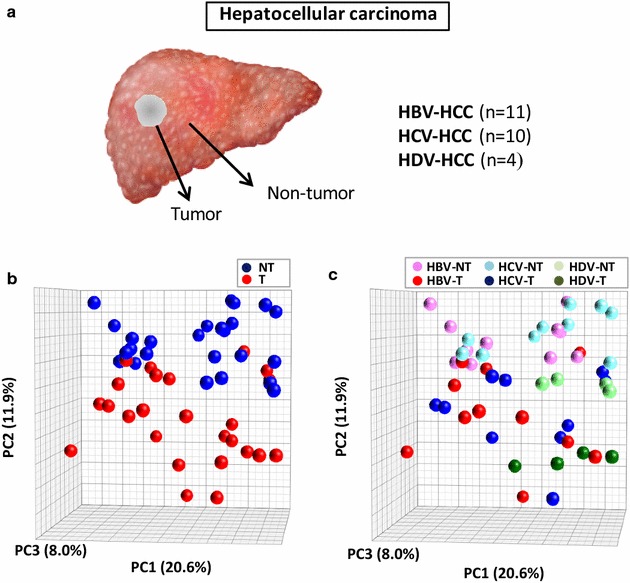
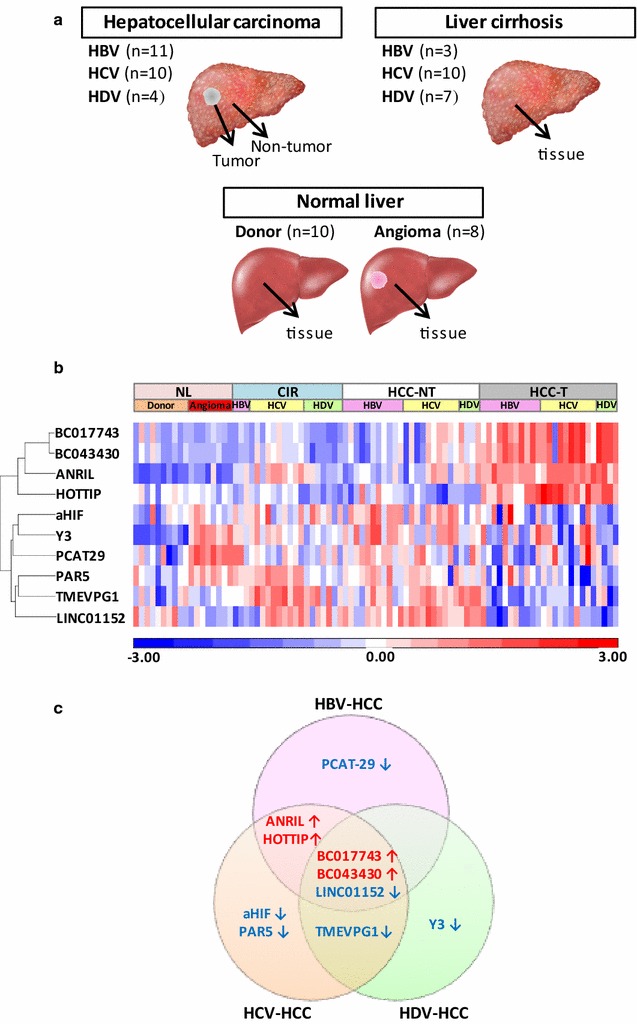
To investigate whether lncRNAs are differentially expressed in HCC of different viral etiology, we profiled 101 disease-related lncRNAs, including 25 lncRNAs previously associated with HCC, in liver specimens obtained from well-characterized patients with HBV-, hepatitis C virus (HCV)-, or hepatitis D virus (HDV)-associated HCC.
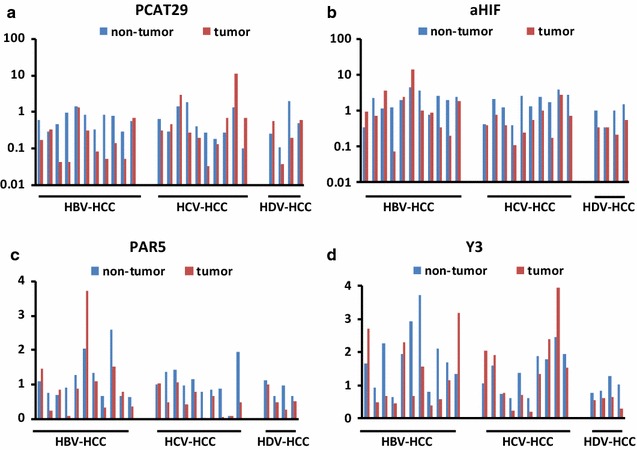
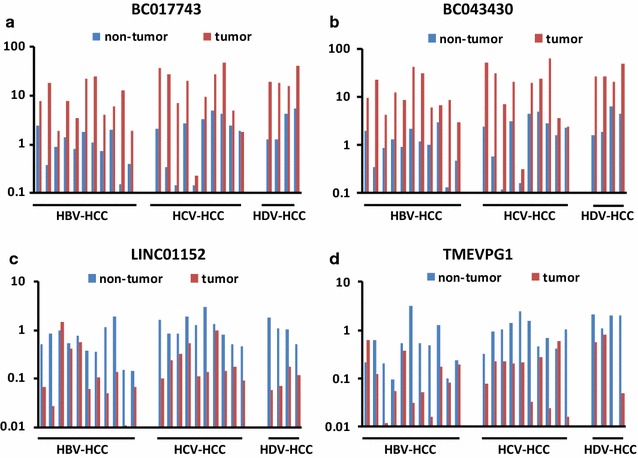
We identified eight novel HCC-related lncRNAs that were significantly dysregulated in HCC tissues compared to their surrounding non-tumorous tissues. Some of these lncRNAs were significantly dysregulated predominantly in one specific hepatitis virus-related HCC, including PCAT-29 in HBV-related HCC, aHIF and PAR5 in HCV-related HCC, and Y3 in HDV-related HCC. Among the lncRNAs previously reported in HCC, we found that DBH-AS1, hDREH and hPVT1 were differentially expressed in HCC of different viral etiology.
Our study suggests that HCC of different viral etiology is regulated by different lncRNAs. The identification of lncRNAs unique to specific hepatitis virus-related HCC may provide new tools for improving the diagnosis of HCC and open new avenues for disease-specific therapeutic interventions.
长链非编码RNA(lncRNA)表达失调与包括肝脏疾病在内的多种人类疾病的发病机制有关。据报道,几种lncRNA在肝细胞癌(HCC)的发生发展中起作用。然而,大多数研究仅分析了乙型肝炎病毒(HBV)相关HCC中的lncRNA,或在一组HCC患者中进行分析,而未考虑病毒病因。
为了研究lncRNA在不同病毒病因的HCC中是否差异表达,我们对101种疾病相关lncRNA进行了分析,其中包括25种先前与HCC相关的lncRNA,这些lncRNA来自特征明确的HBV、丙型肝炎病毒(HCV)或丁型肝炎病毒(HDV)相关HCC患者的肝脏标本。
我们鉴定出8种新的HCC相关lncRNA,与周围非肿瘤组织相比,它们在HCC组织中显著失调。其中一些lncRNA主要在一种特定的肝炎病毒相关HCC中显著失调,包括HBV相关HCC中的PCAT-29、HCV相关HCC中的aHIF和PAR5以及HDV相关HCC中的Y3。在先前报道的HCC中的lncRNA中,我们发现DBH-AS1、hDREH和hPVT1在不同病毒病因的HCC中差异表达。
我们的研究表明,不同病毒病因的HCC由不同的lncRNA调控。鉴定特定肝炎病毒相关HCC特有的lncRNA可能为改善HCC的诊断提供新工具,并为疾病特异性治疗干预开辟新途径。