Eggermont Jos J
Department of Physiology and Pharmacology, University of Calgary, CalgaryAB, Canada; Department of Psychology, University of Calgary, CalgaryAB, Canada.
Front Aging Neurosci. 2016 Nov 14;8:265. doi: 10.3389/fnagi.2016.00265. eCollection 2016.
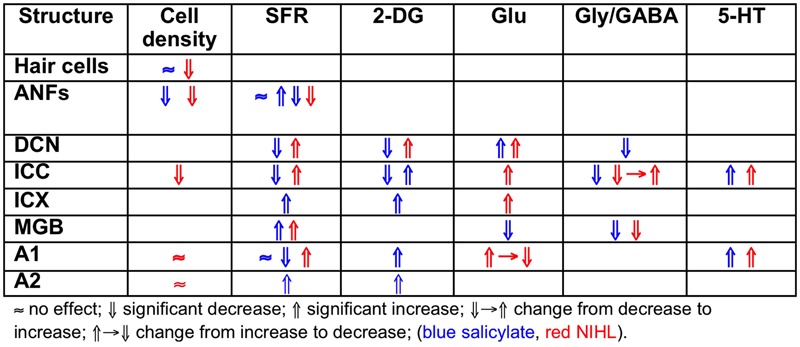
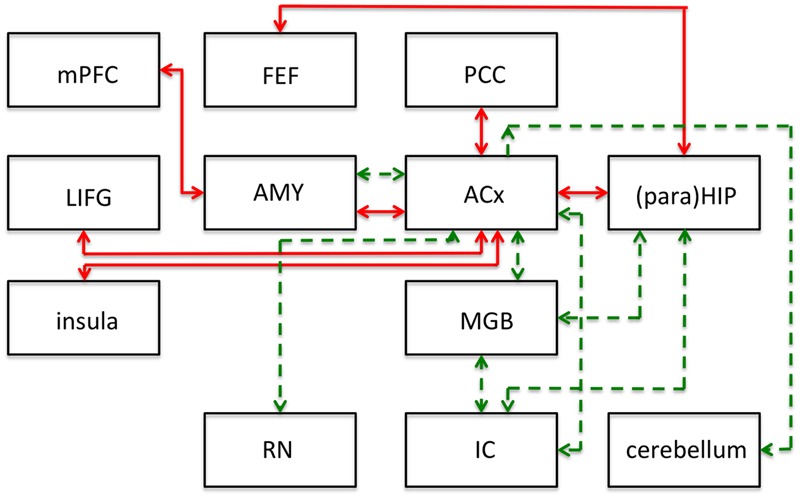
The brain activity of humans with tinnitus of various etiologies is typically studied with electro- and magneto-encephalography and functional magnetic resonance imaging-based imaging techniques. Consequently, they measure population responses and mostly from the neocortex. The latter also underlies changes in neural networks that may be attributed to tinnitus. However, factors not strictly related to tinnitus such as hearing loss and hyperacusis, as well as other co-occurring disorders play a prominent role in these changes. Different types of tinnitus can often not be resolved with these brain-imaging techniques. In animal models of putative behavioral signs of tinnitus, neural activity ranging from auditory nerve to auditory cortex, is studied largely by single unit recordings, augmented by local field potentials (LFPs), and the neural correlates of tinnitus are mainly based on spontaneous neural activity, such as spontaneous firing rates and pair-wise spontaneous spike-firing correlations. Neural correlates of hyperacusis rely on measurement of stimulus-evoked activity and are measured as increased driven firing rates and LFP amplitudes. Connectivity studies would rely on correlated neural activity between pairs of neurons or LFP amplitudes, but are only recently explored. In animal models of tinnitus, only two etiologies are extensively studied; tinnitus evoked by salicylate application and by noise exposure. It appears that they have quite different neural biomarkers. The unanswered question then is: does this different etiology also result in different tinnitus?
通常使用基于脑电图、脑磁图和功能磁共振成像的成像技术来研究患有各种病因耳鸣的人的大脑活动。因此,这些技术测量的是群体反应,且大多来自新皮层。新皮层也是可能归因于耳鸣的神经网络变化的基础。然而,与耳鸣并非严格相关的因素,如听力损失和听觉过敏,以及其他并发疾病在这些变化中起着重要作用。这些脑成像技术往往无法区分不同类型的耳鸣。在假定的耳鸣行为体征的动物模型中,从听神经到听觉皮层的神经活动主要通过单单元记录进行研究,并辅以局部场电位(LFP),耳鸣的神经关联主要基于自发神经活动,如自发放电率和成对自发尖峰放电相关性。听觉过敏的神经关联依赖于对刺激诱发活动的测量,并以驱动放电率和LFP振幅增加来衡量。连接性研究将依赖于神经元对之间的相关神经活动或LFP振幅,但直到最近才开始探索。在耳鸣的动物模型中,只有两种病因得到了广泛研究;水杨酸盐应用和噪声暴露诱发的耳鸣。似乎它们有 quite different neural biomarkers。那么,未解决的问题是:这种不同的病因是否也会导致不同的耳鸣? (注:原文中“quite different neural biomarkers”未准确翻译,因“quite different”含义较模糊,这里保留原文表述)