Schuch Stefanie
Institute of Psychology, RWTH Aachen University Aachen, Germany.
Front Psychol. 2016 Nov 15;7:1722. doi: 10.3389/fpsyg.2016.01722. eCollection 2016.
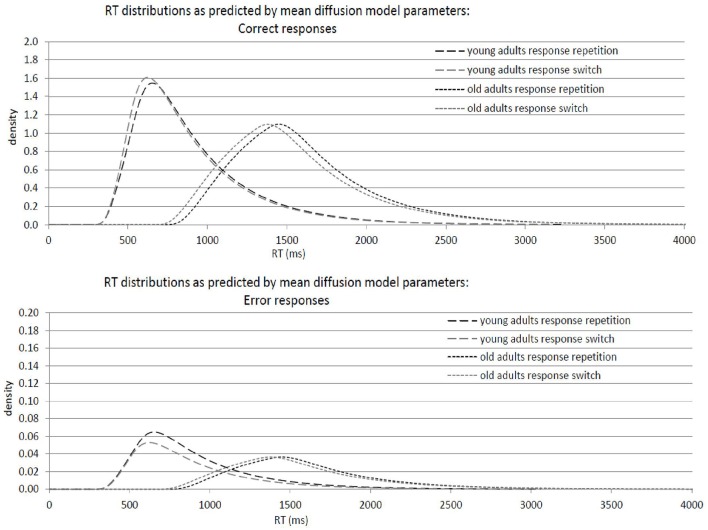
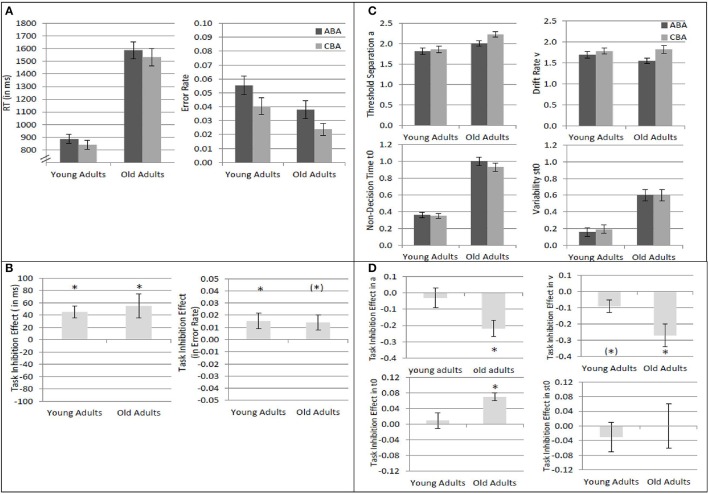
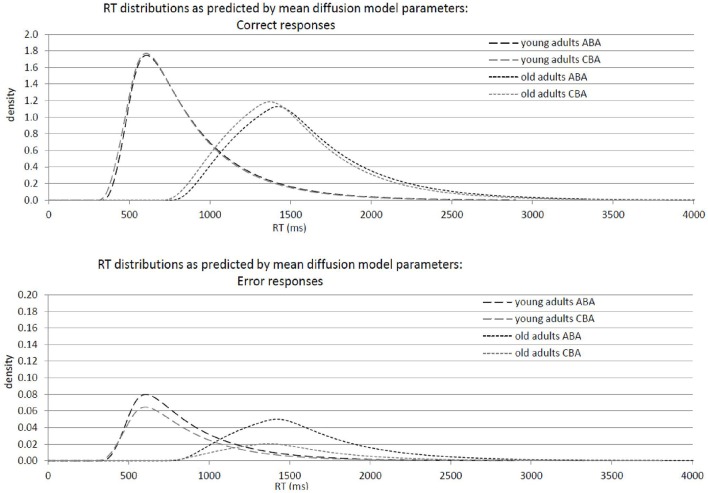
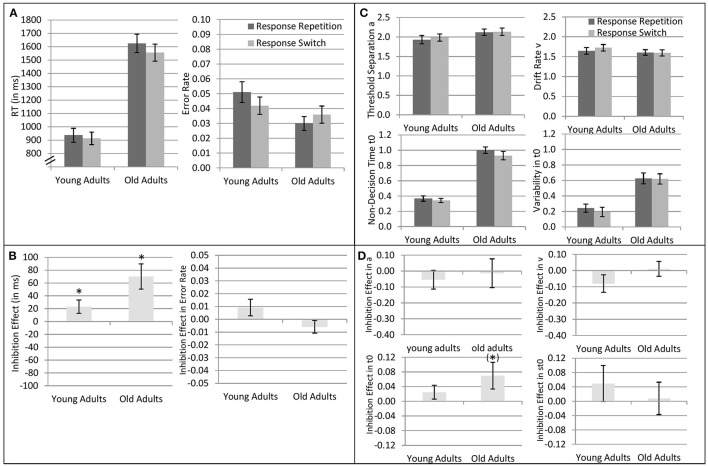
Differences in inhibitory ability between older (64-79 years, = 24) and younger adults (18-26 years, = 24) were investigated using a diffusion model analysis. Participants performed a task-switching paradigm that allows assessing n-2 task repetition costs, reflecting inhibitory control on the level of tasks, as well as n-1 response-repetition costs, reflecting inhibitory control on the level of responses. N-2 task repetition costs were of similar size in both age groups. Diffusion model analysis revealed that for both younger and older adults, drift rate parameters were smaller in the inhibition condition relative to the control condition, consistent with the idea that persisting task inhibition slows down response selection. Moreover, there was preliminary evidence for task inhibition effects in threshold separation and non-decision time in the older, but not the younger adults, suggesting that older adults might apply different strategies when dealing with persisting task inhibition. N-1 response-repetition costs in mean RT were larger in older than younger adults, but in mean error rates tended to be larger in younger than older adults. Diffusion-model analysis revealed longer non-decision times in response repetitions than response switches in both age groups, consistent with the idea that motor processes take longer in response repetitions than response switches due to persisting response inhibition of a previously executed response. The data also revealed age-related differences in overall performance: Older adults responded more slowly and more accurately than young adults, which was reflected by a higher threshold separation parameter in diffusion model analysis. Moreover, older adults showed larger non-decision times and higher variability in non-decision time than young adults, possibly reflecting slower and more variable motor processes. In contrast, overall drift rate did not differ between older and younger adults. Taken together, diffusion model analysis revealed differences in overall performance between the age groups, as well as preliminary evidence for age differences in dealing with task inhibition, but no evidence for an inhibitory deficit in older age.
采用扩散模型分析方法,研究了老年人(64 - 79岁,n = 24)和年轻人(18 - 26岁,n = 24)之间抑制能力的差异。参与者执行了一个任务切换范式,该范式可以评估n - 2任务重复成本,反映任务水平上的抑制控制,以及n - 1反应重复成本,反映反应水平上的抑制控制。两个年龄组的n - 2任务重复成本大小相似。扩散模型分析表明,对于年轻人和老年人来说,抑制条件下的漂移率参数相对于控制条件都较小,这与持续的任务抑制会减慢反应选择的观点一致。此外,有初步证据表明,在老年人而非年轻人中,任务抑制对阈值分离和非决策时间有影响,这表明老年人在处理持续的任务抑制时可能采用不同的策略。老年人平均反应时中的n - 1反应重复成本比年轻人更大,但平均错误率上年轻人往往比老年人更大。扩散模型分析显示,两个年龄组中反应重复的非决策时间都比反应切换的非决策时间长,这与由于对先前执行反应的持续反应抑制,运动过程在反应重复中比反应切换中花费更长时间的观点一致。数据还揭示了总体表现上的年龄相关差异:老年人比年轻人反应更慢、更准确,这在扩散模型分析中表现为更高的阈值分离参数。此外,老年人的非决策时间更长,且非决策时间的变异性比年轻人更高,这可能反映了更慢且更具变异性的运动过程。相比之下,老年人和年轻人的总体漂移率没有差异。综上所述,扩散模型分析揭示了年龄组之间在总体表现上的差异,以及在处理任务抑制方面年龄差异的初步证据,但没有证据表明老年人存在抑制缺陷。