Grange James A, Schuch Stefanie
Keele University, Keele, UK.
RWTH Aachen University, Aachen, Germany.
Behav Res Methods. 2023 Oct;55(7):3348-3369. doi: 10.3758/s13428-022-01956-8. Epub 2022 Sep 22.
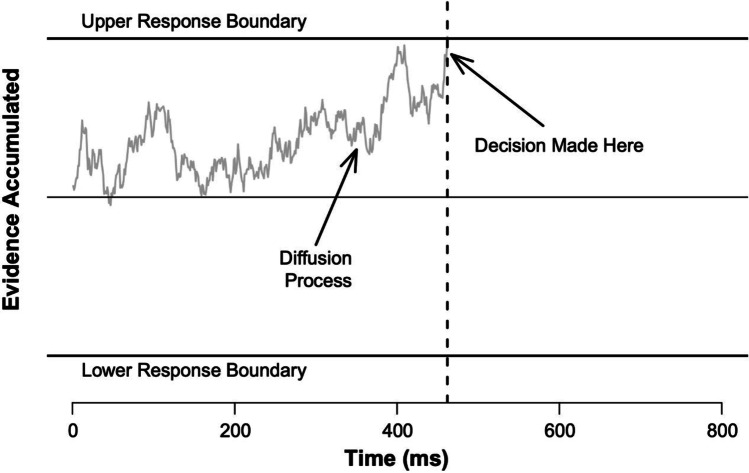
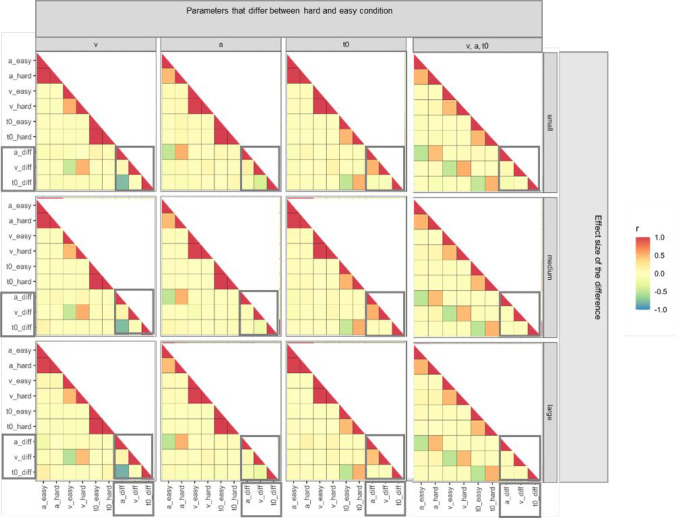
Evidence-accumulation models are a useful tool for investigating the cognitive processes that give rise to behavioural data patterns in reaction times (RTs) and error rates. In their simplest form, evidence-accumulation models include three parameters: The average rate of evidence accumulation over time (drift rate) and the amount of evidence that needs to be accumulated before a response becomes selected (boundary) both characterise the response-selection process; a third parameter summarises all processes before and after the response-selection process (non-decision time). Researchers often compute experimental effects as simple difference scores between two within-subject conditions and such difference scores can also be computed on model parameters. In the present paper, we report spurious correlations between such model parameter difference scores, both in empirical data and in computer simulations. The most pronounced spurious effect is a negative correlation between boundary difference and non-decision difference, which amounts to r = - .70 or larger. In the simulations, we only observed this spurious negative correlation when either (a) there was no true difference in model parameters between simulated experimental conditions, or (b) only drift rate was manipulated between simulated experimental conditions; when a true difference existed in boundary separation, non-decision time, or all three main parameters, the correlation disappeared. We suggest that care should be taken when using evidence-accumulation model difference scores for correlational approaches because the parameter difference scores can correlate in the absence of any true inter-individual differences at the population level.
证据积累模型是一种有用的工具,用于研究在反应时间(RTs)和错误率方面产生行为数据模式的认知过程。在其最简单的形式中,证据积累模型包括三个参数:随时间积累证据的平均速率(漂移率)以及在做出反应选择之前需要积累的证据量(边界),这两者都表征了反应选择过程;第三个参数总结了反应选择过程之前和之后的所有过程(非决策时间)。研究人员通常将实验效应计算为两个受试者内条件之间的简单差异分数,并且这样的差异分数也可以在模型参数上进行计算。在本文中,我们报告了在实证数据和计算机模拟中,此类模型参数差异分数之间的虚假相关性。最明显的虚假效应是边界差异与非决策差异之间的负相关,其相关系数r = -0.70或更大。在模拟中,我们仅在以下两种情况下观察到这种虚假的负相关:(a)模拟实验条件之间的模型参数没有真正差异,或者(b)仅在模拟实验条件之间操纵漂移率;当边界分离、非决策时间或所有三个主要参数存在真正差异时,相关性消失。我们建议,在将证据积累模型差异分数用于相关方法时应谨慎,因为在总体水平上不存在任何真正的个体间差异时,参数差异分数可能会产生相关性。