Kang Chae Hoon, Yang Seung Boo, Lee Woong Hee, Ahn Jae Hong, Goo Dong Erk, Han Nae Jin, Ohm Joon Young
Department of Radiology, Gangneung Asan Hospital, Gangneung, South Korea.
Department of Radiology, Soonchunhyang University Hospital, Gumi, South Korea.
Iran J Radiol. 2016 Sep 11;13(4):e37994. doi: 10.5812/iranjradiol.37994. eCollection 2016 Oct.
Central vein stenosis or occlusion is a common complication that can lead to significant morbidity and dysfunction of access in the hemodialysis patient. More lesions can develop over time, and preserving access becomes a challenge as life expectancy of the hemodialysis patient increases.
The goal was to compare long-term results and determine the outcomes of open-cell stent versus closed-cell stent for central vein stenosis or occlusion in hemodialysis patients.
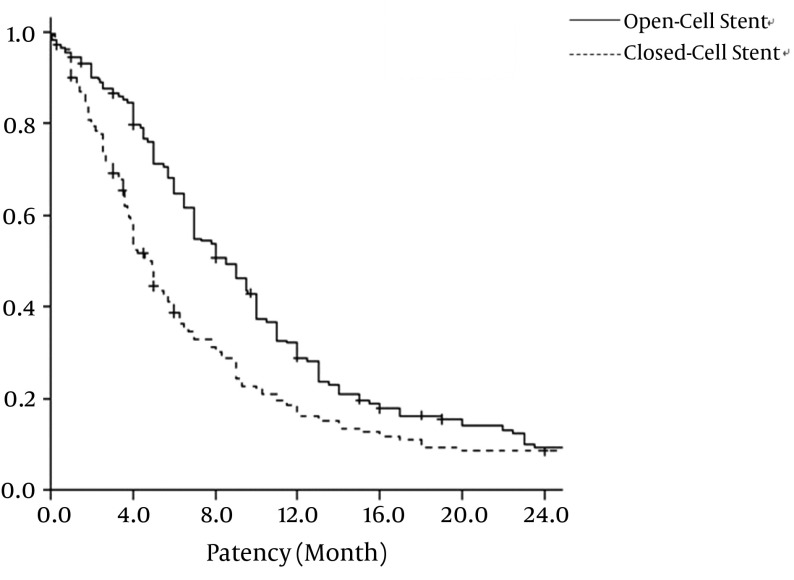
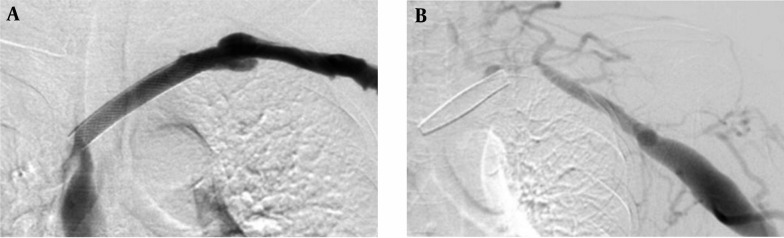
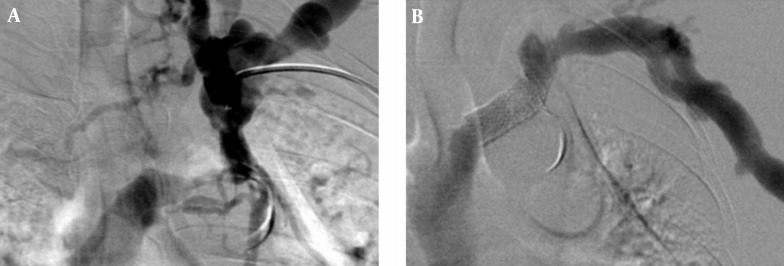
From 1997 to 2015, in 401 hemodialysis patients, stent placement for central vein stenosis or occlusion was performed if balloon angioplasty was unsatisfactory, due to elastic recoil or occurrence of restenosis within 3 months. When thrombus was present, primary stenting was performed. A total of 257 open-cell stents and 144 closed-cell stents were used. Angiographic findings including lesion site, central vein stenosis or occlusion, and presence of thrombosis and complication were evaluated. Primary patency rate and mean patency rate of the stent were compared between two stent groups by Kaplan-Meier survival analysis.
For the open-cell stent group, 159 patients were diagnosed as central vein stenosis and 98 were occlusion. For the closed-cell stent group, 78 were stenosis and 66 were occlusion. There were two complications for central migration and two for procedure-related vein rupture. Open-cell stents and closed-cell stents had mean patency rates of 10.9 ± 0.80 months and 8.5 ± 10.87 months, respectively (P = 0.002).
The open-cell stent is effective and its performance is higher than that obtained with the closed-cell stent for treating central vein stenosis or occlusion in hemodialysis patients.
中心静脉狭窄或闭塞是一种常见并发症,可导致血液透析患者通路出现严重发病情况及功能障碍。随着时间推移,会出现更多病变,并且随着血液透析患者预期寿命的增加,维持通路功能成为一项挑战。
比较开放型支架与闭合型支架治疗血液透析患者中心静脉狭窄或闭塞的长期效果并确定其结局。
1997年至2015年期间,在401例血液透析患者中,如果球囊血管成形术因弹性回缩或在3个月内发生再狭窄而效果不佳,则对中心静脉狭窄或闭塞进行支架置入。当存在血栓时,进行一期支架置入。共使用了257个开放型支架和144个闭合型支架。评估血管造影结果,包括病变部位、中心静脉狭窄或闭塞情况、血栓形成情况及并发症。通过Kaplan-Meier生存分析比较两组支架的一期通畅率和平均通畅率。
开放型支架组中,159例患者被诊断为中心静脉狭窄,98例为闭塞。闭合型支架组中,78例为狭窄,66例为闭塞。有2例中心移位并发症和2例与手术相关的静脉破裂并发症。开放型支架和闭合型支架的平均通畅率分别为10.9±0.80个月和8.5±10.87个月(P = 0.002)。
对于治疗血液透析患者的中心静脉狭窄或闭塞,开放型支架有效,其性能优于闭合型支架。