Sousa Lucas O, Sobral Lays M, Matsumoto Camila S, Saggioro Fabiano P, López Rossana V M, Panepucci Rodrigo A, Curti Carlos, Silva Wilson A, Greene Lewis J, Leopoldino Andréia M
Department of Cell and Molecular Biology and Pathogenic Bioagents, Ribeirão Preto Medical School, University of São Paulo, Brazil; Hemotherapy Center of Ribeirão Preto, Ribeirão Preto Medical School, University of São Paulo, Brazil.
Department of Clinical Analyses, Toxicology and Food Sciences, School of Pharmaceutical Sciences of Ribeirão Preto, University of São Paulo, Brazil.
BBA Clin. 2016 Nov 5;6:159-164. doi: 10.1016/j.bbacli.2016.11.001. eCollection 2016 Dec.
MicroRNAs (miRNAs or miRs) are post-transcriptional regulators of eukaryotic cells and knowledge of differences in miR levels may provide new approaches to diagnosis and therapy.
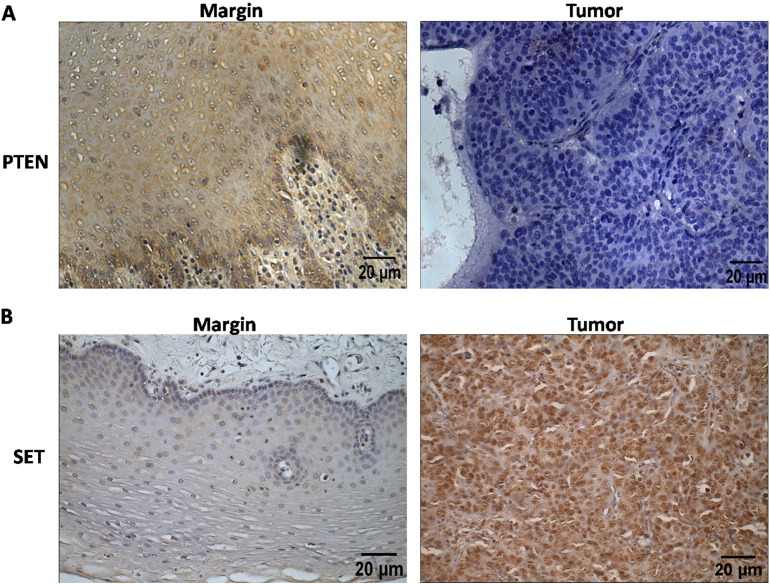
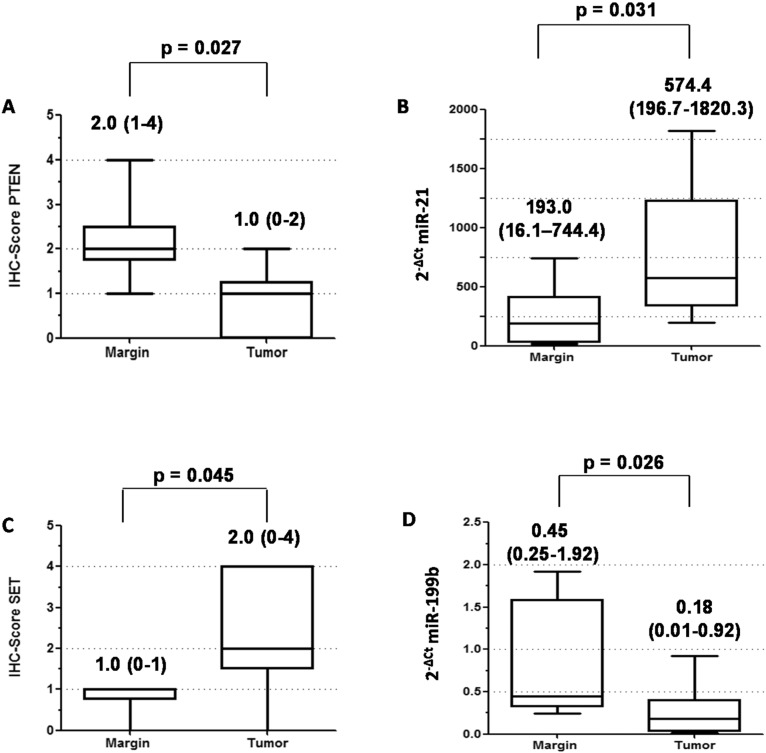
The present study measured the levels of nine miRs in head and neck squamous cell carcinomas (HNSCC) and determined whether clinical pathological features are associated with differences in miR levels. SET (I2PP2A) and PTEN protein levels were also measured, since their levels can be regulated by miR-199b and miR-21, respectively. Nine miRs (miR-15a, miR-21, miR-29b, miR-34c, miR-100, miR-125b, miR-137, miR-133b and miR-199b) were measured by real time qRT-PCR in HNSCC samples from 32 patients and eight resection margins. SET (I2PP2A) and PTEN protein levels were estimated by immunohistochemistry in paired HNSCC tissues and their matched resection margins.
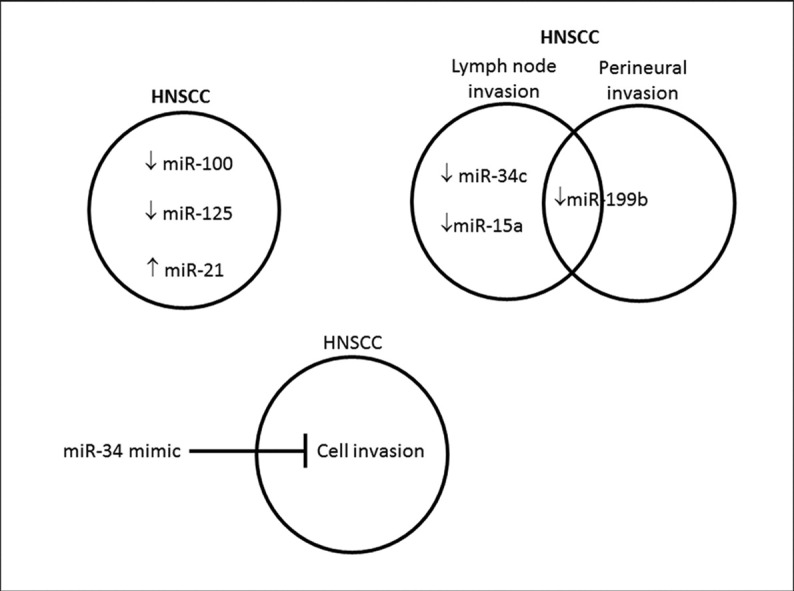
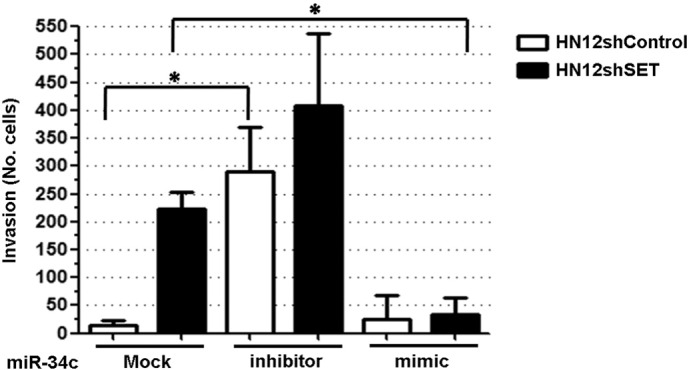
In HNSCC, the presence of lymph node invasion was associated with low miR-15a, miR-34c and miR-199b levels, whereas the presence of perineural invasion was associated with low miR-199b levels. In addition, miR-21 levels were high whereas miR-100 and miR-125b levels were low in HNSCC compared to the resection margins. When HNSCC line HN12, with or without knockdown of SET, were transfected with miR-34c inhibitor or miR-34c mimic, the miR-34c inhibitor increased cell invasion capacity while miR-34c mimic decreased the cell invasion.
We showed that the levels of specific miRs in tumor tissue can provide insight into the maintenance and progression of HNSCC.
MiRNAs are up- or down-regulated during cancer development and progression; they can be prognosis markers and therapeutic targets in HNSCC.
微小RNA(miRNA或miR)是真核细胞的转录后调节因子,了解miR水平的差异可能为诊断和治疗提供新方法。
本研究检测了头颈部鳞状细胞癌(HNSCC)中9种miR的水平,并确定临床病理特征是否与miR水平差异相关。还检测了SET(I2PP2A)和PTEN蛋白水平,因为它们的水平可分别受miR-199b和miR-21的调节。通过实时定量逆转录聚合酶链反应(qRT-PCR)检测了32例患者的HNSCC样本和8个手术切缘中的9种miR(miR-15a、miR-21、miR-29b、miR-34c、miR-100、miR-125b、miR-137、miR-133b和miR-199b)。通过免疫组织化学评估配对的HNSCC组织及其匹配手术切缘中的SET(I2PP2A)和PTEN蛋白水平。
在HNSCC中,淋巴结浸润的存在与miR-15a、miR-34c和miR-199b水平低相关,而神经周围浸润的存在与miR-199b水平低相关。此外,与手术切缘相比,HNSCC中miR-21水平高,而miR-