Wong Janet Yuen-Ha, Choi Anna Wai-Man, Fong Daniel Yee-Tak, Choi Edmond Pui Hang, Wong John Kit-Shing, So Fung Ling, Lau Chu-Leung, Kam Chak-Wah
School of Nursing, Li Ka Shing Faculty of Medicine, The University of Hong Kong, 4/F, William M.W. Mong Block, 21 Sassoon Road, Pokfulam, Hong Kong SAR.
Department of Social Work and Social Administration, Faculty of Social Science, Room 534, Jockey Club Tower, The Centennial Campus, The University of Hong Kong, Pokfulam, Hong Kong SAR.
BMC Public Health. 2016 Nov 29;16(1):1207. doi: 10.1186/s12889-016-3879-y.
Cohabitation, referring to a co-residential romantic relationship between two intimate partners without a marriage license, has become widely accepted in contemporary societies. It has been found that cohabitating women have a higher risk of experiencing intimate partner violence (IPV) than married women. However, as yet, no studies have investigated the level and pattern of IPV-associated physical injuries and its mental health impact on cohabitating women. Therefore, we aim to compare IPV-associated physical injuries between cohabitating and married women by conducting a review of 5-year medical records from the emergency departments of two major public hospitals in Hong Kong.
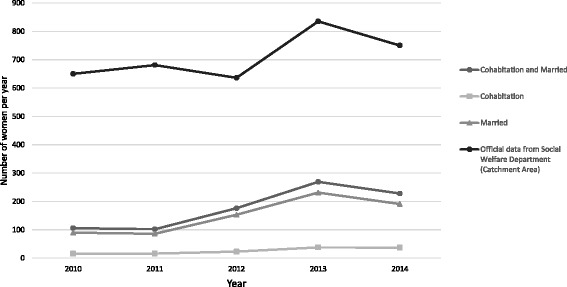
This is a retrospective cohort study. Using two computerized systems, we identified the medical charts of 1011 women who had experienced IPV and presented at emergency departments between 2010 and 2014, of which, 132 were cohabitating and 833 were married.
Cohabitating women were significantly younger (p-value < .0001) and had obtained a higher educational level (p-value = .008) than married women. After adjusting for those two variables, the logistic regression models showed that cohabitating women were approximately 2.1 times more likely than married women to present with head, neck, or facial injuries (OR = 2.1, 95% CI = 1.30-3.40, p = .002), and the risk of having multiple injuries in different locations (head, neck, face, torso, limbs) was almost twice that for cohabitating women compared with married women (OR = 1.82, 95% CI = 1.25-2.65, p = .001). Furthermore, cohabitating women were almost two times as likely as married women to experience more than one method of physical violence (OR = 1.72, 95% CI = 1.18-2.51, p = .005). There were no significant differences regarding mental health, police reporting, and discharge plans.
Owing to recent social changes to the family structure, including the growing acceptance of cohabitation, it is essential that a screening program for IPV is established for cohabitating women, as well as the inclusion of IPV content in medical and nursing curriculums and in-service training.
同居是指两个亲密伴侣在没有结婚证的情况下共同居住的浪漫关系,在当代社会已被广泛接受。研究发现,同居女性遭受亲密伴侣暴力(IPV)的风险高于已婚女性。然而,迄今为止,尚无研究调查与IPV相关的身体伤害程度和模式及其对同居女性心理健康的影响。因此,我们旨在通过回顾香港两家主要公立医院急诊科的5年医疗记录,比较同居女性和已婚女性中与IPV相关的身体伤害情况。
这是一项回顾性队列研究。我们使用两个计算机系统,识别出2010年至2014年间在急诊科就诊的1011名遭受IPV的女性的病历,其中132名是同居女性,833名是已婚女性。
同居女性比已婚女性明显更年轻(p值<0.0001),受教育程度更高(p值=0.008)。在对这两个变量进行调整后,逻辑回归模型显示,同居女性出现头部、颈部或面部损伤的可能性比已婚女性高出约2.1倍(比值比[OR]=2.1,95%置信区间[CI]=1.30-3.40,p=0.002),且在不同部位(头部、颈部、面部、躯干、四肢)多处受伤的风险与已婚女性相比,同居女性几乎高出两倍(OR=1.82,95%CI=1.25-2.65,p=0.001)。此外,同居女性遭受不止一种身体暴力方式的可能性几乎是已婚女性的两倍(OR=1.72,95%CI=1.18-2.51,p=0.005)。在心理健康、报警情况和出院计划方面没有显著差异。
由于近期家庭结构的社会变化,包括对同居的接受度不断提高,为同居女性建立IPV筛查项目,以及将IPV内容纳入医学和护理课程及在职培训至关重要。