Najmi Laeya Abdoli, Aukrust Ingvild, Flannick Jason, Molnes Janne, Burtt Noel, Molven Anders, Groop Leif, Altshuler David, Johansson Stefan, Bjørkhaug Lise, Njølstad Pål Rasmus
KG Jebsen Center for Diabetes Research, Department of Clinical Science, University of Bergen, Bergen, Norway.
Center for Medical Genetics and Molecular Medicine, Haukeland University Hospital, Bergen, Norway.
Diabetes. 2017 Feb;66(2):335-346. doi: 10.2337/db16-0460. Epub 2016 Nov 29.
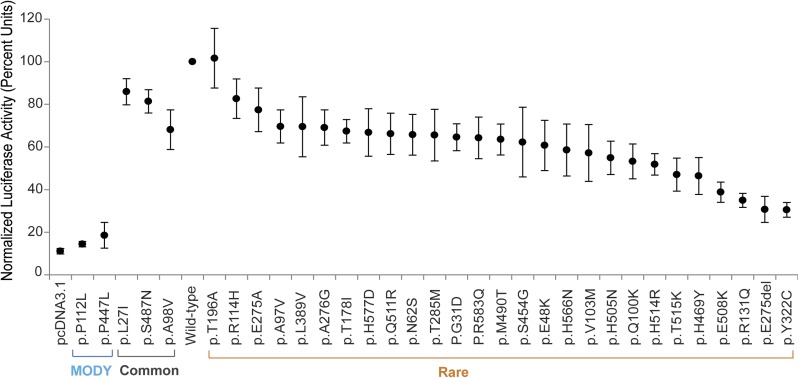
Variants in HNF1A encoding hepatocyte nuclear factor 1α (HNF-1A) are associated with maturity-onset diabetes of the young form 3 (MODY 3) and type 2 diabetes. We investigated whether functional classification of HNF1A rare coding variants can inform models of diabetes risk prediction in the general population by analyzing the effect of 27 HNF1A variants identified in well-phenotyped populations (n = 4,115). Bioinformatics tools classified 11 variants as likely pathogenic and showed no association with diabetes risk (combined minor allele frequency [MAF] 0.22%; odds ratio [OR] 2.02; 95% CI 0.73-5.60; P = 0.18). However, a different set of 11 variants that reduced HNF-1A transcriptional activity to <60% of normal (wild-type) activity was strongly associated with diabetes in the general population (combined MAF 0.22%; OR 5.04; 95% CI 1.99-12.80; P = 0.0007). Our functional investigations indicate that 0.44% of the population carry HNF1A variants that result in a substantially increased risk for developing diabetes. These results suggest that functional characterization of variants within MODY genes may overcome the limitations of bioinformatics tools for the purposes of presymptomatic diabetes risk prediction in the general population.
编码肝细胞核因子1α(HNF-1A)的HNF1A基因变异与青年发病的成年型糖尿病3型(MODY 3)及2型糖尿病相关。我们通过分析在表型明确的人群(n = 4,115)中鉴定出的27个HNF1A变异的影响,研究HNF1A罕见编码变异的功能分类是否能为一般人群的糖尿病风险预测模型提供信息。生物信息学工具将11个变异分类为可能致病,但未显示与糖尿病风险相关(合并次要等位基因频率[MAF] 0.22%;优势比[OR] 2.02;95%置信区间[CI] 0.73 - 5.60;P = 0.18)。然而,另一组11个将HNF-1A转录活性降低至正常(野生型)活性<60%的变异在一般人群中与糖尿病密切相关(合并MAF 0.22%;OR 5.04;95% CI 1.99 - 12.80;P = 0.0007)。我们的功能研究表明,0.44%的人群携带导致患糖尿病风险大幅增加的HNF1A变异。这些结果表明,对于一般人群的症状前糖尿病风险预测而言,MODY基因内变异的功能特征可能克服生物信息学工具的局限性。