Mundo Sano Foundation, Madrid, Spain.
National Center for Tropical Medicine, Institute of Health Carlos III, Madrid, Spain.
PLoS Negl Trop Dis. 2020 Jun 4;14(6):e0008315. doi: 10.1371/journal.pntd.0008315. eCollection 2020 Jun.
Soil transmitted helminths are highly prevalent worldwide. Globally, approximately 1.5 billion people are infected with Ascaris lumbricoides, Trichuris trichiura or hookworm. Endemic countries carry out periodic mass treatment of at-risk populations with albendazole or mebendazole as a control measure. Most prevalence studies have focused on school aged children and therefore control programs are implemented at school level, not at community level. In this study, the prevalence of intestinal helminths, including Strongyloides stercoralis, was examined using a comprehensive laboratory approach in a community in north-western Ethiopia.
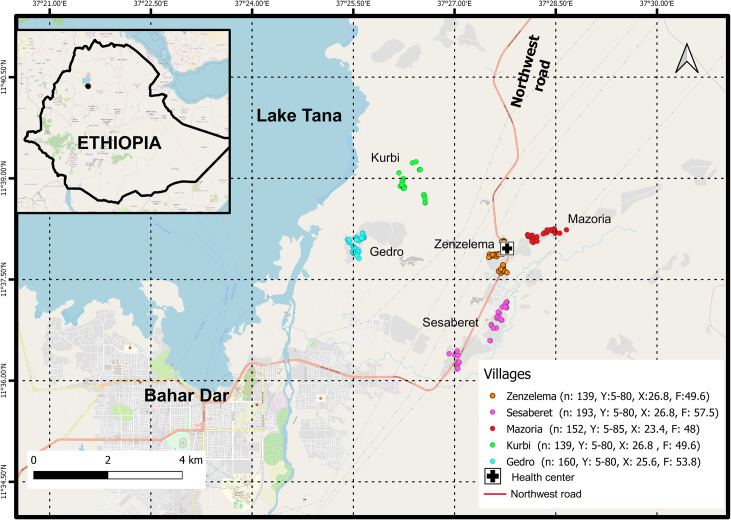
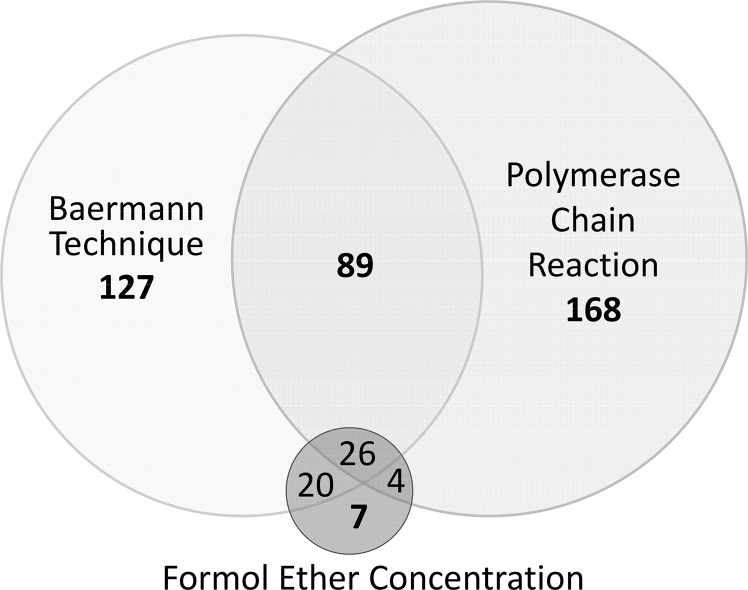
A cross-sectional survey was conducted on 792 individuals ≥5 years old in randomly selected houses in a rural district. Stools were examined using three techniques: a formol-ether concentration, the Baermann technique and a real time polymerase chain reaction test (these last two specific for S. stercoralis). Statistical analyses were performed between two large age groups, children (≤14 years old) and adults (≥15 years old).
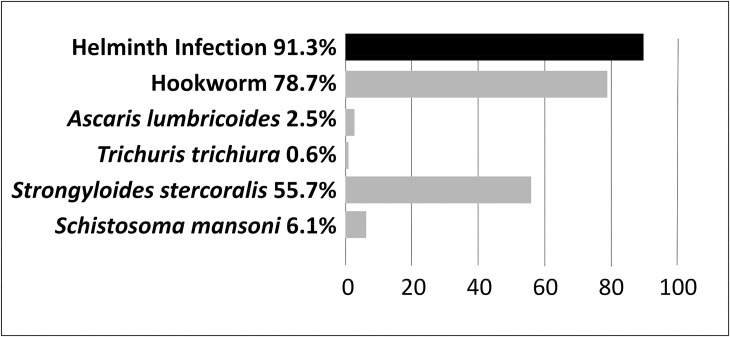
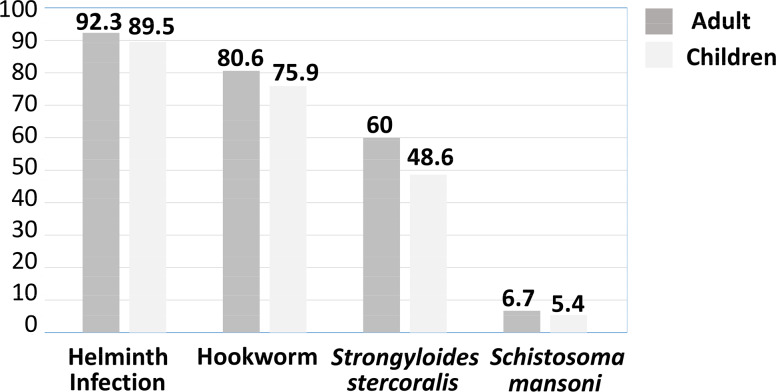
The prevalence of helminths was 91.3%; (95% CI: 89.3-93.3%). Hookworm was the most prevalent, 78.7% (95% CI 75.6-81.4%), followed by S. stercoralis 55.7% (95% CI 52.2-59.1%). Co-infection with both was detected in 45.4% (95% CI 42.0-49.0%) of the participants. The mean age of hookworm-infected individuals was significantly higher than non-infected ones (p = 0.003). Also, S. stercoralis infection was significantly associated with age, being more prevalent in adults (p = 0.002).
This is the highest prevalence of S. stercoralis detected in Ethiopia so far. Our results highlight the need of searching specifically for infection by this parasite since it usually goes unnoticed if helminth studies rely only on conventional diagnostic techniques, i.e. Kato-Katz. Moreover, the focus of these programs on children undermines the actual prevalence of hookworm. The adult population acts as a reservoir for both hookworm and S. stercoralis and this fact may negatively impact the current control programs in Ethiopia which only target treatment of school aged children. This reservoir, together with a lack of adequate water, sanitation and hygiene, increases the probability of re-infection in children. Finally, the high prevalence of S. stercoralis found calls for a comprehensive diagnostic approach in endemic areas in addition to a revision of control measures that is, adding ivermectin to current albendazole/mebendazole, since it is the drug of choice for S. stercoralis.
土壤传播的蠕虫在全球范围内高度流行。全球约有 15 亿人感染蛔虫、鞭虫或钩虫。流行国家定期对高危人群进行阿苯达唑或甲苯咪唑的集体治疗,作为一种控制措施。大多数流行情况研究都集中在学龄儿童身上,因此控制计划是在学校层面实施的,而不是在社区层面。在这项研究中,使用综合实验室方法在埃塞俄比亚西北部的一个社区中检查了肠道蠕虫(包括旋毛虫)的流行情况。
对随机选择的农村地区的 792 名年龄在 5 岁及以上的个体进行横断面调查。使用三种技术检查粪便:福尔马林-乙醚浓缩法、巴氏技术和实时聚合酶链反应试验(后两种技术专门针对旋毛虫)。在两个年龄较大的组之间进行了统计分析,即儿童(≤14 岁)和成人(≥15 岁)。
蠕虫的患病率为 91.3%(95%CI:89.3-93.3%)。钩虫最为常见,患病率为 78.7%(95%CI 75.6-81.4%),其次是旋毛虫 55.7%(95%CI 52.2-59.1%)。在 45.4%(95%CI 42.0-49.0%)的参与者中检测到两种寄生虫的混合感染。感染钩虫的个体的平均年龄明显高于未感染的个体(p=0.003)。此外,旋毛虫感染与年龄显著相关,在成年人中更为普遍(p=0.002)。
这是迄今为止在埃塞俄比亚检测到的旋毛虫最高患病率。我们的研究结果强调了需要专门寻找这种寄生虫的感染,因为如果仅依靠传统的诊断技术(即加藤法)进行寄生虫学研究,通常会忽略它。此外,这些项目将重点放在儿童身上,这削弱了钩虫实际流行情况。成年人群体是钩虫和旋毛虫的储存宿主,这一事实可能会对埃塞俄比亚目前仅针对学龄儿童治疗的控制计划产生负面影响。这种储存宿主加上缺乏足够的水、卫生和个人卫生,增加了儿童再次感染的可能性。最后,旋毛虫的高患病率呼吁在流行地区采取综合诊断方法,并修订控制措施,即在当前的阿苯达唑/甲苯咪唑中添加伊维菌素,因为它是旋毛虫的首选药物。