Triaca Viviana, Calissano Pietro
European Brain Research Institute (EBRI)/R.L. Montalcini Foundation, and Institute of Cell Biology and Neuroscience, National Research Council (IBCN-CNR), Rome, Italy.
Neural Regen Res. 2016 Oct;11(10):1553-1556. doi: 10.4103/1673-5374.193224.
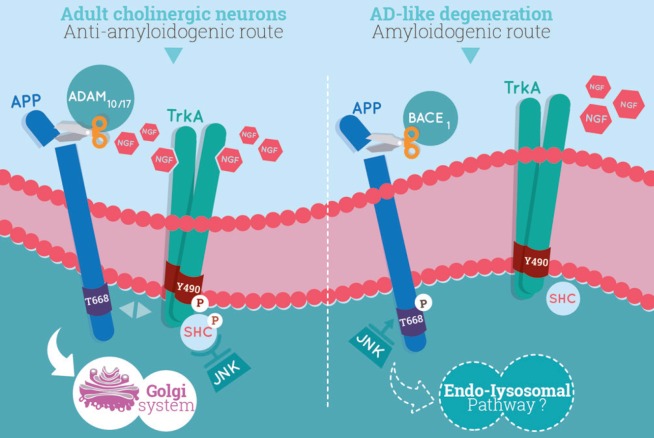
The current idea behind brain pathology is that disease is initiated by mild disturbances of common physiological processes. Overtime, the disruption of the neuronal homeostasis will determine irreversible degeneration and neuronal apoptosis. This could be also true in the case of nerve growth factor (NGF) alterations in sporadic Alzheimer's disease (AD), an age-related pathology characterized by cholinergic loss, amyloid plaques and neurofibrillary tangles. In fact, the pathway activated by NGF, a key neurotrophin for the metabolism of basal forebrain cholinergic neurons (BFCN), is one of the first homeostatic systems affected in prodromal AD. NGF signaling dysfunctions have been thought for decades to occur in AD late stages, as a mere consequence of amyloid-driven disruption of the retrograde axonal transport of neurotrophins to BFCN. Nowadays, a wealth of knowledge is potentially opening a new scenario: NGF signaling impairment occurs at the onset of AD and correlates better than amyloid load with cognitive decline. The recent acceleration in the characterization of anatomical, functional and molecular profiles of early AD is aimed at maximizing the efficacy of existing treatments and setting novel therapies. Accordingly, the elucidation of the molecular events underlying APP metabolism regulation by the NGF pathway in the septo-hippocampal system is crucial for the identification of new target molecules to slow and eventually halt mild cognitive impairment (MCI) and its progression toward AD.
目前关于脑病理学的观点认为,疾病是由常见生理过程的轻微紊乱引发的。随着时间的推移,神经元稳态的破坏将导致不可逆的退化和神经元凋亡。在散发性阿尔茨海默病(AD)中神经生长因子(NGF)改变的情况下,情况可能也是如此。散发性AD是一种与年龄相关的疾病,其特征为胆碱能缺失、淀粉样斑块和神经原纤维缠结。事实上,NGF激活的通路是基底前脑胆碱能神经元(BFCN)代谢的关键神经营养因子,是前驱性AD中最早受影响的稳态系统之一。几十年来,人们一直认为NGF信号功能障碍发生在AD晚期,这仅仅是淀粉样蛋白驱动神经营养因子向BFCN逆行轴突运输中断的结果。如今,大量知识可能正在开启一个新的局面:NGF信号损伤发生在AD发病时,并且与认知能力下降的相关性比淀粉样蛋白负荷更好。近期对早期AD的解剖学、功能和分子特征描述的加速,旨在最大限度地提高现有治疗方法的疗效并制定新的治疗方案。因此,阐明NGF通路在海马系统中调节APP代谢的分子事件,对于识别新的靶分子以减缓并最终阻止轻度认知障碍(MCI)及其向AD的进展至关重要。