Clark Anthony J, Gindin Tatyana, Zhang Baoshan, Wang Lingle, Abel Robert, Murret Colleen S, Xu Fang, Bao Amy, Lu Nina J, Zhou Tongqing, Kwong Peter D, Shapiro Lawrence, Honig Barry, Friesner Richard A
Department of Chemistry, Columbia University, 3000 Broadway, MC 3178, New York, NY 10027, USA.
Department of Pathology, Columbia University Medical Center, 630 W. 168th St, New York, NY 10032, USA.
J Mol Biol. 2017 Apr 7;429(7):930-947. doi: 10.1016/j.jmb.2016.11.021. Epub 2016 Nov 28.
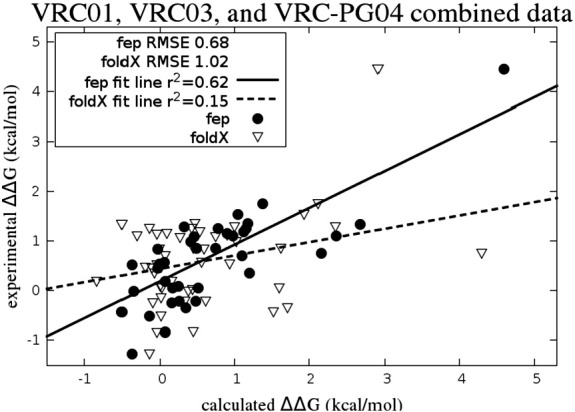
Direct calculation of relative binding affinities between antibodies and antigens is a long-sought goal. However, despite substantial efforts, no generally applicable computational method has been described. Here, we describe a systematic free energy perturbation (FEP) protocol and calculate the binding affinities between the gp120 envelope glycoprotein of HIV-1 and three broadly neutralizing antibodies (bNAbs) of the VRC01 class. The protocol has been adapted from successful studies of small molecules to address the challenges associated with modeling protein-protein interactions. Specifically, we built homology models of the three antibody-gp120 complexes, extended the sampling times for large bulky residues, incorporated the modeling of glycans on the surface of gp120, and utilized continuum solvent-based loop prediction protocols to improve sampling. We present three experimental surface plasmon resonance data sets, in which antibody residues in the antibody/gp120 interface were systematically mutated to alanine. The RMS error in the large set (55 total cases) of FEP tests as compared to these experiments, 0.68kcal/mol, is near experimental accuracy, and it compares favorably with the results obtained from a simpler, empirical methodology. The correlation coefficient for the combined data set including residues with glycan contacts, R=0.49, should be sufficient to guide the choice of residues for antibody optimization projects, assuming that this level of accuracy can be realized in prospective prediction. More generally, these results are encouraging with regard to the possibility of using an FEP approach to calculate the magnitude of protein-protein binding affinities.
直接计算抗体与抗原之间的相对结合亲和力是一个长期追求的目标。然而,尽管付出了巨大努力,但尚未描述出一种普遍适用的计算方法。在此,我们描述了一种系统的自由能微扰(FEP)方案,并计算了HIV-1的gp120包膜糖蛋白与VRC01类的三种广泛中和抗体(bNAbs)之间的结合亲和力。该方案是从成功的小分子研究中改编而来,以应对与蛋白质-蛋白质相互作用建模相关的挑战。具体而言,我们构建了三种抗体-gp120复合物的同源模型,延长了对大体积残基的采样时间,纳入了gp120表面聚糖的建模,并利用基于连续溶剂的环预测方案来改善采样。我们展示了三个实验表面等离子体共振数据集,其中抗体/gp120界面中的抗体残基被系统地突变为丙氨酸。与这些实验相比,在大量FEP测试(共55个案例)中的均方根误差为0.68kcal/mol,接近实验精度,并且与从更简单的经验方法获得的结果相比具有优势。对于包括与聚糖接触的残基的组合数据集,相关系数R = 0.49,假设在预测中能够实现这种精度水平,应该足以指导抗体优化项目中残基的选择。更一般地说,这些结果对于使用FEP方法计算蛋白质-蛋白质结合亲和力的大小的可能性而言是令人鼓舞的。