Kim Young In, Kim Sun Mi, Kim Hyungjin, Han Doug Hyun
Department of Psychiatry, Chung-Ang University Hospital, Seoul, Republic of Korea.
Department of Psychology, Rice University, Houston, TX, USA.
Psychiatry Investig. 2016 Nov;13(6):622-629. doi: 10.4306/pi.2016.13.6.622. Epub 2016 Nov 24.
Repetitive transcranial magnetic stimulation (rTMS) was approved by the Food and Drug Administration to alleviate symptoms of treatment-resistant depression. This study aimed to evaluate the effectiveness of rTMS treatment on alleviating occupational stress by evaluating clinical symptoms and quantitative electroencephalography (QEEG).
Twenty-four health care workers were randomized to receive 12 sessions of active or sham rTMS delivered to the left dorsolateral prefrontal cortex (DLPFC). Each session consisted of 32 trains of 10 Hz repetitive TMS delivered in 5-second trains at 110% of the estimated prefrontal cortex threshold. Before and after the intervention, the Korean version of the occupational stress inventory (K-OSI), Beck's depression inventory (BDI), and Beck's anxiety inventory (BAI) were administered and EEG was performed using a 21-channel digital EEG system.
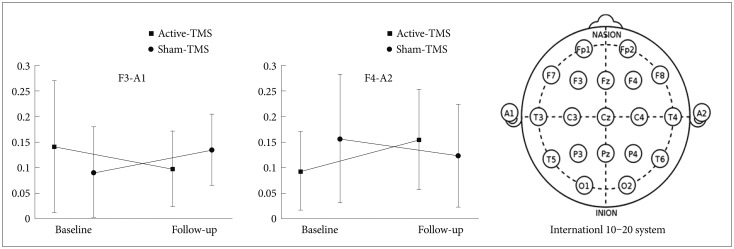
After TMS, the average scores for the affective responses to stressors on the personal strain questionnaire (PSQ) subscale of K-OSI and BDI decreased significantly for the active-TMS group compared to the sham-TMS group. Also, the active-TMS group showed a significantly greater decrease in relative alpha in the F3 electrode and a significantly greater increase in the F4 electrode.
High-frequency rTMS on the left DLPFC had stress-relieving and mood-elevating effects in health care workers, likely by stimulating the left frontal lobe.
重复经颅磁刺激(rTMS)已获美国食品药品监督管理局批准用于缓解难治性抑郁症的症状。本研究旨在通过评估临床症状和定量脑电图(QEEG)来评价rTMS治疗缓解职业压力的有效性。
24名医护人员被随机分为两组,分别接受12次针对左侧背外侧前额叶皮质(DLPFC)的活性rTMS或伪刺激rTMS。每次治疗包括32串10Hz的重复TMS,每串持续5秒,强度为估计的前额叶皮质阈值的110%。在干预前后,使用韩国版职业压力量表(K-OSI)、贝克抑郁量表(BDI)和贝克焦虑量表(BAI)进行评估,并使用21通道数字脑电图系统进行脑电图检查。
与伪刺激rTMS组相比,活性rTMS组在K-OSI个人压力问卷(PSQ)子量表上对应激源的情感反应平均得分以及BDI得分显著降低。此外,活性rTMS组F3电极处的相对阿尔法波显著降低,F4电极处显著升高。
对左侧DLPFC进行高频rTMS对医护人员具有缓解压力和改善情绪的作用,可能是通过刺激左额叶实现的。