Cardoso Claudia R L, Salles Gil F
Department of Internal Medicine, School of Medicine and University Hospital Clementino Fraga Filho, Universidade Federal do Rio de Janeiro, Rua Rodolpho Rocco 255, Cidade Universitária, Rio de Janeiro-RJ 21941-901, Brazil.
Int J Mol Sci. 2016 Dec 6;17(12):2044. doi: 10.3390/ijms17122044.
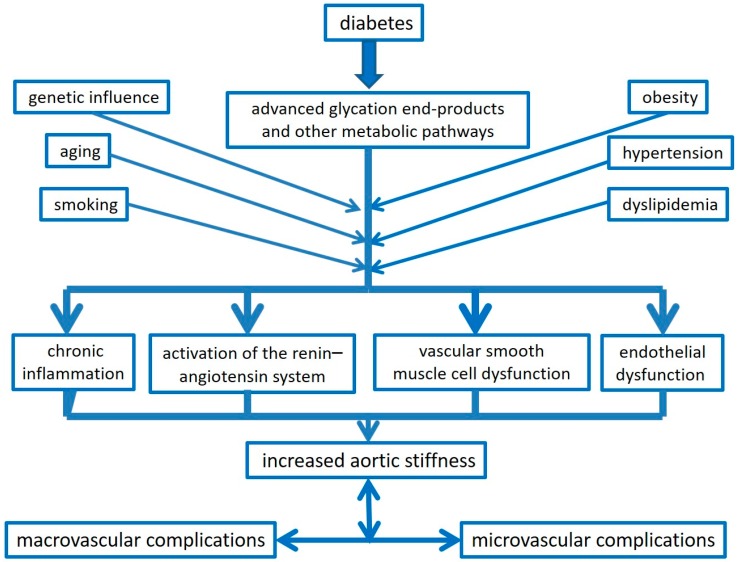
Increased aortic stiffness has been recognized as a predictor of adverse cardiovascular outcomes in some clinical conditions, such as in patients with arterial hypertension and end-stage renal disease, in population-based samples and, more recently, in type 2 diabetic patients. Patients with type 2 diabetes have higher aortic stiffness than non-diabetic individuals, and increased aortic stiffness has been correlated to the presence of micro- and macrovascular chronic diabetic complications. We aimed to review the current knowledge on the relationships between aortic stiffness and diabetic complications, their possible underlying physiopathological mechanisms, and their potential applications to clinical type 2 diabetes management.
在一些临床情况下,如动脉高血压患者、终末期肾病患者、基于人群的样本以及最近的2型糖尿病患者中,主动脉僵硬度增加已被认为是不良心血管结局的预测指标。2型糖尿病患者的主动脉僵硬度高于非糖尿病个体,且主动脉僵硬度增加与糖尿病微血管和大血管慢性并发症的存在相关。我们旨在综述目前关于主动脉僵硬度与糖尿病并发症之间的关系、其可能的潜在生理病理机制以及它们在2型糖尿病临床管理中的潜在应用的知识。