Chou Hsien-Ling, Han Shih-Tsung, Yeh Chun-Fu, Tzeng I-Shaing, Hsieh Tsung-Han, Wu Chin-Chieh, Kuan Jen-Tse, Chen Kuan-Fu
Department of Emergency Medicine, Chang-Gung Memorial Hospital, Linkou Division of Infectious Diseases, Department of Internal Medicine, Chang Gung Memorial Hospital, Linkou, Chang Gung University College of Medicine Tissue Bank, Chang Gung Memorial Hospital, Linkou, Taoyuan Department of Emergency Medicine, Chang Gung Memorial Hospital, Keelung Department of Emergency Medicine, Chang Gung Memorial Hospital, Taipei Community Medicine Research Center, Chang Gung Memorial Hospital, Keelung Clinical Informatics and Medical Statistics Research Center, Chang Gung University, Taoyuan, Taiwan.
Medicine (Baltimore). 2016 Dec;95(49):e5634. doi: 10.1097/MD.0000000000005634.
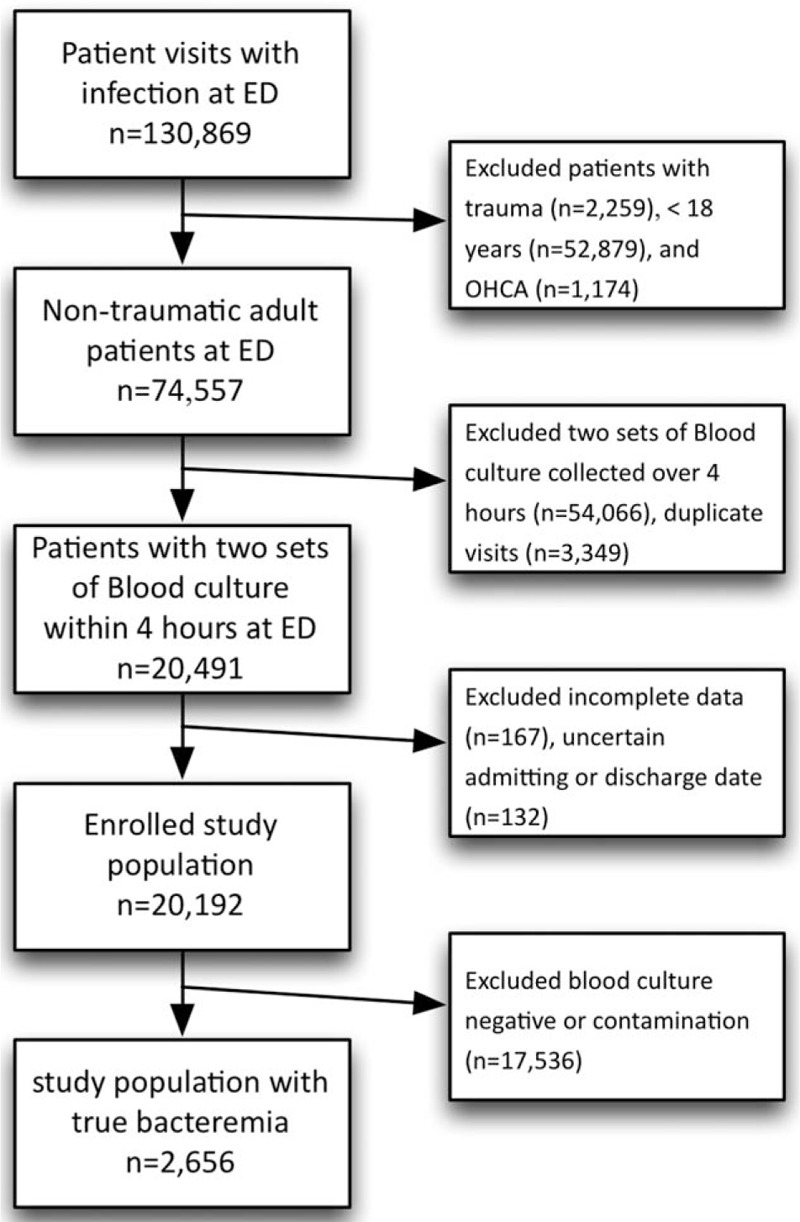
Early diagnosis of bacteremia for patients with suspected sepsis is 1 way to improve prognosis of sepsis. Systemic inflammatory response syndrome (SIRS) has long been utilized as a screening tool to detect bacteremia by front-line healthcare providers. The value of SIRS to predict bacteremia in elderly patients (≥65 years) with suspected sepsis has not yet been examined in emergency departments (EDs).We aimed to evaluate the performance of SIRS components in predicting bacteremia among elderly patients in EDs.We retrospectively evaluated patients with suspected sepsis and 2 sets of blood culture collected within 4 hours after admitting to ED in a tertiary teaching hospital between 2010 and 2012. Patients were categorized into 3-year age groups: young (18-64 years), young-old (65-74 years), and old patients (≥75 years). Vital signs and Glasgow Coma Scale with verbal response obtained at the triage, comorbidities, sites of infection, blood cultures, and laboratory results were retrieved via the electronic medical records.A total of 20,192 patients were included in our study. Among them, 9862 (48.9%) were the elderly patients (young-old and old patients), 2656 (13.2%) developed bacteremia. Among patients with bacteremia, we found the elderly patients had higher SIRS performance (adjusted odds ratio [aOR]: 2.40, 95% confidence interval [CI]: 1.90-3.03 in the young-old and aOR: 2.66, 95% CI: 2.19-3.23 in the old). Fever at the triage was most predictive of bacteremia, especially in the elderly patients (aOR: 2.19, 95% CI: 1.81-2.65 in the young-old and aOR: 2.27, 95% CI: 1.95-2.63 in the old), and tachypnea was not predictive of bacteremia among the elderly patients (all P > 0.2).The performance of SIRS to predict bacteremia was more suitable for elderly patients in EDs observed in this study. The elderly patients presented with more fever and less tachypnea when they had bacteremia.
对疑似脓毒症患者进行菌血症的早期诊断是改善脓毒症预后的一种方法。全身炎症反应综合征(SIRS)长期以来一直被一线医护人员用作检测菌血症的筛查工具。SIRS在预测急诊科(ED)中疑似脓毒症的老年患者(≥65岁)菌血症方面的价值尚未得到研究。我们旨在评估SIRS各组成部分在预测急诊科老年患者菌血症方面的表现。我们回顾性评估了2010年至2012年期间在一家三级教学医院急诊科就诊后4小时内疑似脓毒症且采集了2套血培养的患者。患者按3岁年龄组分类:年轻组(18 - 64岁)、年轻老年组(65 - 74岁)和老年组(≥75岁)。通过电子病历获取分诊时的生命体征和格拉斯哥昏迷量表言语反应、合并症、感染部位、血培养及实验室检查结果。我们的研究共纳入20192例患者。其中,9862例(48.9%)为老年患者(年轻老年组和老年组),2656例(13.2%)发生菌血症。在菌血症患者中,我们发现老年患者的SIRS表现更高(年轻老年组调整优势比[aOR]:2.40,95%置信区间[CI]:1.90 - 3.03;老年组aOR:2.66,95% CI:2.19 - 3.23)。分诊时发热对菌血症的预测性最强,尤其是在老年患者中(年轻老年组aOR:2.19,95% CI:1.81 - 2.65;老年组aOR:2.27,95% CI:1.95 - 2.63),而呼吸急促在老年患者中对菌血症无预测性(所有P>0.2)。本研究观察到,SIRS预测菌血症的表现更适用于急诊科的老年患者。老年患者发生菌血症时发热更多,呼吸急促更少。