Hornok Sándor, Szőke Krisztina, Kováts Dávid, Estók Péter, Görföl Tamás, Boldogh Sándor A, Takács Nóra, Kontschán Jenő, Földvári Gábor, Barti Levente, Corduneanu Alexandra, Sándor Attila D
Department of Parasitology and Zoology, University of Veterinary Medicine, Budapest, Hungary.
Department of Evolutionary Zoology and Human Biology, Debrecen University, Debrecen, Hungary.
PLoS One. 2016 Dec 8;11(12):e0167735. doi: 10.1371/journal.pone.0167735. eCollection 2016.
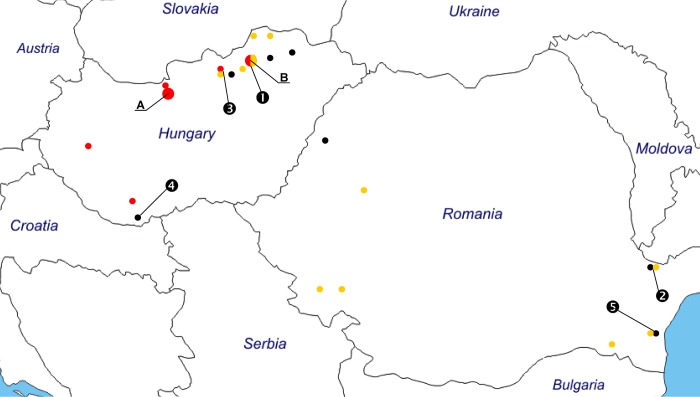
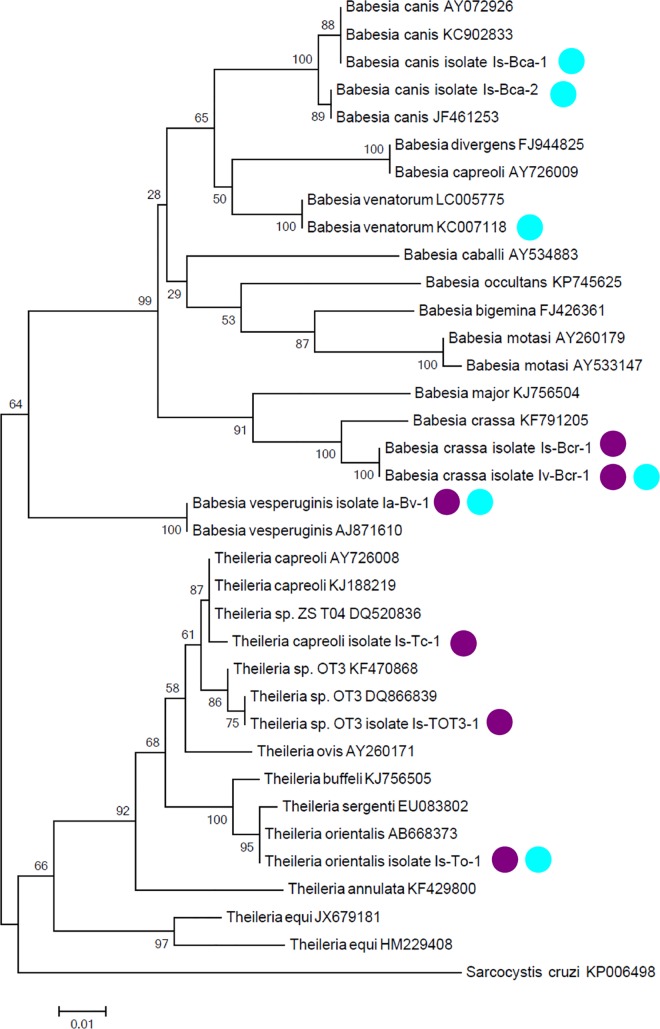
In this study 308 ticks (Ixodes ariadnae: 26 larvae, 14 nymphs, five females; I. vespertilionis: 89 larvae, 27 nymphs, eight females; I. simplex: 80 larvae, 50 nymphs, nine females) have been collected from 200 individuals of 17 bat species in two countries, Hungary and Romania. After DNA extraction these ticks were molecularly analysed for the presence of piroplasm DNA. In Hungary I. ariadnae was most frequently identified from bat species in the family Vespertilionidae, whereas I. vespertilionis was associated with Rhinolophidae. Ixodes ariadnae was not found in Romania. Four, four and one new bat host species of I. ariadnae, I. vespertilionis and I. simplex were identified, respectively. DNA sequences of piroplasms were detected in 20 bat ticks (15 larvae, four nymphs and one female). I. simplex carried piroplasm DNA sequences significantly more frequently than I. vespertilionis. In I. ariadnae only Babesia vesperuginis DNA was detected, whereas in I. vespertilionis sequences of both B. vesperuginis and B. crassa. From I. simplex the DNA of B. canis, Theileria capreoli, T. orientalis and Theileria sp. OT3 were amplified, as well as a shorter sequence of the zoonotic B. venatorum. Bat ticks are not known to infest dogs or ruminants, i.e. typical hosts and reservoirs of piroplasms molecularly identified in I. vespertilionis and I. simplex. Therefore, DNA sequences of piroplasms detected in these bat ticks most likely originated from the blood of their respective bat hosts. This may indicate either that bats are susceptible to a broader range of piroplasms than previously thought, or at least the DNA of piroplasms may pass through the gut barrier of bats during digestion of relevant arthropod vectors. In light of these findings, the role of bats in the epidemiology of piroplasmoses deserves further investigation.
在本研究中,从匈牙利和罗马尼亚两国17种蝙蝠的200只个体身上采集了308只蜱虫(阿里阿德涅硬蜱:26只幼虫、14只若虫、5只雌虫;食虫蝙蝠硬蜱:89只幼虫、27只若虫、8只雌虫;单纯硬蜱:80只幼虫、50只若虫、9只雌虫)。提取DNA后,对这些蜱虫进行分子分析以检测梨形虫DNA的存在。在匈牙利,阿里阿德涅硬蜱最常从蝙蝠科的蝙蝠物种中鉴定出来,而食虫蝙蝠硬蜱与菊头蝠科有关。在罗马尼亚未发现阿里阿德涅硬蜱。分别鉴定出阿里阿德涅硬蜱、食虫蝙蝠硬蜱和单纯硬蜱的4种、4种和1种新蝙蝠宿主物种。在20只蝙蝠蜱虫(15只幼虫、4只若虫和1只雌虫)中检测到梨形虫的DNA序列。单纯硬蜱携带梨形虫DNA序列的频率明显高于食虫蝙蝠硬蜱。在阿里阿德涅硬蜱中仅检测到蝙蝠巴贝斯虫DNA,而在食虫蝙蝠硬蜱中检测到蝙蝠巴贝斯虫和粗壮巴贝斯虫的序列。从单纯硬蜱中扩增出犬巴贝斯虫、小泰勒虫、东方泰勒虫和泰勒虫属OT3的DNA,以及人畜共患的伯氏巴贝斯虫的较短序列。已知蝙蝠蜱虫不会寄生在狗或反刍动物身上,即食虫蝙蝠硬蜱和单纯硬蜱中分子鉴定出的梨形虫的典型宿主和储存宿主。因此,在这些蝙蝠蜱虫中检测到的梨形虫DNA序列很可能源自其各自蝙蝠宿主的血液。这可能表明蝙蝠比以前认为的更容易感染更广泛的梨形虫,或者至少梨形虫的DNA在相关节肢动物媒介消化过程中可能穿过蝙蝠的肠道屏障。鉴于这些发现,蝙蝠在梨形虫病流行病学中的作用值得进一步研究。