Liu Heng, Chen Hua, Wu Bo, Zhang Tijiang, Wang Jinhui, Huang Kexin, Song Ganjun, Zhan Jian
Department of Radiology, Affiliated Hospital of Zunyi Medical University, Medical Imaging Center of Guizhou Province, Zunyi, Guizhou.
Department of Psychology, Hangzhou Normal University; Zhejiang Key Laboratory for Research in Assessment of Cognitive Impairments, Hangzhou.
Neuropsychiatr Dis Treat. 2016 Nov 25;12:3031-3039. doi: 10.2147/NDT.S120909. eCollection 2016.
The aim of this study was to explore the amplitude of spontaneous brain activity fluctuations in patients with relapsing-remitting multiple sclerosis (RRMS) using the amplitude of low-frequency fluctuation (ALFF) method.
ALFF and SPM8 were utilized to assess alterations in regional spontaneous brain activities in patients with RRMS in comparison with healthy controls (HCs). The beta values of altered brain regions between patients with RRMS and HCs were extracted, and a receiver operating characteristic (ROC) curve was generated to calculate the sensitivities and specificities of these different brain areas for distinguishing patients with RRMS from HCs. Pearson correlation analyses were applied to assess the relationships between the beta values of altered brain regions and disease duration and Expanded Disability Status Scale (EDSS) score.
A total of 18 patients with RRMS (13 females; five males) and 18 sex-, age-, and education-matched HCs (14 females; four males) were recruited for this study.
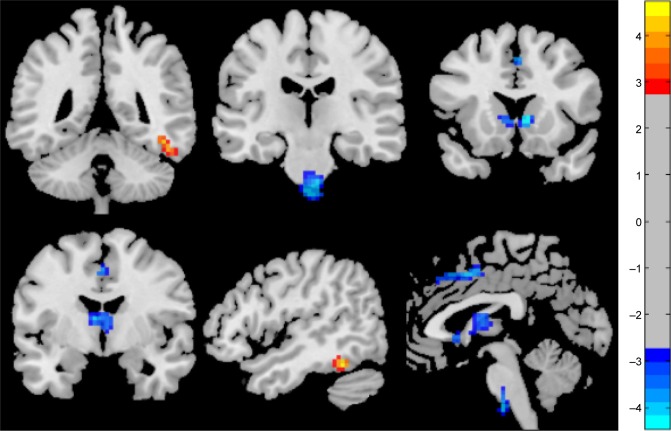
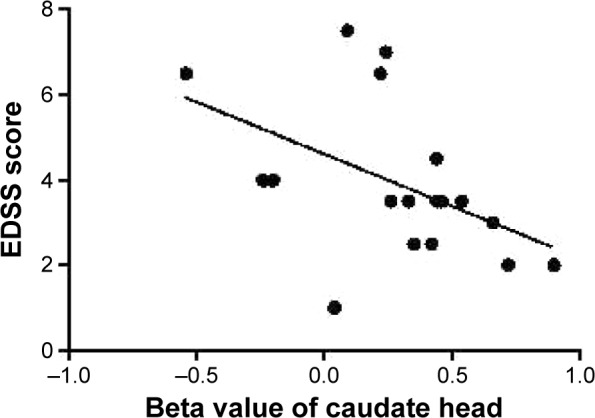
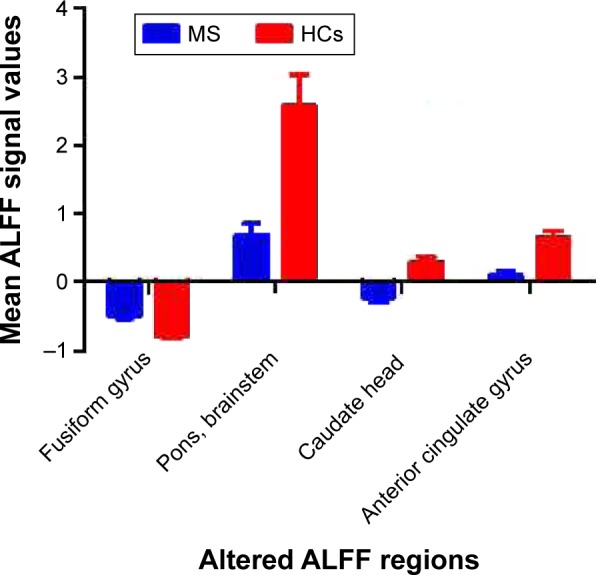
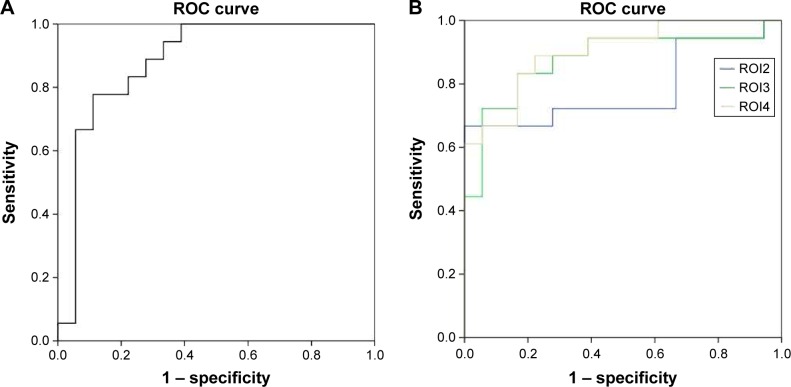
Compared with HCs, patients with RRMS showed higher ALFF responses in the right fusiform gyrus (Brodmann area [BA] 37) and lower ALFF responses in the bilateral anterior cingulate cortices (BA 24 and 32), bilateral heads of the caudate nuclei, and bilateral brainstem. The ROC analysis revealed that the beta values of these abnormal brain areas showed high degrees of sensitivity and specificity for distinguishing patients with RRMS from HCs. The EDSS score showed a significant negative Pearson correlation with the beta value of the caudate head (=-0.474, =0.047).
RRMS is associated with disturbances in spontaneous regional brain activity in specific areas, and these specific abnormalities may provide important information about the neural mechanisms underlying behavioral impairment in RRMS.
本研究旨在采用低频振幅(ALFF)方法探究复发缓解型多发性硬化症(RRMS)患者脑自发活动波动的幅度。
与健康对照者(HCs)相比,利用ALFF和SPM8评估RRMS患者局部脑自发活动的改变。提取RRMS患者和HCs之间脑区改变的β值,并生成受试者工作特征(ROC)曲线,以计算这些不同脑区区分RRMS患者和HCs的敏感性和特异性。应用Pearson相关性分析评估脑区改变的β值与病程及扩展残疾状态量表(EDSS)评分之间的关系。
本研究共招募了18例RRMS患者(13例女性;5例男性)和18例性别、年龄及教育程度匹配的HCs(14例女性;4例男性)。
与HCs相比,RRMS患者右侧梭状回(布罗德曼区[BA]37)的ALFF反应较高,而双侧前扣带回皮质(BA 24和32)、双侧尾状核头部及双侧脑干的ALFF反应较低。ROC分析显示,这些异常脑区的β值在区分RRMS患者和HCs方面具有高度的敏感性和特异性。EDSS评分与尾状核头部的β值呈显著负Pearson相关性(r = -0.474,P = 0.047)。
RRMS与特定区域的脑自发活动紊乱有关,这些特定异常可能为RRMS行为障碍的神经机制提供重要信息。