Senapati Rashmirani, Senapati Nihar Nalini, Dwibedi Bhagirathi
Virology Division, Regional Medical Research centre (ICMR), Nalco square, Chandrasekharpur, Bhubaneswar, 751023 Odisha India.
Department of Anesthesia, Dr RML Hospital, New Delhi, India.
Infect Agent Cancer. 2016 Nov 25;11:59. doi: 10.1186/s13027-016-0107-4. eCollection 2016.
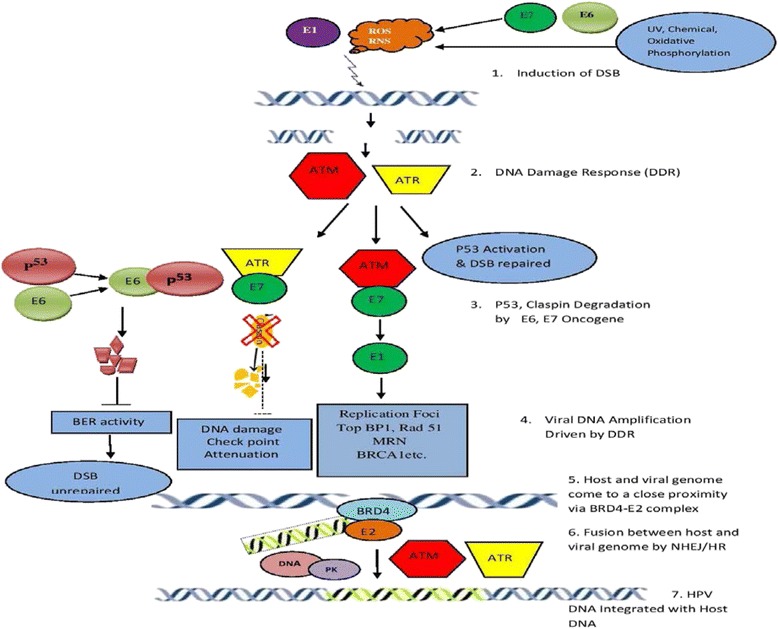
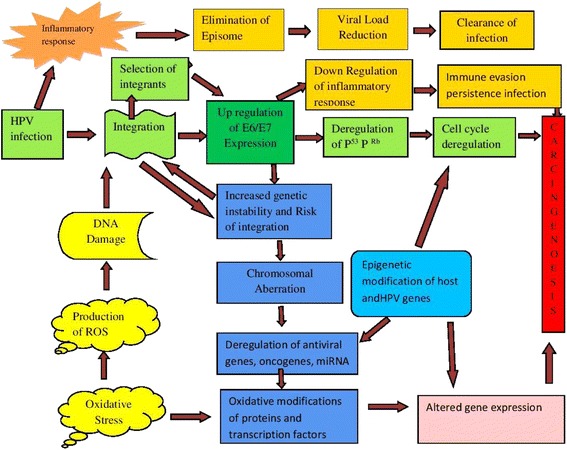
Human Papillomavirus is the major etiological agent in the development of cervical cancer but not a sufficient cause. Despite significant research, the underlying mechanisms of progression from a low-grade squamous intraepithelial lesion to high grade squamous intraepithelial lesion are yet to be understood. Deregulation of viral gene expression and host genomic instability play a central role in virus-mediated carcinogenesis. Key events such as viral integration and epigenetic modifications may lead to the deregulation of viral and host gene expression. This review has summarized the available literature to describe the possible mechanism and role of viral integration in mediating carcinogenesis. HPV integration begins with DNA damage or double strand break induced either by oxidative stress or HPV proteins and the subsequent steps are driven by the DNA damage responses. Inflammation and oxidative stress could be considered as cofactors in stimulating viral integration and deregulation of cellular and viral oncogenes during the progression of cervical carcinoma. All these events together with the host and viral genetic and epigenetic modifications in neoplastic progression have also been reviewed which may be relevant in identifying a new preventive therapeutic strategy. In the absence of therapeutic intervention for HPV-infected individuals, future research focus should be directed towards preventing and reversing of HPV integration. DNA damage response, knocking out integrated HPV sequences, siRNA approach, modulating the selection mechanism of cells harboring integrated genomes and epigenetic modifiers are the possible therapeutic targets.
人乳头瘤病毒是宫颈癌发生的主要病因,但并非充分病因。尽管进行了大量研究,低度鳞状上皮内病变进展为高度鳞状上皮内病变的潜在机制仍未明确。病毒基因表达失调和宿主基因组不稳定在病毒介导的致癌过程中起核心作用。病毒整合和表观遗传修饰等关键事件可能导致病毒和宿主基因表达失调。本综述总结了现有文献,以描述病毒整合在介导致癌作用中的可能机制和作用。人乳头瘤病毒整合始于由氧化应激或人乳头瘤病毒蛋白诱导的DNA损伤或双链断裂,随后的步骤由DNA损伤反应驱动。炎症和氧化应激可被视为宫颈癌进展过程中刺激病毒整合以及细胞和病毒癌基因失调的辅助因素。本综述还探讨了所有这些事件以及肿瘤进展过程中宿主和病毒的遗传及表观遗传修饰,这些可能与确定新的预防治疗策略相关。在缺乏针对人乳头瘤病毒感染个体的治疗干预措施的情况下,未来的研究重点应指向预防和逆转人乳头瘤病毒整合。DNA损伤反应、敲除整合的人乳头瘤病毒序列、小干扰RNA方法、调节携带整合基因组细胞的选择机制以及表观遗传修饰因子是可能的治疗靶点。