Canen Mara J, Brooker Rebecca J
Montana State University, Department of Psychology, PO Box 173440 Bozeman, MT 59717, United States.
Montana State University, Department of Psychology, PO Box 173440 Bozeman, MT 59717, United States.
Biol Psychol. 2017 Feb;123:103-110. doi: 10.1016/j.biopsycho.2016.12.003. Epub 2016 Dec 8.
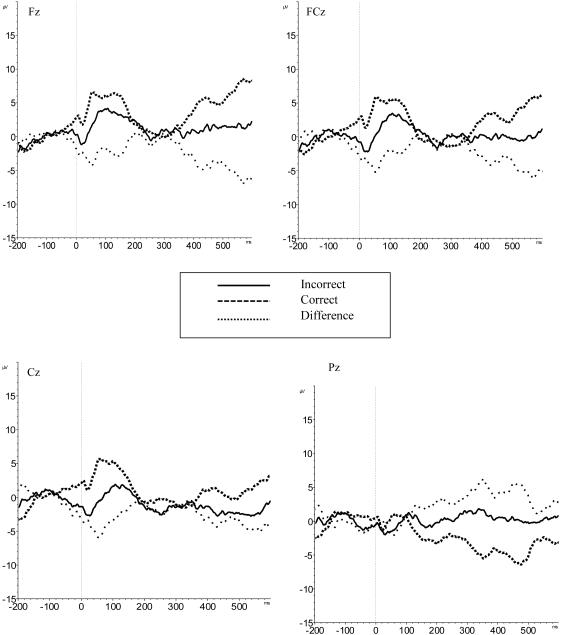
The Error Related Negativity (ERN) is a neural marker of performance monitoring that has been inconsistently linked to anxiety risk in children. One avenue for understanding inconsistencies is to investigate other neural dynamics linked to ERN. In this study, we investigated interactions between ERN and power in the theta frequency band, which is associated with attentional control and theorized to contribute ERN, in association with childhood anxiety risk. Fifty-nine 3-year-old children provided usable EEG data during a modified go/no-go task. Associations between ERN and anxious behaviors in preschoolers were moderated by theta power during incorrect trials. Specifically, when theta power was low, greater ERN predicted more social withdrawal; when theta power was high, ERN and social withdrawal were unrelated. Our findings suggest that ERN and theta may jointly contribute to anxiety risk in early childhood.
错误相关负波(ERN)是一种与表现监测相关的神经标志物,它与儿童焦虑风险之间的联系并不一致。理解这些不一致性的一个途径是研究与ERN相关的其他神经动力学。在本研究中,我们调查了ERN与θ频段功率之间的相互作用,θ频段与注意力控制相关,并且理论上认为它对ERN有贡献,同时研究了这种相互作用与儿童焦虑风险的关系。59名3岁儿童在一项改良的停止信号任务中提供了可用的脑电图数据。在错误试验期间,θ频段功率调节了学龄前儿童中ERN与焦虑行为之间的关联。具体而言,当θ频段功率较低时,较大的ERN预示着更多的社交退缩;当θ频段功率较高时,ERN与社交退缩无关。我们的研究结果表明,ERN和θ频段可能共同影响幼儿期的焦虑风险。