Kristoffersen Laila, Støen Ragnhild, Rygh Hilde, Sognnæs Margunn, Follestad Turid, Mohn Hilde S, Nissen Ingrid, Bergseng Håkon
Department of Pediatrics, St. Olav's University Hospital, Trondheim, Norway.
Department of Laboratory Medicine, Children's and Women's Health, Norwegian University of Science and Technology, NTNU, Trondheim, Norway.
Trials. 2016 Dec 12;17(1):593. doi: 10.1186/s13063-016-1730-5.
Skin-to-skin care immediately following delivery is a common practice for term infants and has been shown to improve cardiorespiratory stability, facilitate early bonding, and promote breastfeeding. Since 2007, the use of skin-to-skin care has been practiced for preterm infants from 32 weeks of gestation in the delivery room at St. Olav's University Hospital. In the present study we aim to investigate whether skin-to-skin care following delivery is safe, and how it affects early and late outcomes compared to standard care for very preterm infants.
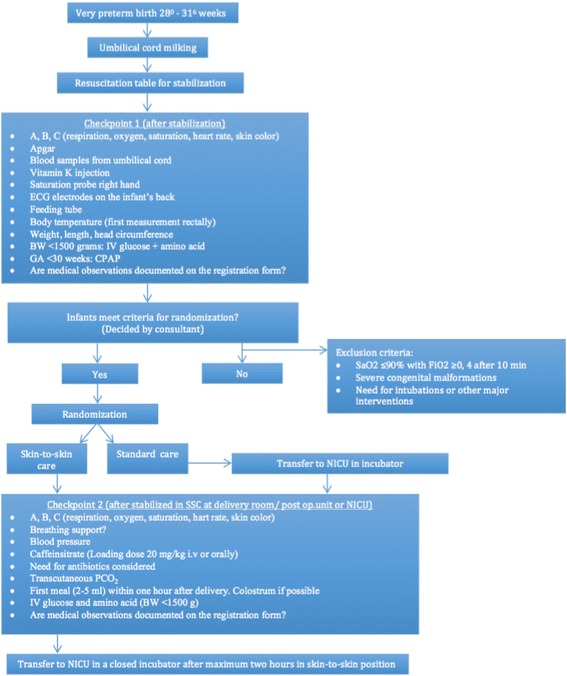
METHODS/DESIGN: A randomized controlled trial (RCT) of skin-to-skin care in the delivery room for very preterm infants born at gestational age 28-31 weeks with birth weight >1000 grams. Infants with severe congenital malformations or need of intubation in the delivery room are excluded. A detailed checklist and a flowchart were prepared for the study, and all involved professionals (neonatologists, neonatal nurses, obstetricians, anesthesiologists, midwives) participated in medical simulation training prior to study start on February 1, 2014. A consultant in neonatology and a neonatal nurse are present at all deliveries. Infants with birth weight <1500 grams receive an intravenous line with glucose, amino acids, and caffeine citrate in the delivery room. Infants with gestational age <30 weeks are routinely put on continuous positive airway pressure (CPAP). After initial stabilization, infants are randomized to skin-to-skin care or are transferred to the nursery in an incubator. Primary outcome is cognitive development at 2 years measured with the Bayley Scales of Infant Development, Third Edition. Secondary outcomes are safety defined as hypothermia, respiratory failure, and/or cardiopulmonary resuscitation, physiological stability after birth and motor, language and cognitive development at 1 year for the child, and mental health measured with the State-Trait Anxiety Inventory (STAI) at discharge, and at 3 months and 2 years after expected date of delivery for the mothers.
The study may have important implications for the initial care for very preterm infants after delivery and increase our understanding of how early skin-to-skin care affects preterm infants and their mothers.
ClinicalTrials, NCT02024854 . Registered on 19 December 2013.
分娩后立即进行皮肤接触护理是足月儿的常见做法,且已证明其可改善心肺稳定性、促进早期情感联结并推动母乳喂养。自2007年起,圣奥拉夫大学医院产房对妊娠32周起的早产儿实施了皮肤接触护理。在本研究中,我们旨在调查分娩后进行皮肤接触护理是否安全,以及与极早产儿的标准护理相比,其对早期和晚期结局有何影响。
方法/设计:一项针对胎龄28 - 31周、出生体重>1000克的极早产儿在产房进行皮肤接触护理的随机对照试验(RCT)。排除在产房有严重先天性畸形或需要插管的婴儿。为该研究准备了详细的检查表和流程图,所有参与的专业人员(新生儿科医生、新生儿护士、产科医生、麻醉师、助产士)在2014年2月1日研究开始前参加了医学模拟培训。每次分娩时都有一名新生儿科顾问和一名新生儿护士在场。出生体重<1500克的婴儿在产房接受含葡萄糖、氨基酸和枸橼酸咖啡因的静脉输液。胎龄<30周的婴儿常规接受持续气道正压通气(CPAP)。初始稳定后,将婴儿随机分为接受皮肤接触护理组或转入保育箱。主要结局是使用贝利婴幼儿发展量表第三版在2岁时测量的认知发展。次要结局包括定义为体温过低、呼吸衰竭和/或心肺复苏的安全性、出生后的生理稳定性以及儿童1岁时的运动、语言和认知发展,以及母亲在出院时、预计分娩日期后3个月和2年时使用状态 - 特质焦虑量表(STAI)测量的心理健康状况。
该研究可能对极早产儿分娩后的初始护理具有重要意义,并增进我们对早期皮肤接触护理如何影响早产儿及其母亲的理解。
ClinicalTrials,NCT02024854。于2013年12月19日注册。