Department of Earth, Environmental and Planetary Sciences, Brown University, 324 Brook Street, Providence, RI 02912, USA.
Department of Space Studies, Southwest Research Institute, 1050 Walnut Street, Suite 300, Boulder, CO 80302, USA.
Sci Adv. 2016 Dec 9;2(12):e1601658. doi: 10.1126/sciadv.1601658. eCollection 2016 Dec.
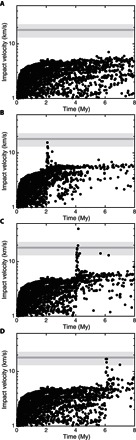
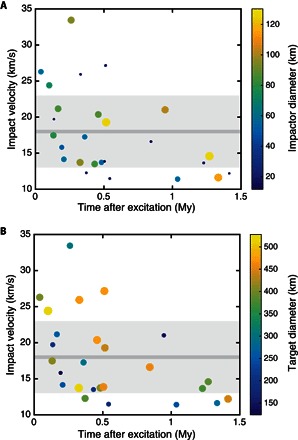
The presence, formation, and migration of giant planets fundamentally shape planetary systems. However, the timing of the formation and migration of giant planets in our solar system remains largely unconstrained. Simulating planetary accretion, we find that giant planet migration produces a relatively short-lived spike in impact velocities lasting ~0.5 My. These high-impact velocities are required to vaporize a significant fraction of Fe,Ni metal and silicates and produce the CB (Bencubbin-like) metal-rich carbonaceous chondrites, a unique class of meteorites that were created in an impact vapor-melt plume ~5 My after the first solar system solids. This indicates that the region where the CB chondrites formed was dynamically excited at this early time by the direct interference of the giant planets. Furthermore, this suggests that the formation of the giant planet cores was protracted and the solar nebula persisted until ~5 My.
巨行星的存在、形成和迁移从根本上塑造了行星系统。然而,我们太阳系中巨行星的形成和迁移的时间仍然很大程度上没有得到限制。通过模拟行星吸积,我们发现巨行星迁移产生了一个相对短暂的撞击速度峰值,持续时间约为 0.5 百万年。这些高撞击速度是将相当一部分铁、镍金属和硅酸盐蒸发并产生 CB(本库宾型)富金属碳质球粒陨石所必需的,CB 陨石是一类独特的陨石,它们是在第一个太阳系固体之后约 500 万年在一次撞击蒸汽熔体羽流中形成的。这表明,在这个早期,巨行星的直接干扰使 CB 陨石形成的区域在动力学上受到了激发。此外,这表明巨行星核心的形成是漫长的,太阳星云一直持续到约 500 万年。