Hoff Grégory, Bertrand Claire, Zhang Lingli, Piotrowski Emilie, Chipot Ludovic, Bontemps Cyril, Confalonieri Fabrice, McGovern Stephen, Lecointe François, Thibessard Annabelle, Leblond Pierre
UMR 1128, Dynamique des Génomes et Adaptation Microbienne, Université de LorraineVandœuvre-lès-Nancy, France; UMR 1128, Institut National de la Recherche Agronomique, Dynamique des Génomes et Adaptation MicrobienneVandœuvre-lès-Nancy, France.
Institute for Integrative Biology of the Cell (I2BC), CEA, Centre National de la Recherche Scientifique, Université Paris-Sud Orsay, France.
Front Microbiol. 2016 Nov 28;7:1901. doi: 10.3389/fmicb.2016.01901. eCollection 2016.
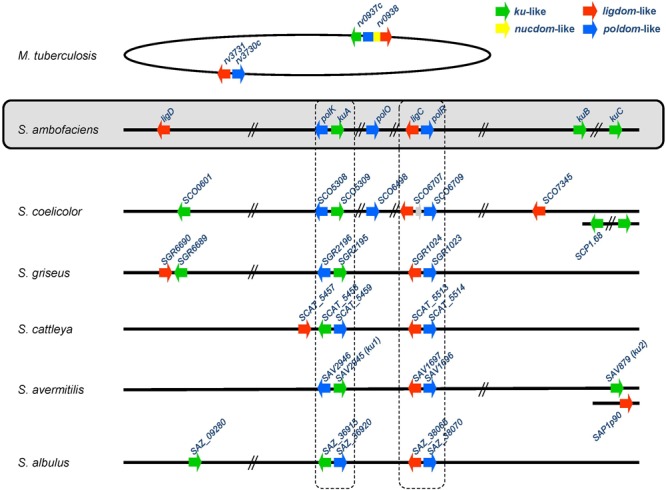
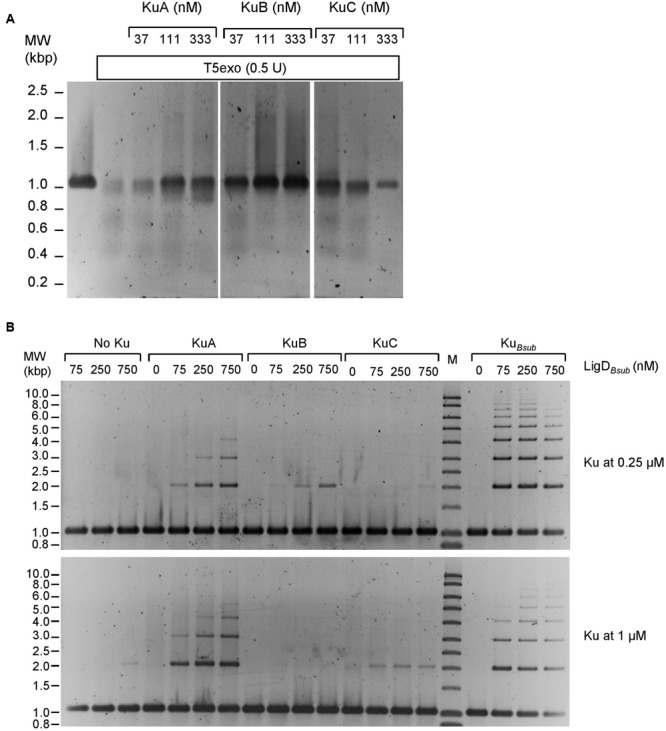
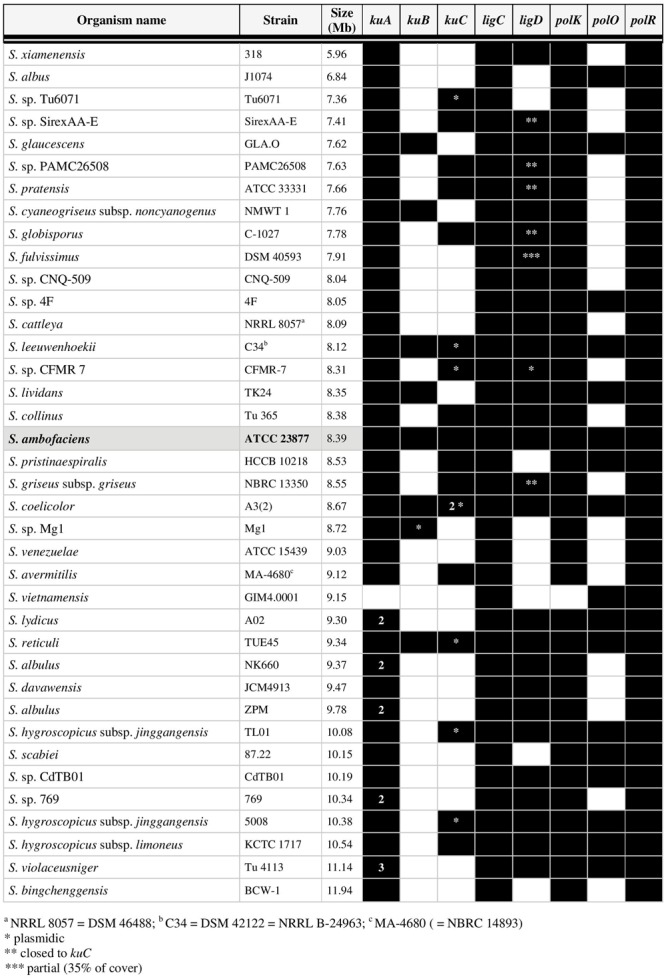
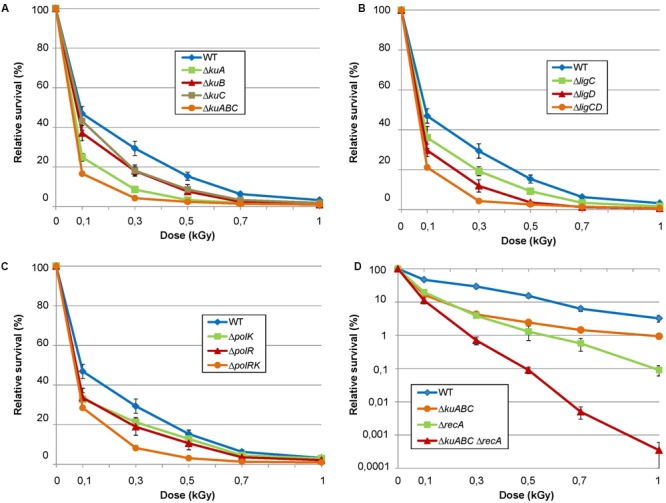
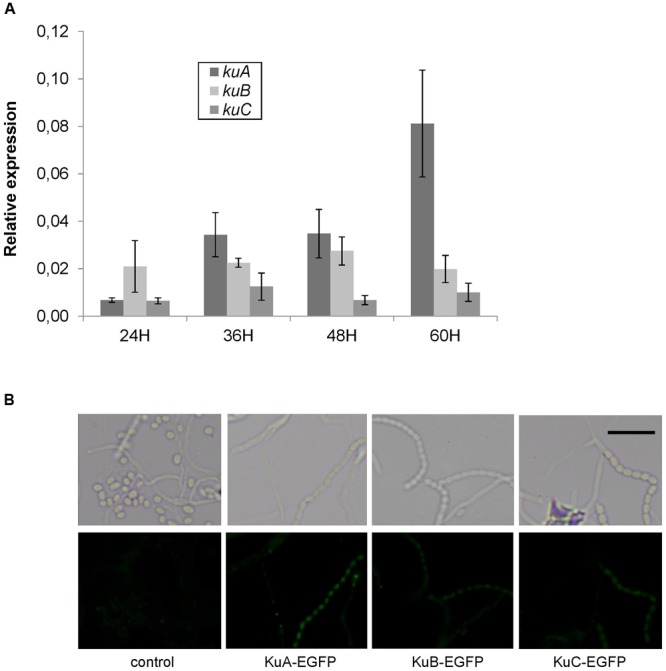
Non-homologous end-joining (NHEJ) is a double strand break (DSB) repair pathway which does not require any homologous template and can ligate two DNA ends together. The basic bacterial NHEJ machinery involves two partners: the Ku protein, a DNA end binding protein for DSB recognition and the multifunctional LigD protein composed a ligase, a nuclease and a polymerase domain, for end processing and ligation of the broken ends. analyses performed in the 38 sequenced genomes of species revealed the existence of a large panel of NHEJ-like genes. Indeed, genes or domain homologues are scattered throughout the genome in multiple copies and can be distinguished in two categories: the "core" NHEJ gene set constituted of conserved loci and the "variable" NHEJ gene set constituted of NHEJ-like genes present in only a part of the species. In ATCC23877, not only the deletion of "core" genes but also that of "variable" genes led to an increased sensitivity to DNA damage induced by electron beam irradiation. Multiple mutants of , ligase or polymerase encoding genes showed an aggravated phenotype compared to single mutants. Biochemical assays revealed the ability of Ku-like proteins to protect and to stimulate ligation of DNA ends. RT-qPCR and GFP fusion experiments suggested that -like genes show a growth phase dependent expression profile consistent with their involvement in DNA repair during spores formation and/or germination.
非同源末端连接(NHEJ)是一种双链断裂(DSB)修复途径,它不需要任何同源模板,能够将两个DNA末端连接在一起。基本的细菌NHEJ机制涉及两个伙伴:Ku蛋白,一种用于识别DSB的DNA末端结合蛋白;以及多功能LigD蛋白,它由连接酶、核酸酶和聚合酶结构域组成,用于断裂末端的加工和连接。对38个已测序物种基因组进行的分析揭示了大量类似NHEJ的基因的存在。实际上,基因或结构域同源物以多个拷贝分散在整个基因组中,可分为两类:由保守基因座组成的“核心”NHEJ基因集和仅存在于部分物种中的类似NHEJ基因组成的“可变”NHEJ基因集。在嗜热栖热菌ATCC23877中,不仅“核心”基因的缺失,而且“可变”基因的缺失都会导致对电子束照射诱导的DNA损伤的敏感性增加。连接酶或聚合酶编码基因的多个突变体与单个突变体相比表现出更严重的表型。生化分析揭示了类Ku蛋白保护和刺激DNA末端连接的能力。RT-qPCR和绿色荧光蛋白融合实验表明,类似基因呈现出与它们在孢子形成和/或萌发过程中参与DNA修复相一致的生长阶段依赖性表达谱。