Thabane Lehana, Hopewell Sally, Lancaster Gillian A, Bond Christine M, Coleman Claire L, Campbell Michael J, Eldridge Sandra M
Clinical Epidemiology and Biostatistics, McMaster University, Hamilton, Ontario Canada.
Oxford Clinical Trials Research Unit, Nuffield Department of Orthopaedics, Rheumatology and Musculoskeletal Sciences, University of Oxford, Oxford, UK.
Pilot Feasibility Stud. 2016 May 20;2:25. doi: 10.1186/s40814-016-0065-z. eCollection 2016.
Feasibility and pilot studies are essential components of planning or preparing for a larger randomized controlled trial (RCT). They are intended to provide useful information about the feasibility of the main RCT-with the goal of reducing uncertainty and thereby increasing the chance of successfully conducting the main RCT. However, research has shown that there are serious inadequacies in the reporting of pilot and feasibility studies. Reasons for this include a lack of explicit publication policies for pilot and feasibility studies in many journals, unclear definitions of what constitutes a pilot or feasibility RCT/study, and a lack of clarity in the objectives and methodological focus. All these suggest that there is an urgent need for new guidelines for reporting pilot and feasibility studies.
The aim of this paper is to describe the methods and processes in our development of an extension to the Consolidated Standards of Reporting Trials (CONSORT) Statement for reporting pilot and feasibility RCTs, that are executed in preparation for a future, more definitive RCT.
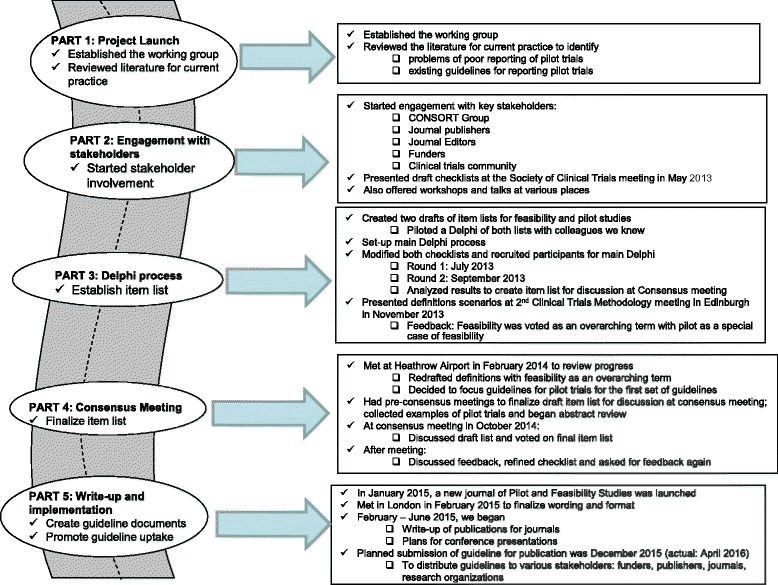
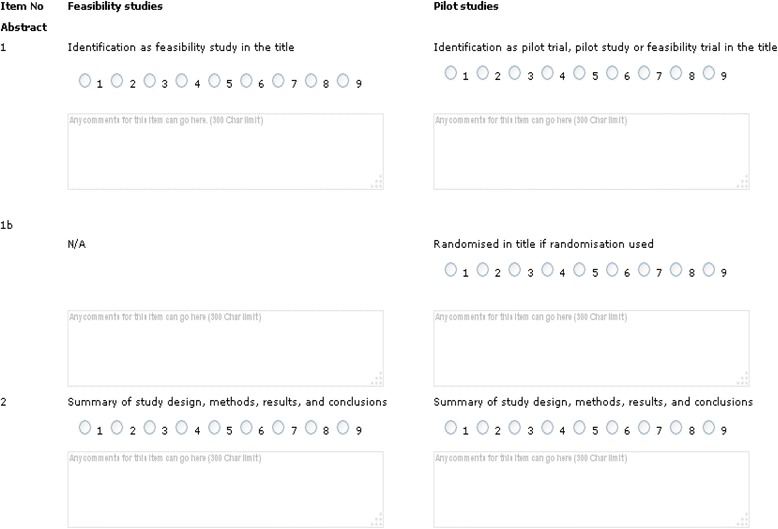
METHODS/DESIGN: There were five overlapping parts to the project: (i) -which involved establishing a working group and conducting a review of the literature; (ii) -which entailed consultation with the CONSORT group, journal editors and publishers, the clinical trials community, and funders; (iii) a -used to assess the agreement of experts on initial definitions and to generate a reporting checklist for pilot RCTs, based on the 2010 CONSORT statement extension applicable to reporting pilot studies; (iv) a -to discuss, add, remove, or modify checklist items, with input from experts in the field; and (v) which included a guideline document which gives an explanation and elaboration (E&E) and which will provide advice for each item, together with examples of good reporting practice. This final part also included a plan for dissemination and publication of the guideline.
We anticipate that implementation of our guideline will improve the reporting completeness, transparency, and quality of pilot RCTs, and hence benefit several constituencies, including authors of journal manuscripts, funding agencies, educators, researchers, and end-users.
可行性研究和预试验是规划或筹备大型随机对照试验(RCT)的重要组成部分。其目的是提供有关主要RCT可行性的有用信息,目标是减少不确定性,从而增加成功开展主要RCT的机会。然而,研究表明,预试验和可行性研究的报告存在严重不足。原因包括许多期刊缺乏针对预试验和可行性研究的明确发表政策、对什么构成预试验或可行性RCT/研究的定义不明确,以及目标和方法重点不清晰。所有这些都表明迫切需要新的预试验和可行性研究报告指南。
本文旨在描述我们制定《报告试验的统一标准》(CONSORT)声明扩展版的方法和过程,该扩展版用于报告为未来更具确定性的RCT做准备而进行的预试验和可行性RCT。
方法/设计:该项目有五个重叠部分:(i)——包括成立一个工作组并进行文献综述;(ii)——需要与CONSORT小组、期刊编辑和出版商、临床试验界以及资助者进行协商;(iii)——用于评估专家对初始定义的一致性,并根据适用于报告预试验的2010年CONSORT声明扩展版生成预试验RCT的报告清单;(iv)——在该部分中,根据该领域专家的意见讨论、添加、删除或修改清单项目;(v)——包括一份指南文件,该文件给出解释和阐述(E&E),并将为每个项目提供建议以及良好报告实践的示例。最后这部分还包括指南的传播和发表计划。
我们预计我们的指南的实施将提高预试验RCT的报告完整性、透明度和质量,从而使包括期刊稿件作者、资助机构、教育工作者、研究人员和最终用户在内的多个群体受益。