Zahedi Alireza, Monis Paul, Aucote Sarah, King Brendon, Paparini Andrea, Jian Fuchun, Yang Rongchang, Oskam Charlotte, Ball Andrew, Robertson Ian, Ryan Una
Vector and Waterborne Pathogen Research Group, School of Veterinary and Life Sciences, Murdoch University, Perth, Australia.
Australian Water Quality Centre, South Australian Water Corporation, Adelaide, Australia.
PLoS One. 2016 Dec 14;11(12):e0168169. doi: 10.1371/journal.pone.0168169. eCollection 2016.
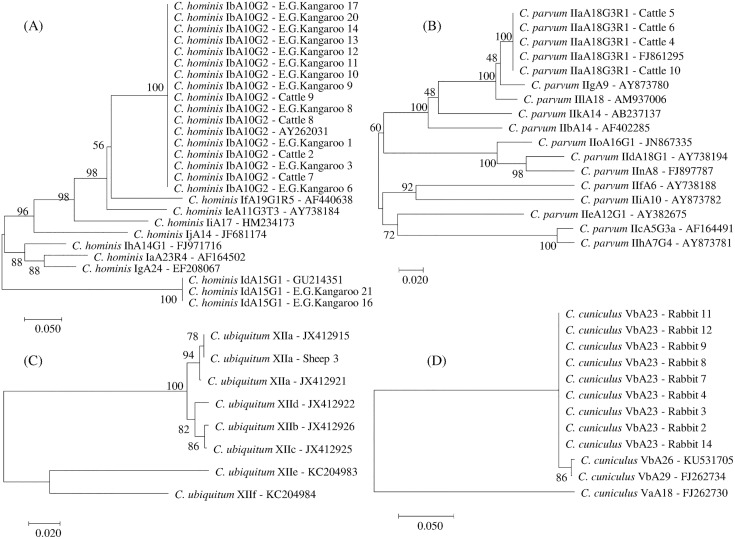
Cryptosporidium is one of the most common zoonotic waterborne parasitic diseases worldwide and represents a major public health concern of water utilities in developed nations. As animals in catchments can shed human-infectious Cryptosporidium oocysts, determining the potential role of animals in dissemination of zoonotic Cryptosporidium to drinking water sources is crucial. In the present study, a total of 952 animal faecal samples from four dominant species (kangaroos, rabbits, cattle and sheep) inhabiting Sydney's drinking water catchments were screened for the presence of Cryptosporidium using a quantitative PCR (qPCR) and positives sequenced at multiple loci. Cryptosporidium species were detected in 3.6% (21/576) of kangaroos, 7.0% (10/142) of cattle, 2.3% (3/128) of sheep and 13.2% (14/106) of rabbit samples screened. Sequence analysis of a region of the 18S rRNA locus identified C. macropodum and C. hominis in 4 and 17 isolates from kangaroos respectively, C. hominis and C. parvum in 6 and 4 isolates respectively each from cattle, C. ubiquitum in 3 isolates from sheep and C. cuniculus in 14 isolates from rabbits. All the Cryptosporidium species identified were zoonotic species with the exception of C. macropodum. Subtyping using the 5' half of gp60 identified C. hominis IbA10G2 (n = 12) and IdA15G1 (n = 2) in kangaroo faecal samples; C. hominis IbA10G2 (n = 4) and C. parvum IIaA18G3R1 (n = 4) in cattle faecal samples, C. ubiquitum subtype XIIa (n = 1) in sheep and C. cuniculus VbA23 (n = 9) in rabbits. Additional analysis of a subset of samples using primers targeting conserved regions of the MIC1 gene and the 3' end of gp60 suggests that the C. hominis detected in these animals represent substantial variants that failed to amplify as expected. The significance of this finding requires further investigation but might be reflective of the ability of this C. hominis variant to infect animals. The finding of zoonotic Cryptosporidium species in these animals may have important implications for the management of drinking water catchments to minimize risk to public health.
隐孢子虫病是全球最常见的人畜共患水源性寄生虫病之一,也是发达国家水务部门主要关注的公共卫生问题。由于集水区的动物可排出具有人感染性的隐孢子虫卵囊,因此确定动物在人畜共患隐孢子虫传播至饮用水源过程中的潜在作用至关重要。在本研究中,采用定量聚合酶链反应(qPCR)对悉尼饮用水集水区的4种优势物种(袋鼠、兔子、牛和羊)的952份动物粪便样本进行隐孢子虫检测,并对阳性样本进行多个位点测序。在所检测的袋鼠样本中,3.6%(21/576)检测到隐孢子虫;牛样本中,7.0%(10/142)检测到隐孢子虫;绵羊样本中,2.3%(3/128)检测到隐孢子虫;兔子样本中,13.2%(14/106)检测到隐孢子虫。对18S rRNA基因座区域进行序列分析,在袋鼠的4份和17份分离株中分别鉴定出大袋鼠隐孢子虫和人隐孢子虫;在牛的分离株中,分别有6份和4份鉴定为人隐孢子虫和微小隐孢子虫;在绵羊的3份分离株中鉴定出泛在隐孢子虫;在兔子的14份分离株中鉴定出兔隐孢子虫。除大袋鼠隐孢子虫外,所有鉴定出的隐孢子虫物种均为人畜共患病原体。利用gp60基因5'端进行亚型分析,在袋鼠粪便样本中鉴定出人隐孢子虫IbA10G2(n = 12)和IdA15G1(n = 2);在牛粪便样本中鉴定出人隐孢子虫IbA10G2(n = 4)和微小隐孢子虫IIaA18G3R1(n = 4);在绵羊中鉴定出泛在隐孢子虫XIIa亚型(n = 1);在兔子中鉴定出兔隐孢子虫VbA23(n = 9)。使用靶向MIC1基因保守区域和gp60基因3'端的引物对部分样本进行进一步分析,结果表明在这些动物中检测到的人隐孢子虫代表了未能按预期扩增的大量变体。这一发现的意义需要进一步研究,但可能反映了这种人隐孢子虫变体感染动物的能力。在这些动物中发现人畜共患隐孢子虫物种可能对饮用水集水区的管理具有重要意义,以将对公众健康的风险降至最低。