Maphis Nicole, Jiang Shanya, Xu Guixiang, Kokiko-Cochran Olga N, Roy Saktimayee M, Van Eldik Linda J, Watterson D Martin, Lamb Bruce T, Bhaskar Kiran
Department of Molecular Genetics and Microbiology, MSC08 4660, 1 University of New Mexico, University of New Mexico, Albuquerque, NM, 87131, USA.
Stark Neurosciences Research Institute, Indiana University, 320W 15th Street, NB Suite 414C, Indianapolis, IN, 46202, USA.
Alzheimers Res Ther. 2016 Dec 15;8(1):54. doi: 10.1186/s13195-016-0221-y.
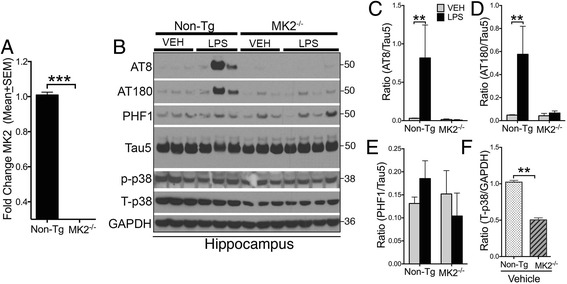
Hyperphosphorylation and aggregation of tau protein are the pathological hallmarks of Alzheimer's disease and related tauopathies. We previously demonstrated that the microglial activation induces tau hyperphosphorylation and cognitive impairment via activation of p38 mitogen-activated protein kinase (p38 MAPK) in the hTau mouse model of tauopathy that was deficient for microglial fractalkine receptor CX3CR1.
We report an isoform-selective, brain-permeable, and orally bioavailable small molecule inhibitor of p38α MAPK (MW181) and its effects on tau phosphorylation in vitro and in hTau mice.
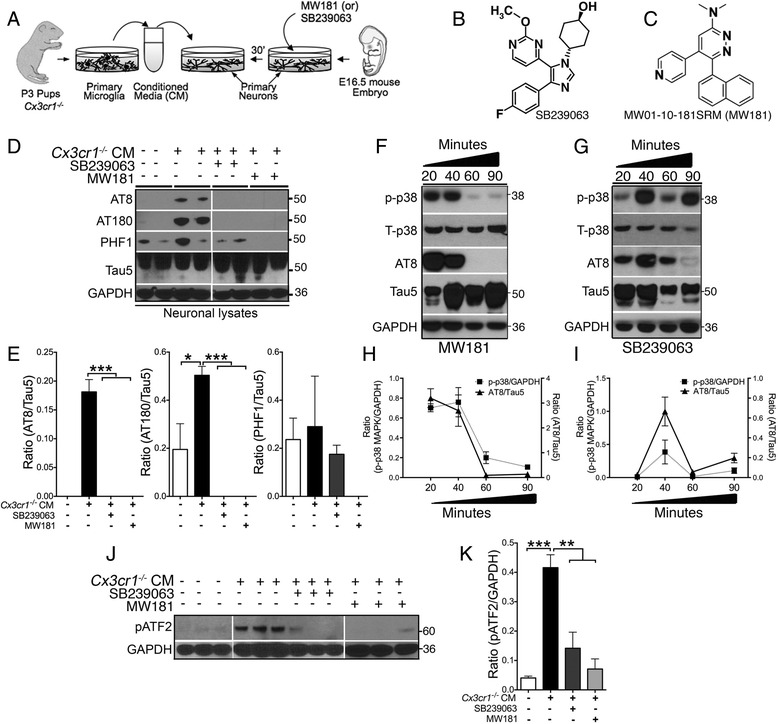
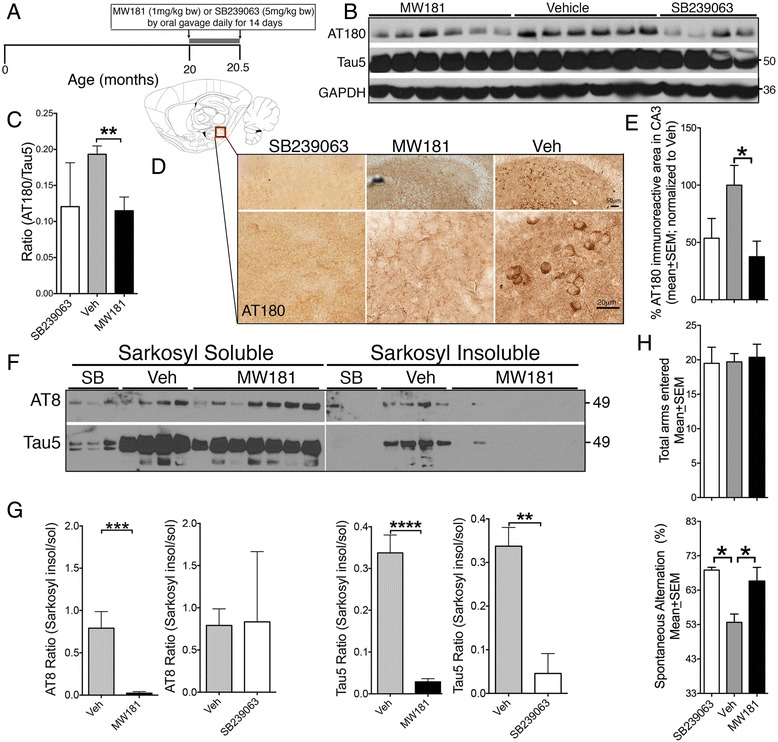
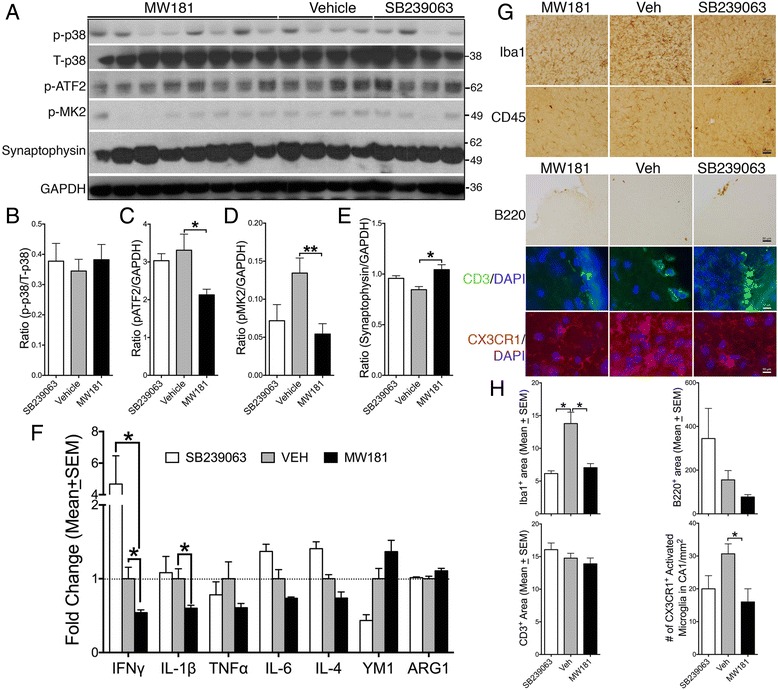
First, pretreatment of mouse primary cortical neurons with MW181 completely blocked inflammation-induced p38α MAPK activation and AT8 (pS199/pS202) site tau phosphorylation, with the maximum effect peaking at 60-90 min after stimulation. Second, treatment of old (~20 months of age) hTau mice with MW181 (1 mg/kg body weight; 14 days via oral gavage) significantly reduced p38α MAPK activation compared with vehicle-administered hTau mice. This also resulted in a significant reduction in AT180 (pT231) site tau phosphorylation and Sarkosyl-insoluble tau aggregates. Third, MW181 treatment significantly increased synaptophysin protein expression and resulted in improved working memory. Fourth, MW181 administration reduced phosphorylated MAPK-activated protein kinase 2 (pMK2) and phosphorylated activating transcription factor 2 (pATF2), which are known substrates of p38α MAPK. Finally, MW181 reduced the expression of interferon-γ and interleukin-1β.
Taken together, these studies support p38α MAPK as a valid therapeutic target for the treatment of tauopathies.
tau蛋白的过度磷酸化和聚集是阿尔茨海默病及相关tau蛋白病的病理特征。我们之前在小胶质细胞趋化因子受体CX3CR1缺陷的tau蛋白病hTau小鼠模型中证明,小胶质细胞激活通过p38丝裂原活化蛋白激酶(p38 MAPK)的激活诱导tau蛋白过度磷酸化和认知障碍。
我们报告了一种p38α MAPK的亚型选择性、脑渗透性且口服生物可利用的小分子抑制剂(MW181)及其在体外和hTau小鼠中对tau蛋白磷酸化的影响。
首先,用MW181预处理小鼠原代皮质神经元可完全阻断炎症诱导的p38α MAPK激活以及AT8(pS199/pS202)位点的tau蛋白磷酸化,最大效应在刺激后60 - 90分钟达到峰值。其次,用MW181(1毫克/千克体重;通过灌胃给药14天)处理老年(约20月龄)hTau小鼠,与给予赋形剂的hTau小鼠相比,显著降低了p38α MAPK的激活。这也导致AT180(pT231)位点的tau蛋白磷酸化和 Sarkosyl不溶性tau聚集体显著减少。第三,MW181处理显著增加了突触素蛋白表达,并改善了工作记忆。第四,MW181给药降低了磷酸化的MAPK激活蛋白激酶2(pMK2)和磷酸化的激活转录因子2(pATF2),它们是p38α MAPK的已知底物。最后,MW181降低了干扰素-γ和白细胞介素-1β的表达。
综上所述,这些研究支持p38α MAPK作为治疗tau蛋白病的有效治疗靶点。