Wang Mengyun, Li Qiaoxin, Gu Chengyuan, Zhu Yao, Yang Yajun, Wang Jiucun, Jin Li, He Jing, Ye Dingwei, Wei Qingyi
Cancer Institute, Collaborative Innovation Center for Cancer Medicine, Fudan University Shanghai Cancer Center, Shanghai, China.
Department of Oncology, Shanghai Medical College, Fudan University, Shanghai, China.
Oncotarget. 2017 Apr 11;8(15):24362-24371. doi: 10.18632/oncotarget.13848.
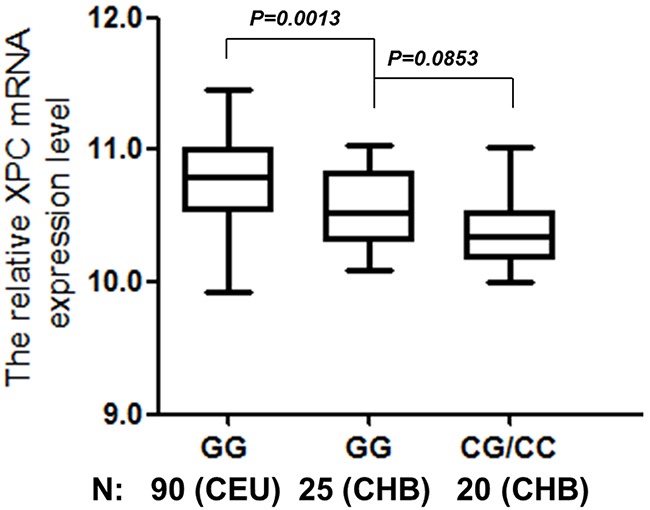
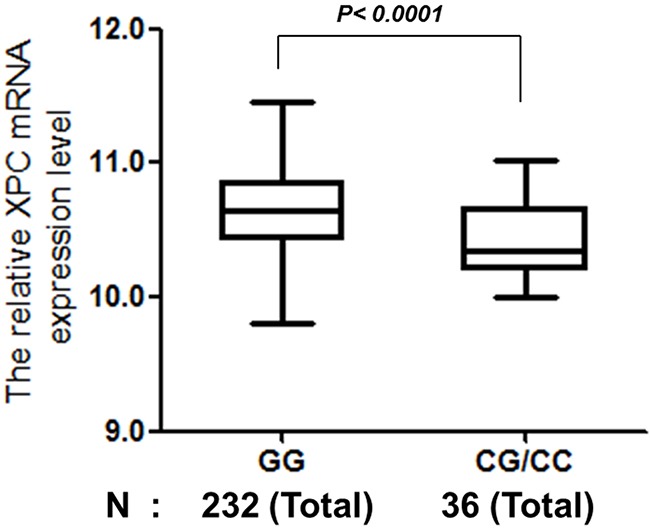
Genetic variants of nucleotide excision repair (NER) genes have been extensively investigated for their roles in the development of prostate cancer (PCa); however, the published results have been inconsistent. In a hospital-based case-control study of 1,004 PCa cases and 1,055 cancer-free controls, we genotyped eight potentially functional single nucleotide polymorphisms (SNPs) of NER genes (i.e., XPC, rs2228001 T>G and rs1870134 G>C; XPD, rs13181 T>G and rs238406 G>T; XPG, rs1047768 T>C, rs751402 C>T, and rs17655 G>C; and XPF, rs2276464 G>C) and assessed their associations with risk of PCa by using logistic regression analysis. Among these eight SNPs investigated, only XPC rs1870134 CG/CC variant genotypes were associated with a decreased risk of prostate cancer under a dominant genetic model (adjusted odds ratio [OR] = 0.77, 95% confidence interval [CI] = 0.64-1.91, P = 0.003). Phenotype-genotype analysis also suggested that the XPC rs1870134 CG/CC variant genotypes were associated with significantly decreased expression levels of XPC mRNA in a mix population of different ethnicities. These findings suggested that XPC SNPs may contribute to risk of PCa in Eastern Chinese men.
核苷酸切除修复(NER)基因的遗传变异在前列腺癌(PCa)发生发展中的作用已得到广泛研究;然而,已发表的结果并不一致。在一项基于医院的病例对照研究中,我们纳入了1004例PCa患者和1055例无癌对照,对NER基因的8个潜在功能性单核苷酸多态性(SNP)进行基因分型(即XPC基因的rs2228001 T>G和rs1870134 G>C;XPD基因的rs13181 T>G和rs238406 G>T;XPG基因的rs1047768 T>C、rs751402 C>T和rs17655 G>C;以及XPF基因的rs2276464 G>C),并采用逻辑回归分析评估它们与PCa风险的关联。在这8个研究的SNP中,在显性遗传模型下,仅XPC基因的rs1870134 CG/CC变异基因型与前列腺癌风险降低相关(校正比值比[OR]=0.77,95%置信区间[CI]=0.64 - 1.91,P = 0.003)。表型-基因型分析还表明,在不同种族混合人群中,XPC基因的rs1870134 CG/CC变异基因型与XPC mRNA表达水平显著降低相关。这些发现提示XPC基因的SNP可能影响中国东部男性患PCa的风险。