Michishita Ryoma, Jiang Ying, Ariyoshi Daisuke, Yoshida Marie, Moriyama Hideko, Yamato Hiroshi
Department of Health Development, Institute of Industrial Ecological Sciences, University of Occupational and Environmental Health.
J Occup Health. 2017 Mar 28;59(2):122-130. doi: 10.1539/joh.16-0182-OA. Epub 2016 Dec 15.
This study was designed to clarify the effects of active rest, with a focus on the practice of short-time group exercise by workplace units, on personal relationships, mental health, physical activity, and work ability among workers.
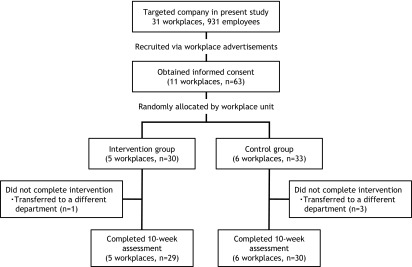
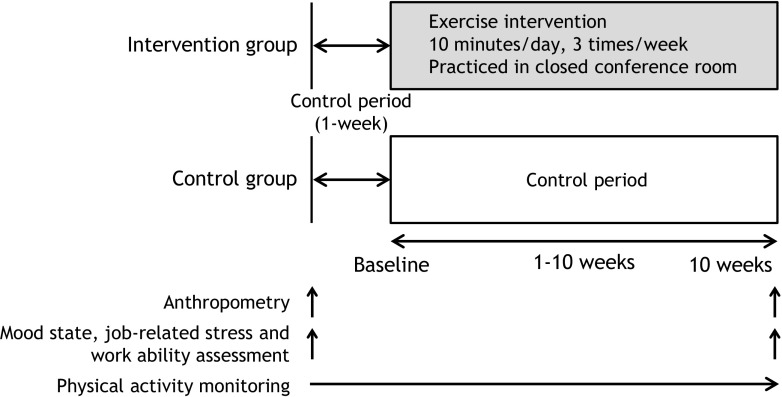
Fifty-nine white-collar workers (40 males and 19 females) performed our active rest (short-time exercise) program, which consists of warm-up, cognitive functional training, aerobic exercise, resistance training and cool-down for 10 minutes per day, 3 times per week during their lunch breaks for 10 weeks. Participants from a workplace unit were randomly allocated to the intervention (five workplaces, n=29) or control groups (six workplaces, n=30). The participants' anthropometric measurements, and their Profile of Mood States (POMS) 2, Brief Job Stress Questionnaire (BJSQ), physical activity levels and Work Ability Index were examined at the baseline and after the 10-week intervention.
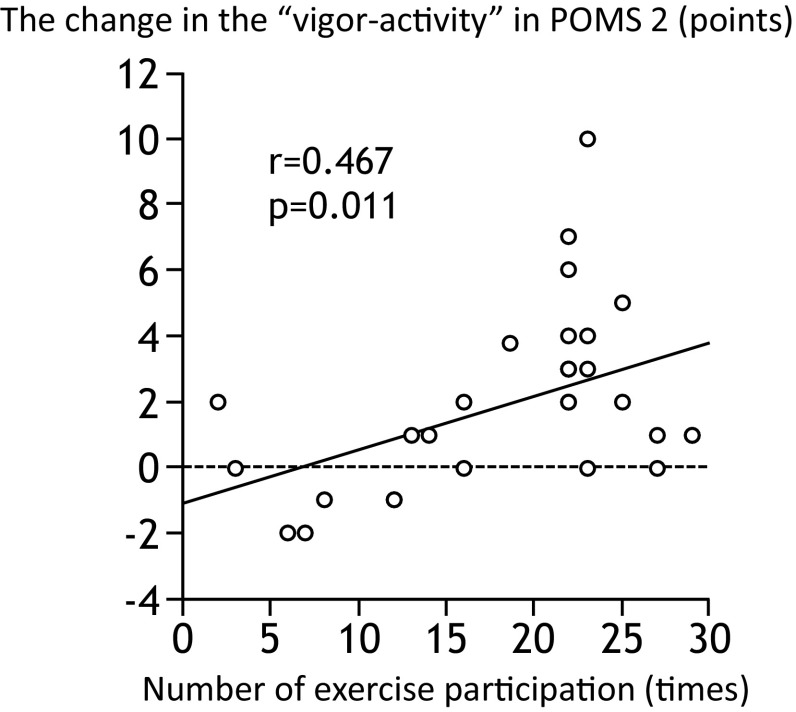
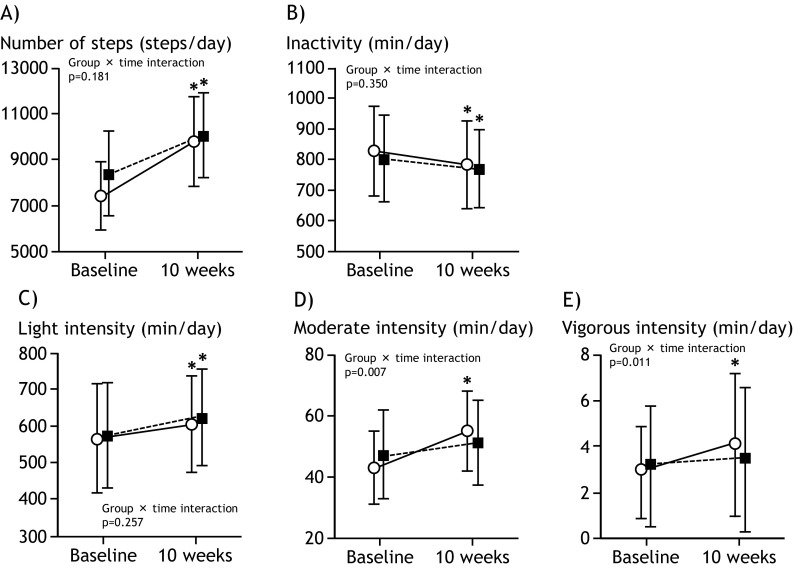
After 10 weeks, physical activity levels, especially the time spent in moderate and vigorous intensity, increased in the intervention group (p<0.05). The items of "vigor-activity" and "friendliness" improved in POMS 2, while "vigor," "interpersonal stress," "support from superiors, colleagues, and family/friends," and "job satisfaction" improved in BJSQ in the intervention group (p<0.05). In the intervention group, the number of exercise participation was positively correlated with the change in "vigor-activity" in POMS 2 (r=0.467, p=0.011).
These results suggest that the practice of active rest by workplace units is important for improving personal relationships, mental health, and physical activity among workers.
本研究旨在阐明以工作单位进行短时间集体锻炼为重点的积极休息对员工人际关系、心理健康、身体活动和工作能力的影响。
59名白领员工(40名男性和19名女性)参与了我们的积极休息(短时间锻炼)计划,该计划包括热身、认知功能训练、有氧运动、阻力训练和放松活动,每天10分钟,每周3次,在午餐休息时间进行,为期10周。来自一个工作单位的参与者被随机分配到干预组(5个工作场所,n = 29)或对照组(6个工作场所,n = 30)。在基线和10周干预后,对参与者进行人体测量,并检查他们的情绪状态量表(POMS)2、简短工作压力问卷(BJSQ)、身体活动水平和工作能力指数。
10周后,干预组的身体活动水平,尤其是中等强度和高强度活动所花费的时间有所增加(p < 0.05)。干预组的POMS 2中“活力 - 活动”和“友好性”项目有所改善,而BJSQ中的“活力”、“人际压力”、“上级、同事和家人/朋友的支持”以及“工作满意度”有所改善(p < 0.05)。在干预组中,锻炼参与次数与POMS 2中“活力 - 活动”的变化呈正相关(r = 0.467,p = 0.011)。
这些结果表明,工作单位进行积极休息对改善员工的人际关系、心理健康和身体活动很重要。