Kreyberg Ina, Bains Karen E S, Carlsen Kai-H, Granum Berit, Gudmundsdóttir Hrefna K, Haugen Guttorm, Hedlin Gunilla, Hilde Katarina, Jonassen Christine M, Nordhagen Live S, Nordlund Björn, Sjøborg Katrine D, Skjerven Håvard O, Staff Anne C, Söderhäll Cilla, Vettukatil Riyas M, Lødrup Carlsen Karin C
Faculty of Medicine, Institute of Clinical Medicine, University of Oslo, Oslo, Norway.
Division of Paediatric and Adolescent Medicine, Oslo University Hospital, Oslo, Norway.
ERJ Open Res. 2019 Apr 8;5(2). doi: 10.1183/23120541.00197-2018. eCollection 2019 Apr.
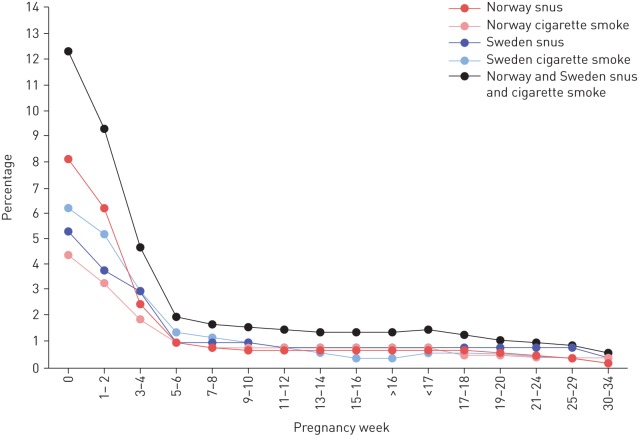
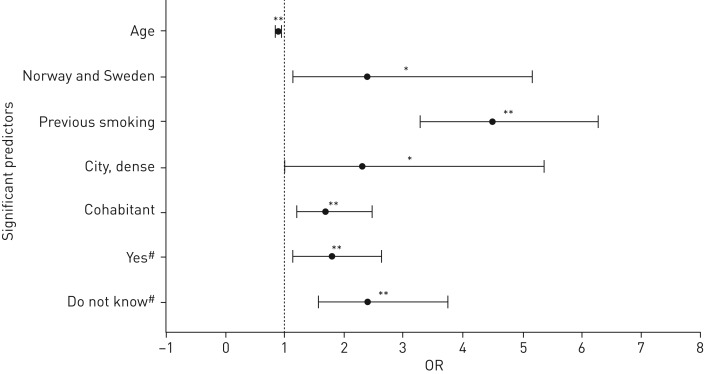
In young women, the use of snus increases in parallel with decreasing smoking rates but the use in pregnancy is unclear. Our aims were to determine the prevalence of snus use, smoking and other nicotine-containing product use during pregnancy, and to identify predictors for snus use in pregnancy. Prevalence was determined for 2528 women in Norway and Sweden based on the Preventing Atopic Dermatitis and ALLergies (PreventADALL) study, a population-based, mother-child birth cohort. Electronic questionnaires were completed in pregnancy week 18 and/or week 34, and potential predictors of snus use were analysed using logistic regression models. Ever use of any snus, tobacco or nicotine-containing products was reported by 35.7% of women, with similar rates of snus use (22.5%) and smoking (22.6%). Overall, 11.3% of women reported any use of nicotine-containing products in pregnancy up to 34 weeks, most often snus alone (6.5%). Most women (87.2%) stopped using snus by week 6 of pregnancy. Snus use in pregnancy was inversely associated with age and positively associated with urban living and personal or maternal history of smoking. While 11.3% of women used snus or other nicotine-containing products at some time, most stopped when recognising their pregnancy. Younger, urban living, previously smoking women were more likely to use snus in pregnancy.
在年轻女性中,口含烟的使用量随着吸烟率的下降而增加,但孕期口含烟的使用情况尚不清楚。我们的目的是确定孕期口含烟、吸烟及其他含尼古丁产品的使用情况,并找出孕期使用口含烟的预测因素。基于预防特应性皮炎和过敏症(PreventADALL)研究(一项基于人群的母婴出生队列研究),对挪威和瑞典的2528名女性的患病率进行了测定。在妊娠第18周和/或第34周完成电子问卷调查,并使用逻辑回归模型分析口含烟使用的潜在预测因素。35.7%的女性报告曾使用过任何口含烟、烟草或含尼古丁产品,口含烟使用率(22.5%)和吸烟率(22.6%)相近。总体而言,11.3%的女性报告在妊娠34周前的孕期曾使用过含尼古丁产品,最常见的是仅使用口含烟(6.5%)。大多数女性(87.2%)在妊娠第6周前停止使用口含烟。孕期口含烟的使用与年龄呈负相关,与城市居住情况以及个人或母亲吸烟史呈正相关。虽然11.3%的女性在某些时候使用过口含烟或其他含尼古丁产品,但大多数人在意识到自己怀孕后就停止使用了。年龄较小、居住在城市、之前吸烟的女性在孕期更有可能使用口含烟。