Alund Alexander W, Mercer Kelly E, Pulliam Casey F, Suva Larry J, Chen Jin-Ran, Badger Thomas M, Ronis Martin J J
Arkansas Children's Nutrition Center, University of Arkansas for Medical Sciences, Little Rock, Arkansas.
Interdisciplinary Biomedical Sciences, University of Arkansas for Medical Sciences, Little Rock, Arkansas.
Alcohol Clin Exp Res. 2017 Jan;41(1):46-56. doi: 10.1111/acer.13284. Epub 2016 Dec 17.
Chronic alcohol consumption leads to increased fracture risk and an elevated risk of osteoporosis by decreasing bone accrual through increasing osteoclast activity and decreasing osteoblast activity. We have shown that this mechanism involves the generation of reactive oxygen species (ROS) produced by NADPH oxidases. It was hypothesized that different dietary antioxidants, N-acetyl cysteine (NAC; 1.2 mg/kg/d), and α-tocopherol (Vit.E; 60 mg/kg/d) would be able to attenuate the NADPH oxidase-mediated ROS effects on bone due to chronic alcohol intake.
To study the effects of these antioxidants, female mice received a Lieber-DeCarli liquid diet containing ethanol (EtOH) with or without additional antioxidant for 8 weeks.
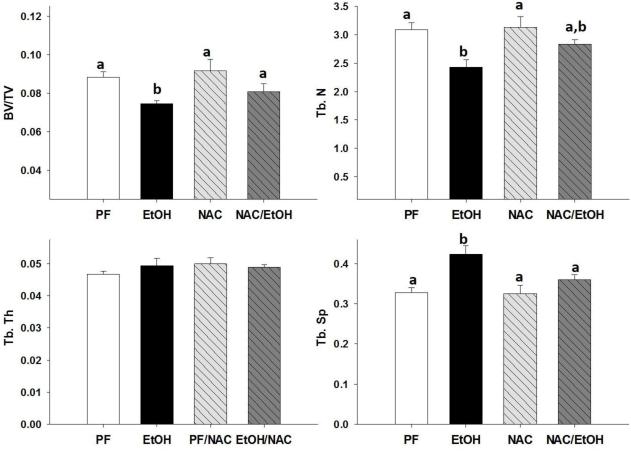
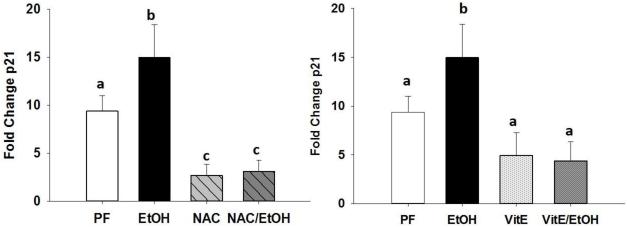
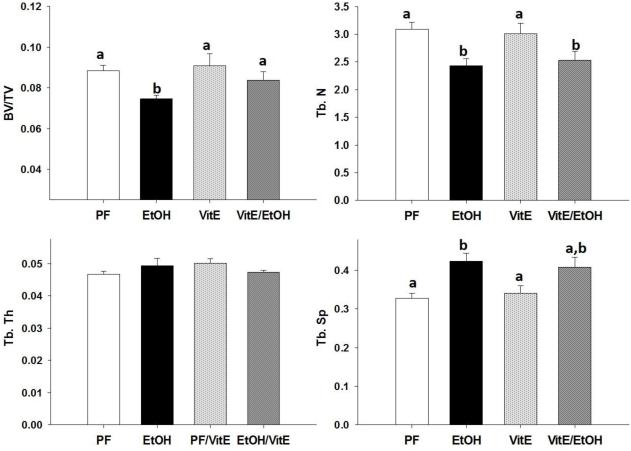
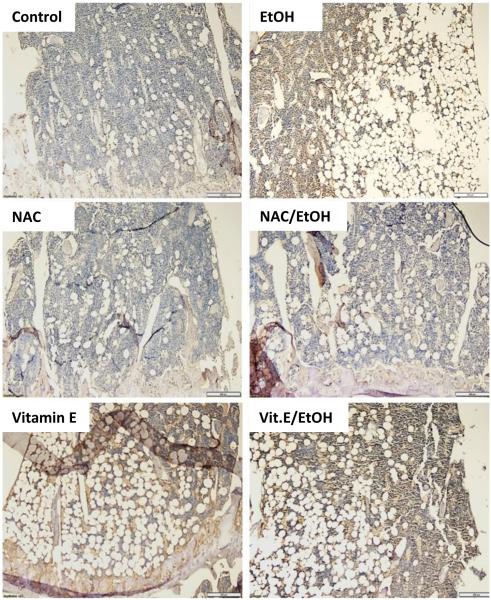
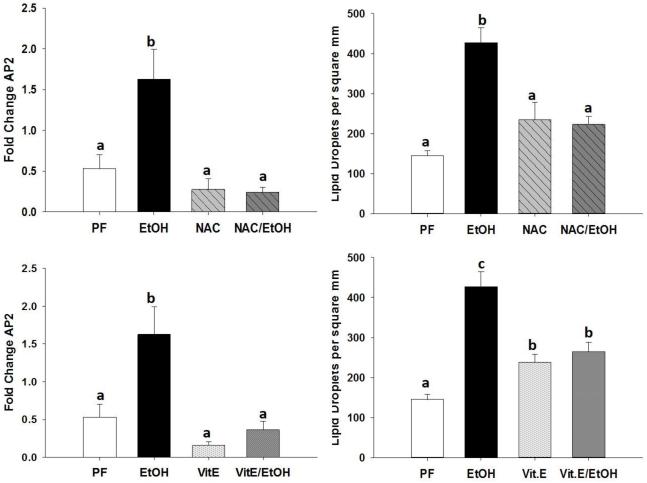
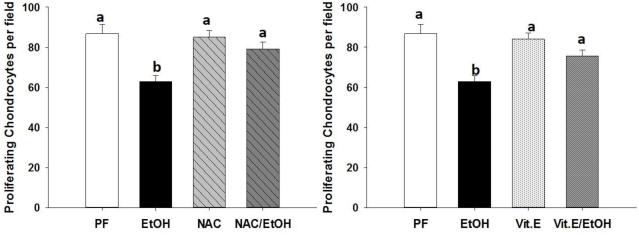
Tibias displayed decreased cortical bone mineral density in both the EtOH and EtOH + antioxidant groups compared to pair-fed (PF) and PF + antioxidant groups (p < 0.05). However, there was significant protection from trabecular bone loss in mice fed either antioxidant (p < 0.05). Microcomputed tomography analysis demonstrated a significant decrease in bone volume (bone volume/tissue volume) and trabecular number (p < 0.05), along with a significant increase in trabecular separation in the EtOH compared to PF (p < 0.05). In contrast, the EtOH + NAC and EtOH + Vit.E did not statistically differ from their respective PF controls. Ex vivo histologic sections of tibias were stained for nitrotyrosine, an indicator of intracellular damage by ROS, and tibias from mice fed EtOH exhibited significantly more staining than PF controls. EtOH treatment significantly increased the number of marrow adipocytes per mm as well as mRNA expression of aP2, an adipocyte marker in bone. Only NAC was able to reduce the number of marrow adipocytes to PF levels. EtOH-fed mice exhibited reduced bone length (p < 0.05) and had a reduced number of proliferating chondrocytes within the growth plate. NAC and Vit.E prevented this (p < 0.05).
These data show that alcohol's pathological effects on bone extend beyond decreasing bone mass and suggest a partial protective effect of the dietary antioxidants NAC and Vit.E at these doses with regard to alcohol effects on bone turnover and bone morphology.
长期饮酒会增加骨折风险,并通过增加破骨细胞活性和降低成骨细胞活性来减少骨量积累,从而提高骨质疏松症的风险。我们已经表明,这种机制涉及由烟酰胺腺嘌呤二核苷酸磷酸(NADPH)氧化酶产生的活性氧(ROS)。据推测,不同的膳食抗氧化剂,N-乙酰半胱氨酸(NAC;1.2毫克/千克/天)和α-生育酚(维生素E;60毫克/千克/天)能够减轻NADPH氧化酶介导的ROS对因长期饮酒而导致的骨骼的影响。
为了研究这些抗氧化剂的作用,雌性小鼠接受含有乙醇(EtOH)的Lieber-DeCarli液体饮食,持续8周,其中一组添加了抗氧化剂,另一组未添加。
与配对喂养(PF)组和PF +抗氧化剂组相比,EtOH组和EtOH +抗氧化剂组的胫骨皮质骨矿物质密度均降低(p <0.05)。然而,喂食任何一种抗氧化剂的小鼠的小梁骨丢失都得到了显著的保护(p <0.05)。微计算机断层扫描分析表明,与PF组相比,EtOH组的骨体积(骨体积/组织体积)和小梁数量显著减少(p <0.05),小梁间距显著增加(p <0.05)。相比之下,EtOH + NAC组和EtOH +维生素E组与各自的PF对照组在统计学上没有差异。胫骨的离体组织学切片用硝基酪氨酸染色,硝基酪氨酸是ROS细胞内损伤的指标,喂食EtOH的小鼠的胫骨染色明显多于PF对照组。EtOH处理显著增加了每毫米骨髓脂肪细胞的数量以及骨中脂肪细胞标志物aP2的mRNA表达。只有NAC能够将骨髓脂肪细胞的数量减少到PF组的水平。喂食EtOH的小鼠的骨长度缩短(p <0.05),生长板内增殖软骨细胞的数量减少。NAC和维生素E可防止这种情况(p <0.05)。
这些数据表明,酒精对骨骼的病理影响不仅仅是降低骨量,还表明在这些剂量下,膳食抗氧化剂NAC和维生素E对酒精对骨转换和骨形态的影响具有部分保护作用。