Burton Anya, Byrnes Graham, Stone Jennifer, Tamimi Rulla M, Heine John, Vachon Celine, Ozmen Vahit, Pereira Ana, Garmendia Maria Luisa, Scott Christopher, Hipwell John H, Dickens Caroline, Schüz Joachim, Aribal Mustafa Erkin, Bertrand Kimberly, Kwong Ava, Giles Graham G, Hopper John, Pérez Gómez Beatriz, Pollán Marina, Teo Soo-Hwang, Mariapun Shivaani, Taib Nur Aishah Mohd, Lajous Martín, Lopez-Riduara Ruy, Rice Megan, Romieu Isabelle, Flugelman Anath Arzee, Ursin Giske, Qureshi Samera, Ma Huiyan, Lee Eunjung, Sirous Reza, Sirous Mehri, Lee Jong Won, Kim Jisun, Salem Dorria, Kamal Rasha, Hartman Mikael, Miao Hui, Chia Kee-Seng, Nagata Chisato, Vinayak Sudhir, Ndumia Rose, van Gils Carla H, Wanders Johanna O P, Peplonska Beata, Bukowska Agnieszka, Allen Steve, Vinnicombe Sarah, Moss Sue, Chiarelli Anna M, Linton Linda, Maskarinec Gertraud, Yaffe Martin J, Boyd Norman F, Dos-Santos-Silva Isabel, McCormack Valerie A
Section of Environment and Radiation, International Agency for Research on Cancer, 150 cours Albert Thomas, 69372, Lyon, Cedex 09, France.
Centre for Genetic Origins of Health and Disease, Curtin University and the University of Western Australia, Perth, Australia.
Breast Cancer Res. 2016 Dec 19;18(1):130. doi: 10.1186/s13058-016-0787-0.
Inter-women and intra-women comparisons of mammographic density (MD) are needed in research, clinical and screening applications; however, MD measurements are influenced by mammography modality (screen film/digital) and digital image format (raw/processed). We aimed to examine differences in MD assessed on these image types.
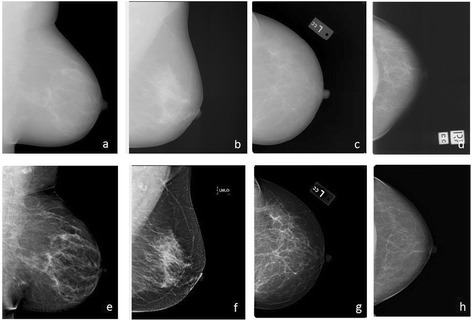
We obtained 1294 pairs of images saved in both raw and processed formats from Hologic and General Electric (GE) direct digital systems and a Fuji computed radiography (CR) system, and 128 screen-film and processed CR-digital pairs from consecutive screening rounds. Four readers performed Cumulus-based MD measurements (n = 3441), with each image pair read by the same reader. Multi-level models of square-root percent MD were fitted, with a random intercept for woman, to estimate processed-raw MD differences.
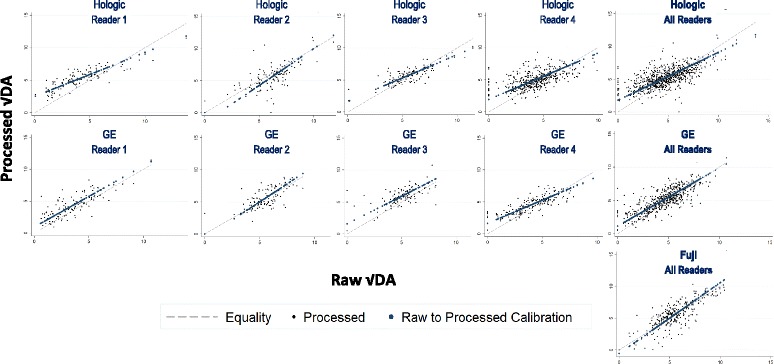
Breast area did not differ in processed images compared with that in raw images, but the percent MD was higher, due to a larger dense area (median 28.5 and 25.4 cm respectively, mean √dense area difference 0.44 cm (95% CI: 0.36, 0.52)). This difference in √dense area was significant for direct digital systems (Hologic 0.50 cm (95% CI: 0.39, 0.61), GE 0.56 cm (95% CI: 0.42, 0.69)) but not for Fuji CR (0.06 cm (95% CI: -0.10, 0.23)). Additionally, within each system, reader-specific differences varied in magnitude and direction (p < 0.001). Conversion equations revealed differences converged to zero with increasing dense area. MD differences between screen-film and processed digital on the subsequent screening round were consistent with expected time-related MD declines.
MD was slightly higher when measured on processed than on raw direct digital mammograms. Comparisons of MD on these image formats should ideally control for this non-constant and reader-specific difference.
在研究、临床及筛查应用中,需要对女性之间以及女性个体内部的乳腺X线密度(MD)进行比较;然而,MD测量受乳腺X线摄影方式(屏-片/数字)及数字图像格式(原始/处理后)的影响。我们旨在研究这些图像类型上评估的MD差异。
我们从Hologic和通用电气(GE)直接数字系统以及富士计算机X线摄影(CR)系统中获取了1294对以原始和处理后格式保存的图像,以及来自连续筛查轮次的128对屏-片和处理后的CR-数字图像。四位阅片者进行基于积云的MD测量(n = 3441),每对图像由同一位阅片者阅读。对平方根百分比MD拟合多级模型,对女性采用随机截距,以估计处理后-原始MD差异。
与原始图像相比,处理后图像的乳房面积无差异,但MD百分比更高,这是由于致密面积更大(中位数分别为28.5和25.4平方厘米,致密面积平均差异的平方根为0.44厘米(95%可信区间:0.36,0.52))。这种致密面积平方根的差异在直接数字系统中显著(Hologic为0.50厘米(95%可信区间:0.39,0.61),GE为0.56厘米(95%可信区间:0.42,0.69)),但在富士CR系统中不显著(0.06厘米(95%可信区间:-0.10,0.23))。此外,在每个系统内,阅片者特异性差异在大小和方向上各不相同(p < 0.001)。转换方程显示,差异随着致密面积的增加而趋于零。后续筛查轮次中屏-片和处理后数字图像之间的MD差异与预期的与时间相关的MD下降一致。
在处理后的直接数字乳腺X线摄影上测量的MD略高于原始图像。在这些图像格式上进行MD比较时,理想情况下应控制这种非恒定且阅片者特异性的差异。