Savchenko Ekaterina, Malm Tarja, Konttinen Henna, Hämäläinen Riikka H, Guerrero-Toro Cindy, Wojciechowski Sara, Giniatullin Rashid, Koistinaho Jari, Magga Johanna
Department of Neurobiology, A.I.Virtanen Institute for Molecular Sciences, University of Eastern Finland Kuopio, Finland.
Department of Neurobiology, A.I.Virtanen Institute for Molecular Sciences, University of Eastern FinlandKuopio, Finland; Department of Pharmacology and Toxicology, Research Unit of Biomedicine, University of OuluOulu, Finland.
Front Cell Neurosci. 2016 Dec 5;10:279. doi: 10.3389/fncel.2016.00279. eCollection 2016.
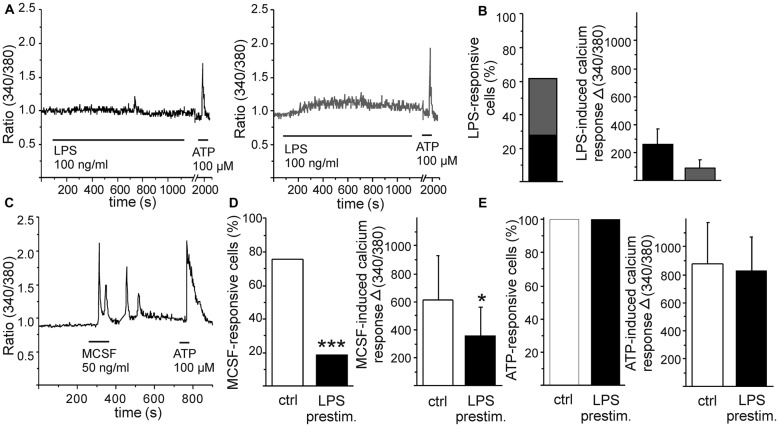
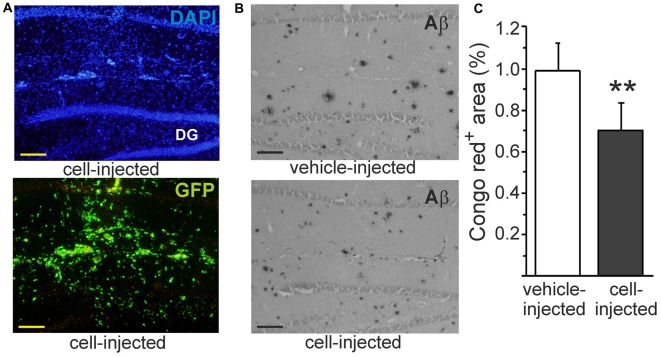
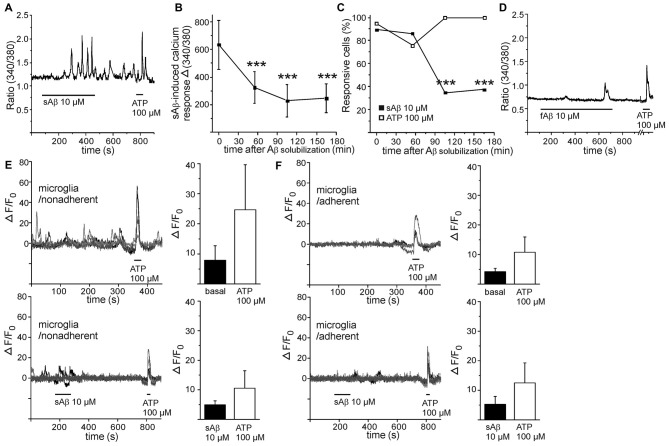
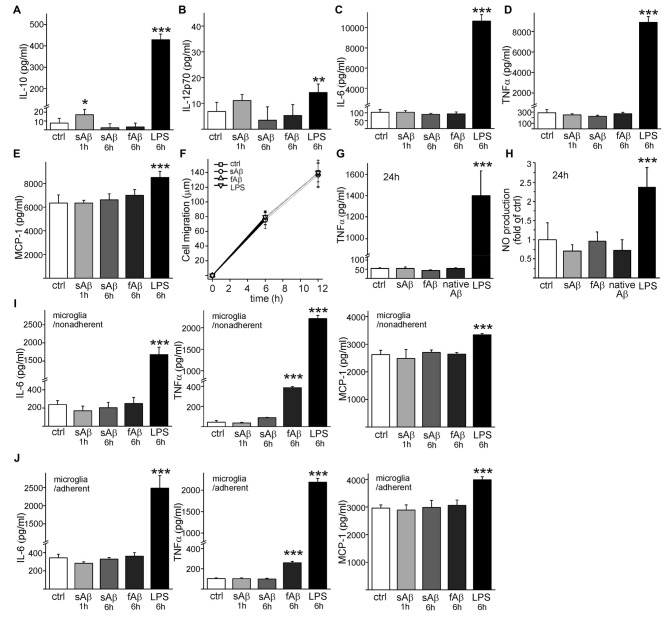
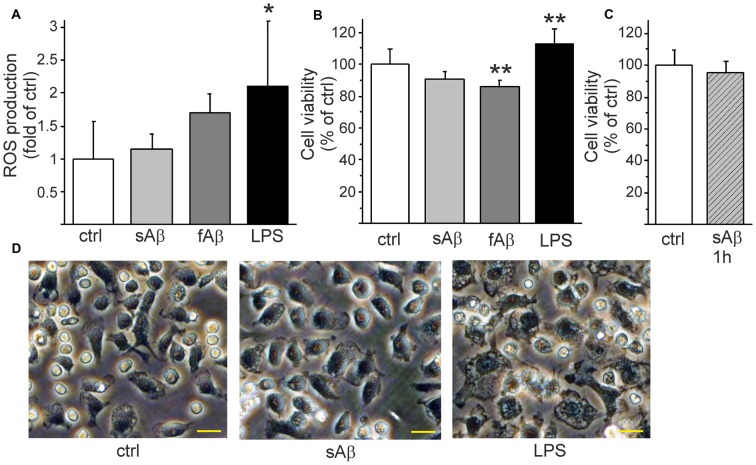
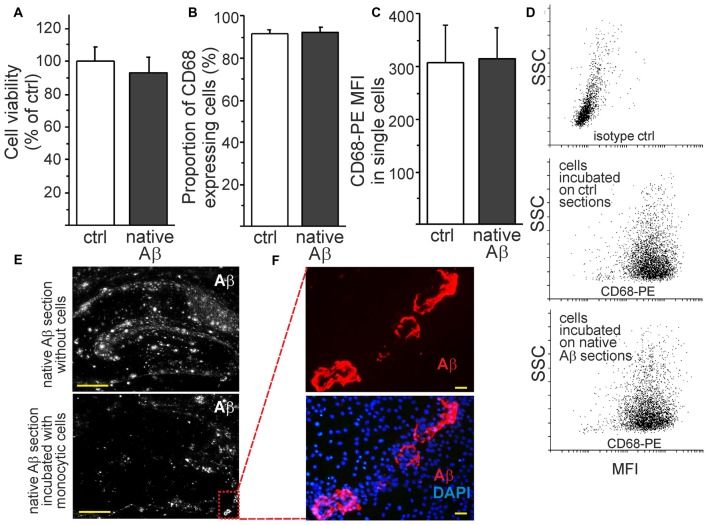
: Accumulation of amyloid β (Aβ) is one of the main hallmarks of Alzheimer's disease (AD). The enhancement of Aβ clearance may provide therapeutic means to restrict AD pathology. The cellular responses to different forms of Aβ in monocytic cells are poorly known. We aimed to study whether different forms of Aβ induce inflammatory responses in monocytic phagocytes and how Aβ may affect monocytic cell survival and function to retain phagocytosis in Aβ-laden environment. : Monocytic cells were differentiated from bone marrow hematopoietic stem cells (HSC) in the presence of macrophage-colony stimulating factor. Monocytic cells were stimulated with synthetic Aβ42 and intracellular calcium responses were recorded with calcium imaging. The formation of reactive oxygen species (ROS), secretion of cytokines and cell viability were also assessed. Finally, monocytic cells were introduced to native Aβ deposits and the cellular responses in terms of cell viability, pro-inflammatory activation and phagocytosis were determined. The ability of monocytic cells to phagocytose Aβ plaques was determined after intrahippocampal transplantation . : Freshly solubilized Aβ induced calcium oscillations, which persisted after removal of the stimulus. After few hours of aggregation, Aβ was not able to induce oscillations in monocytic cells. Instead, lipopolysaccharide (LPS) induced calcium responses divergent from Aβ-induced response. Furthermore, while LPS induced massive production of pro-inflammatory cytokines, neither synthetic Aβ species nor native Aβ deposits were able to induce pro-inflammatory activation of monocytic cells, contrary to primary microglia. Finally, monocytic cells retained their viability in the presence of Aβ and exhibited phagocytic activity towards native fibrillar Aβ deposits and congophilic Aβ plaques. : Monocytic cells carry diverse cellular responses to Aβ and inflammatory stimulus LPS. Even though Aβ species cause specific responses in calcium signaling, they completely lack the ability to induce pro-inflammatory phenotype of monocytic cells. Monocytes retain their viability and function in Aβ-laden brain.
淀粉样β蛋白(Aβ)的积累是阿尔茨海默病(AD)的主要标志之一。增强Aβ清除率可能为限制AD病理过程提供治疗手段。单核细胞对不同形式Aβ的细胞反应鲜为人知。我们旨在研究不同形式的Aβ是否会在单核吞噬细胞中诱导炎症反应,以及Aβ如何影响单核细胞的存活和功能,以便在富含Aβ的环境中保持吞噬作用。
单核细胞在巨噬细胞集落刺激因子存在的情况下从骨髓造血干细胞(HSC)分化而来。用合成Aβ42刺激单核细胞,并用钙成像记录细胞内钙反应。还评估了活性氧(ROS)的形成、细胞因子的分泌和细胞活力。最后,将单核细胞引入天然Aβ沉积物中,并确定细胞在活力、促炎激活和吞噬作用方面的反应。在海马内移植后测定单核细胞吞噬Aβ斑块的能力。
新鲜溶解的Aβ诱导钙振荡,在去除刺激后仍持续存在。聚集数小时后,Aβ无法在单核细胞中诱导振荡。相反,脂多糖(LPS)诱导的钙反应与Aβ诱导的反应不同。此外,虽然LPS诱导大量促炎细胞因子的产生,但与原代小胶质细胞相反,合成Aβ种类和天然Aβ沉积物均不能诱导单核细胞的促炎激活。最后,单核细胞在Aβ存在的情况下保持其活力,并对天然纤维状Aβ沉积物和嗜刚果红Aβ斑块表现出吞噬活性。
单核细胞对Aβ和炎症刺激LPS有多种细胞反应。尽管Aβ种类在钙信号传导中引起特定反应,但它们完全缺乏诱导单核细胞促炎表型的能力。单核细胞在富含Aβ的大脑中保持其活力和功能。