A.I. Virtanen Institute for Molecular Sciences, University of Eastern Finland, 70211, Kuopio, Finland.
Departments of Molecular Biophysics and Biochemistry and Neuroscience, Yale School of Medicine, Yale University, New Haven, CT, USA.
J Neuroinflammation. 2022 Jun 15;19(1):147. doi: 10.1186/s12974-022-02486-y.
Microglia are the endogenous immune cells of the brain and act as sensors of pathology to maintain brain homeostasis and eliminate potential threats. In Alzheimer's disease (AD), toxic amyloid beta (Aβ) accumulates in the brain and forms stiff plaques. In late-onset AD accounting for 95% of all cases, this is thought to be due to reduced clearance of Aβ. Human genome-wide association studies and animal models suggest that reduced clearance results from aberrant function of microglia. While the impact of neurochemical pathways on microglia had been broadly studied, mechanical receptors regulating microglial functions remain largely unexplored.
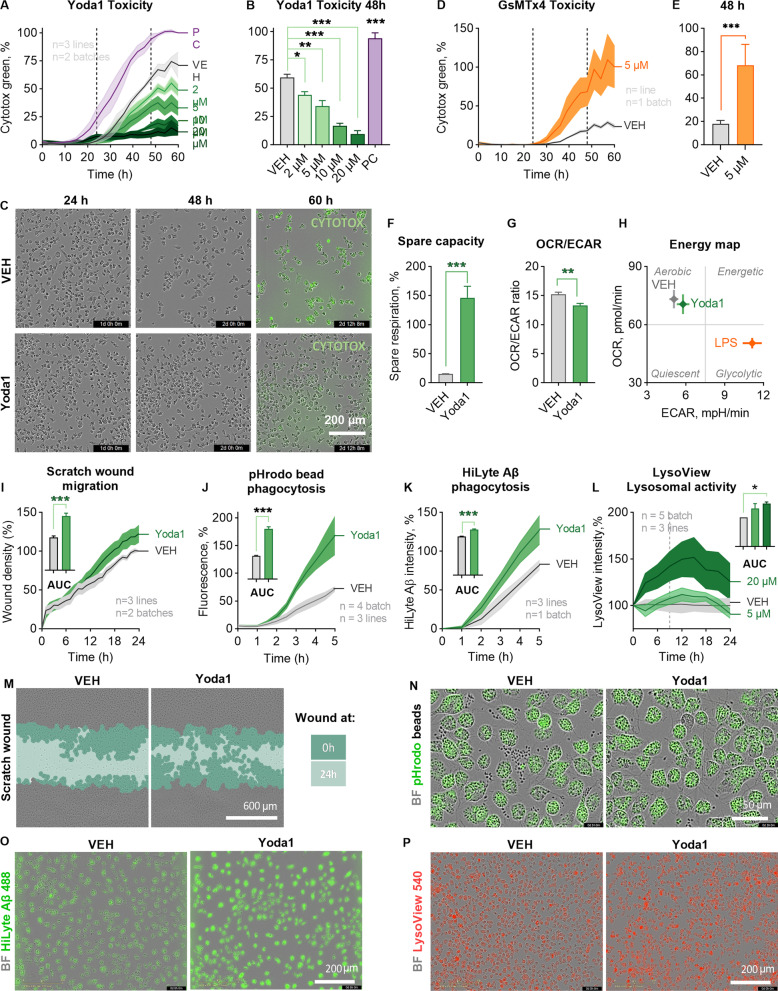
Here we showed that a mechanotransduction ion channel, PIEZO1, is expressed and functional in human and mouse microglia. We used a small molecule agonist, Yoda1, to study how activation of PIEZO1 affects AD-related functions in human induced pluripotent stem cell (iPSC)-derived microglia-like cells (iMGL) under controlled laboratory experiments. Cell survival, metabolism, phagocytosis and lysosomal activity were assessed using real-time functional assays. To evaluate the effect of activation of PIEZO1 in vivo, 5-month-old 5xFAD male mice were infused daily with Yoda1 for two weeks through intracranial cannulas. Microglial Iba1 expression and Aβ pathology were quantified with immunohistochemistry and confocal microscopy. Published human and mouse AD datasets were used for in-depth analysis of PIEZO1 gene expression and related pathways in microglial subpopulations.
We show that PIEZO1 orchestrates Aβ clearance by enhancing microglial survival, phagocytosis, and lysosomal activity. Aβ inhibited PIEZO1-mediated calcium transients, whereas activation of PIEZO1 with a selective agonist, Yoda1, improved microglial phagocytosis resulting in Aβ clearance both in human and mouse models of AD. Moreover, PIEZO1 expression was associated with a unique microglial transcriptional phenotype in AD as indicated by assessment of cellular metabolism, and human and mouse single-cell datasets.
These results indicate that the compromised function of microglia in AD could be improved by controlled activation of PIEZO1 channels resulting in alleviated Aβ burden. Pharmacological regulation of these mechanoreceptors in microglia could represent a novel therapeutic paradigm for AD.
小胶质细胞是大脑的内源性免疫细胞,作为病理的传感器,维持大脑的内稳态并消除潜在威胁。在阿尔茨海默病(AD)中,有毒的淀粉样β(Aβ)在大脑中积累并形成坚硬的斑块。在占所有病例 95%的晚发性 AD 中,这被认为是由于 Aβ的清除减少所致。人类全基因组关联研究和动物模型表明,清除减少是由于小胶质细胞功能异常所致。虽然神经化学途径对小胶质细胞的影响已被广泛研究,但调节小胶质细胞功能的机械受体在很大程度上仍未得到探索。
在这里,我们表明机械转导离子通道 PIEZO1 在人和小鼠小胶质细胞中表达和起作用。我们使用小分子激动剂 Yoda1 在受控的实验室实验中研究激活 PIEZO1 如何影响人类诱导多能干细胞(iPSC)衍生的小胶质样细胞(iMGL)中与 AD 相关的功能。使用实时功能测定法评估细胞存活、代谢、吞噬作用和溶酶体活性。为了评估激活 PIEZO1 在体内的效果,5 个月大的 5xFAD 雄性小鼠通过颅内套管每天输注 Yoda1 持续两周。通过免疫组织化学和共聚焦显微镜定量评估小胶质细胞 Iba1 表达和 Aβ 病理学。使用已发表的人类和小鼠 AD 数据集对小胶质细胞亚群中 PIEZO1 基因表达和相关途径进行深入分析。
我们表明 PIEZO1 通过增强小胶质细胞的存活、吞噬作用和溶酶体活性来协调 Aβ 的清除。Aβ 抑制了 PIEZO1 介导的钙瞬变,而用选择性激动剂 Yoda1 激活 PIEZO1 可改善小胶质细胞的吞噬作用,从而在人类和小鼠 AD 模型中清除 Aβ。此外,PIEZO1 的表达与 AD 中独特的小胶质细胞转录表型相关,这表明细胞代谢以及人类和小鼠单细胞数据集的评估。
这些结果表明,通过控制激活 PIEZO1 通道来改善 AD 中小胶质细胞的功能,可减轻 Aβ 负担。在小胶质细胞中对这些机械受体进行药理学调节可能代表 AD 的一种新的治疗范例。