Masuda Takanori, Funama Yoshinori, Kiguchi Masao, Imada Naoyuki, Oku Takayuki, Sato Tomoyasu, Awai Kazuo
Department of Radiological Technology, Tsuchiya General Hospital, Nakajima-cho 3-30, Naka-ku, Hiroshima, 730-8655 Japan ; Department of Diagnostic Radiology, Graduate School of Biomedical Sciences, Hiroshima University, Hiroshima, Japan.
Department of Medical Physics, Faculty of Life Sciences, Kumamoto University, Kumamoto, Japan.
Springerplus. 2016 Dec 1;5(1):2064. doi: 10.1186/s40064-016-3715-y. eCollection 2016.
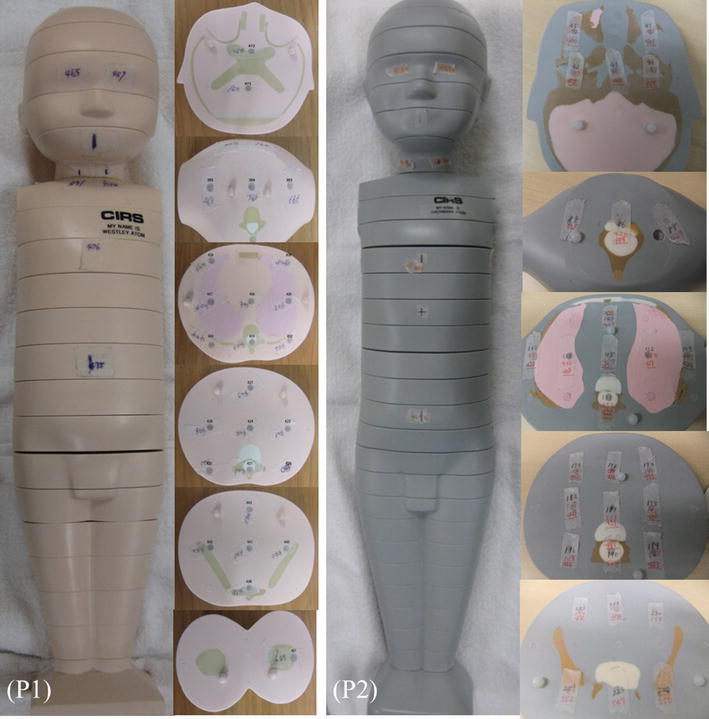
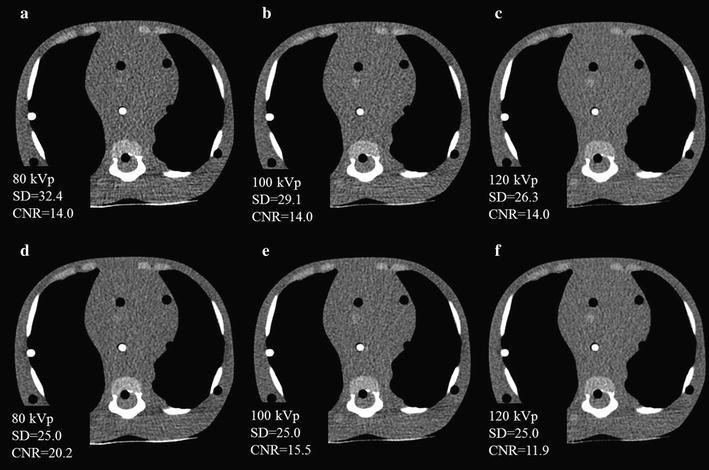
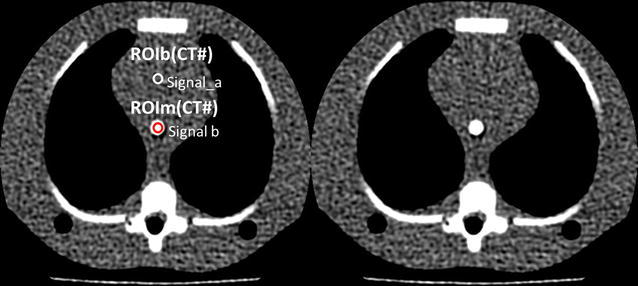
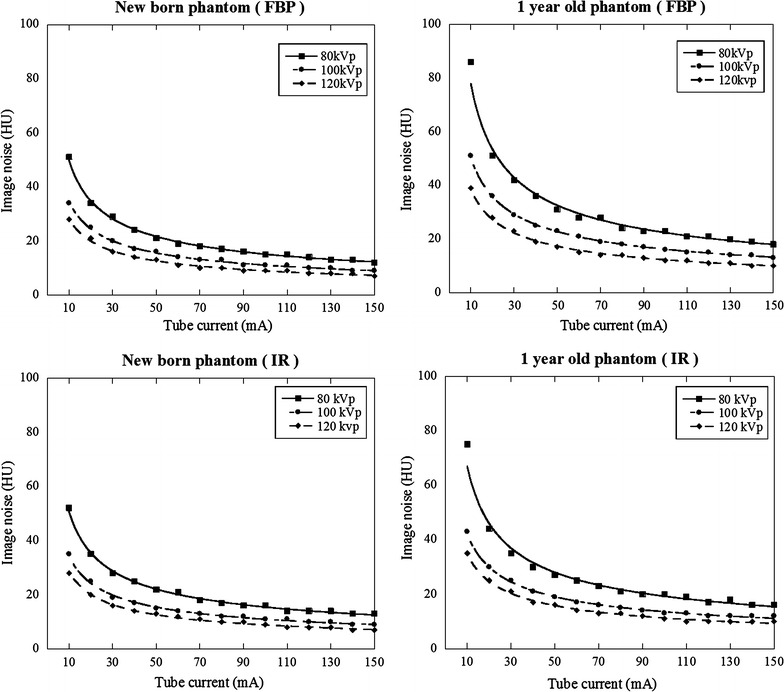
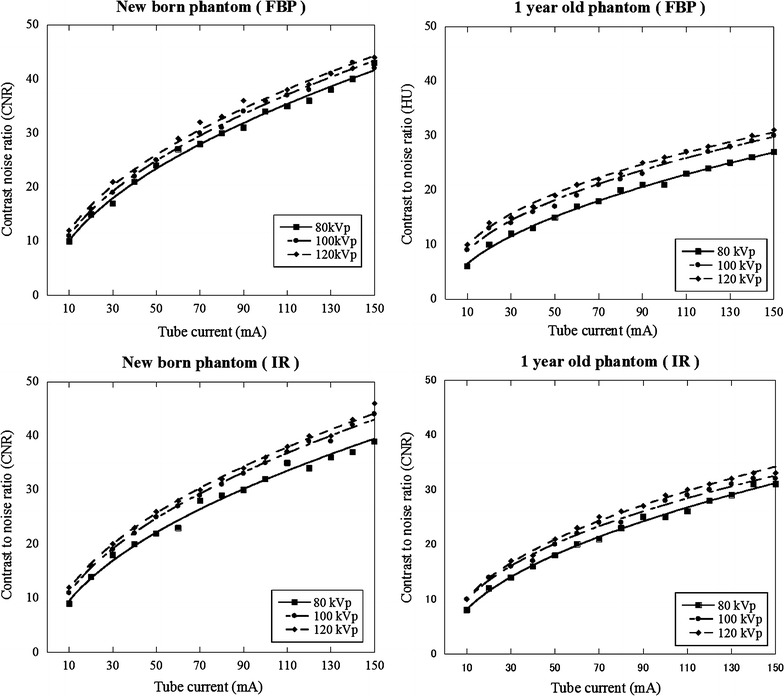
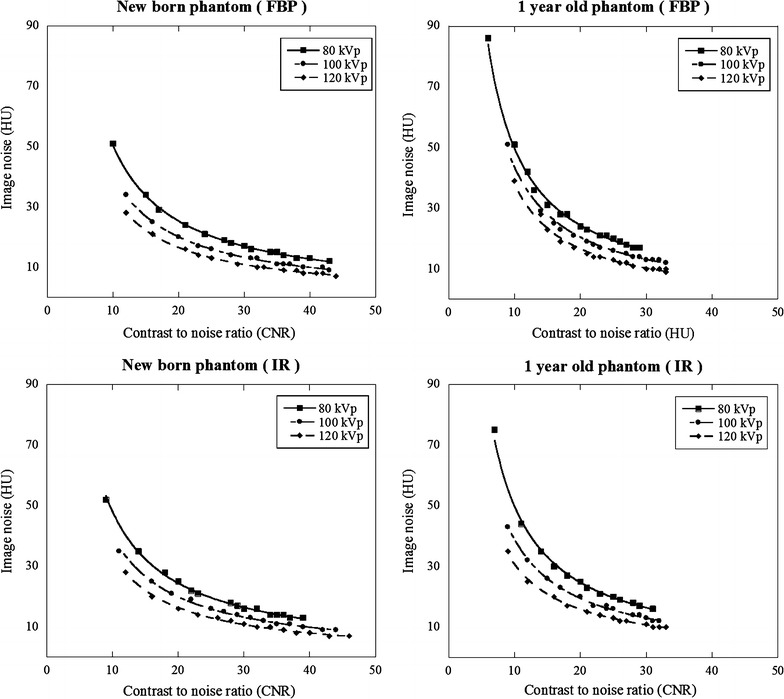
To figure out the relationship between image noise and contrast noise ratio (CNR) at different tube voltages, using anthropomorphic new-born and 1-year-old phantoms, and to discuss the feasibility of radiation dose reduction, based on the obtained CNR index from image noise. We performed helical scans of the anthropomorphic new-born and 1-year-old phantoms. The CT numbers of the simulated aorta and image noise of the simulated mediastinum were measured; then CNR was calculated on 80, 100, and 120-kVp images reconstructed with filtered back projection (FBP) and iterative reconstruction (IR). We also measured the center and surface dose in the case of CNR of 14 using radio-photoluminescence glass dosimeters.
The CT number of the simulated aorta was increased with decreasing tube voltage from 120 to 80 kVp (362.5-535.1 HU for the new-born, 358.9-532.6 HU for the 1-year-old). At CNR of 14, the center dose was 0.4, 0.6 and 0.9 mGy at FBP and 0.5, 0.6 and 0.9 mGy at IR and with the new-born phantom acquired at 80, 100 and 120 kVp, respectively. The center dose for FBP image was reduced by 56% at 80 kVp, 34% at 100 kVp for the new-born and 36% at 80 kVp, 22% at 100 kVp for the 1-year-old compared with that at 120 kVp. We obtained a relationship between image noise and CNR at different tube voltages using the anthropomorphic new-born and 1-year-old phantoms.
The use of index of CNR with low-tube voltage may achieve further radiation dose reduction in pediatric CT examination.
使用新生儿和1岁儿童的仿真人体模型,探究不同管电压下图像噪声与对比噪声比(CNR)之间的关系,并基于从图像噪声获得的CNR指数,探讨降低辐射剂量的可行性。我们对新生儿和1岁儿童的仿真人体模型进行了螺旋扫描。测量了模拟主动脉的CT值和模拟纵隔的图像噪声;然后在使用滤波反投影(FBP)和迭代重建(IR)重建的80、100和120 kVp图像上计算CNR。我们还使用放射光致发光玻璃剂量计测量了CNR为14时的中心剂量和表面剂量。
随着管电压从120 kVp降至80 kVp,模拟主动脉的CT值增加(新生儿为362.5 - 535.1 HU,1岁儿童为358.9 - 532.6 HU)。在CNR为14时,对于新生儿,FBP重建在80、100和120 kVp下的中心剂量分别为0.4、0.6和0.9 mGy,IR重建分别为0.5、0.6和0.9 mGy。与120 kVp时相比,80 kVp时新生儿FBP图像的中心剂量降低了56%,100 kVp时降低了34%;1岁儿童80 kVp时降低了36%,100 kVp时降低了22%。我们使用新生儿和1岁儿童的仿真人体模型得出了不同管电压下图像噪声与CNR之间的关系。
在儿科CT检查中,使用低管电压的CNR指数可能进一步降低辐射剂量。