Peters Jeannette B, Boer Lonneke M, Molema Johan, Heijdra Yvonne F, Prins Judith B, Vercoulen Jan H
Department of Pulmonary Diseases, Radboud University Medical Center, Nijmegen, The Netherlands.
Department of Medical Psychology, Radboud University Medical Center, Postbus 66, 6560 AB Groesbeek, Nijmegen, The Netherlands.
Int J Behav Med. 2017 Aug;24(4):571-583. doi: 10.1007/s12529-016-9622-3.
The purposes of the study are to identify clinical phenotypes that reflect the level of adaptation to the disease and to examine whether these clinical phenotypes respond differently to treatment as usual (TAU) and pulmonary rehabilitation (PR), the latter with its strong emphasis on improving adaptation.
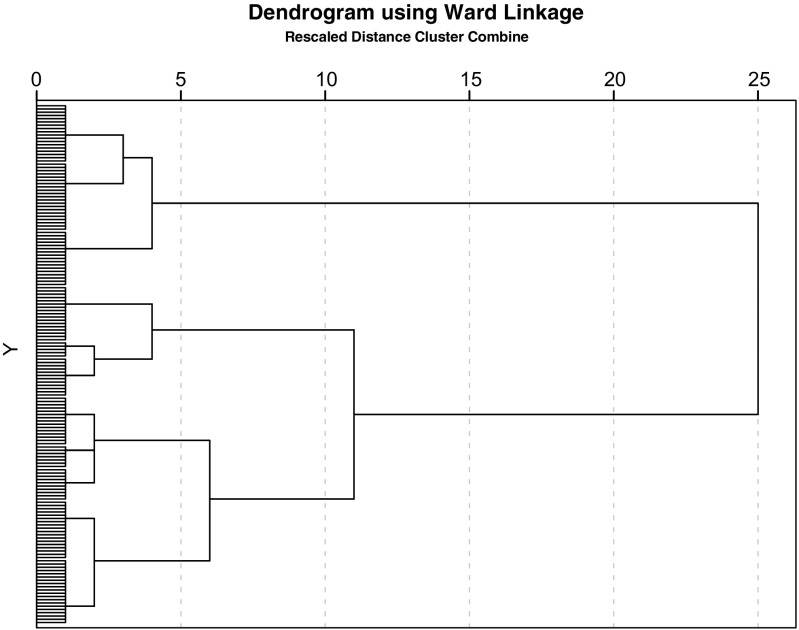
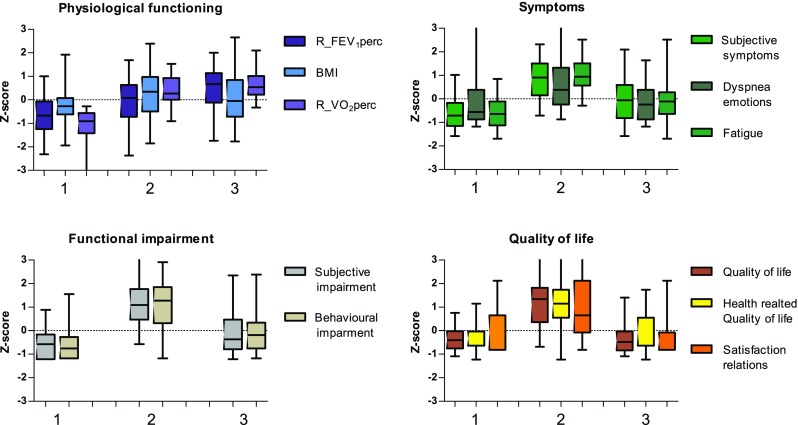
Clusters were identified by a cluster analysis using data on many subdomains of the four domains of health status (HS) (physiological functioning, functional impairment, symptoms and quality of life) in 160 outpatients with chronic obstructive pulmonary disease (COPD) receiving TAU. By discriminant analysis in the TAU sample, all 459 PR patients could be assigned to one of the identified clusters. The effect of TAU and PR on HS was examined with paired t tests.
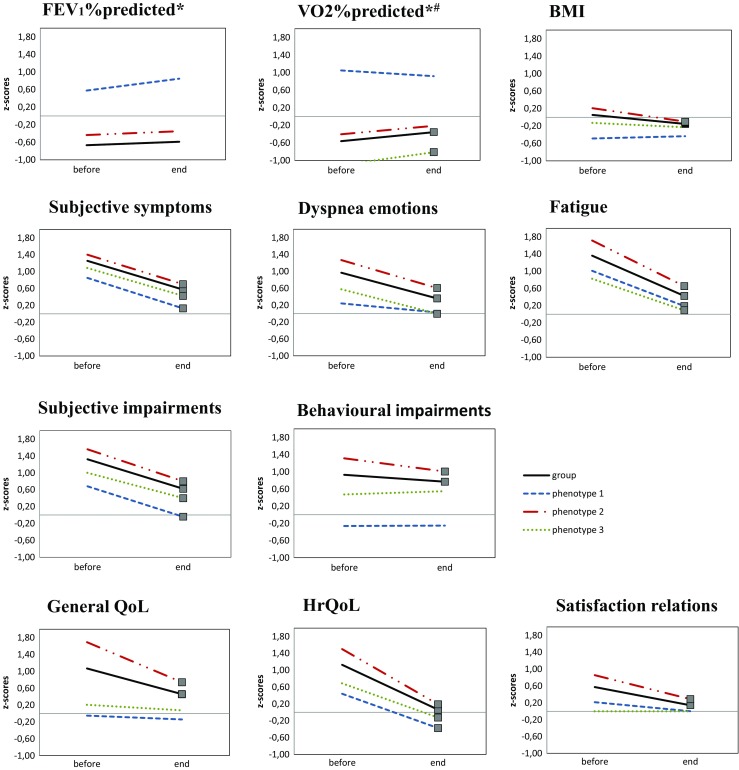
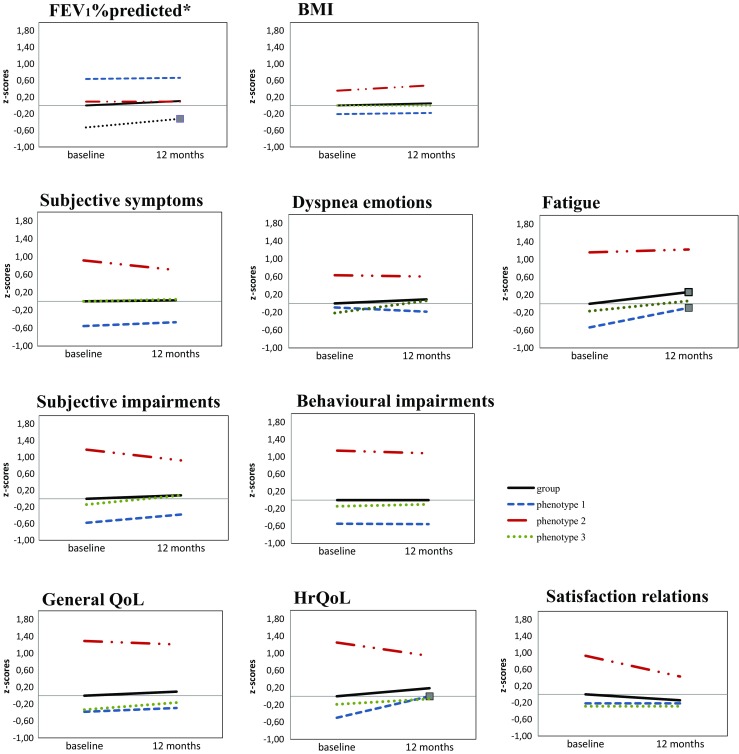
Three distinct phenotypes were identified in the TAU sample. Two types were labelled adapted: phenotype 1 (moderate COPD-low impact on HS, n = 53) and phenotype 3 (severe COPD-moderate impact on HS, n = 73). One type was labelled non-adapted: phenotype 2 (moderate COPD-high impact on HS, n = 34). After 1-year TAU, the integral health status of all patients did not improve in any subdomain. In contrast, at the end of PR, significant improvements in HS were found in all three phenotypes especially the non-adapted.
Different phenotypes exist in COPD that are based on behavioural aspects (i.e. the level of adaptation to the disease). Non-adapted patient responds better to treatments with a strong emphasis on improving adaptation by learning the patient better self-management skills. Knowing to which clinical phenotype a patient belongs helps to optimize patient-tailored treatment.
本研究的目的是识别反映疾病适应水平的临床表型,并检查这些临床表型对常规治疗(TAU)和肺康复(PR)的反应是否不同,后者特别强调改善适应性。
使用接受TAU治疗的160例慢性阻塞性肺疾病(COPD)门诊患者健康状况(HS)四个领域(生理功能、功能障碍、症状和生活质量)许多子领域的数据,通过聚类分析确定聚类。通过对TAU样本进行判别分析,可将所有459例PR患者分配到已确定的聚类之一。采用配对t检验检查TAU和PR对HS的影响。
在TAU样本中识别出三种不同的表型。两种类型被标记为适应型:表型1(中度COPD - 对HS影响低,n = 53)和表型3(重度COPD - 对HS影响中度,n = 73)。一种类型被标记为未适应型:表型2(中度COPD - 对HS影响高,n = 34)。经过1年的TAU治疗后,所有患者的整体健康状况在任何子领域均未改善。相比之下,在PR结束时,所有三种表型,尤其是未适应型,HS均有显著改善。
COPD中存在基于行为方面(即对疾病的适应水平)的不同表型。未适应型患者对特别强调通过学习更好的自我管理技能来改善适应性的治疗反应更好。了解患者属于哪种临床表型有助于优化个体化治疗。