Sasaki Yuri, Iwanari Osamu, Arakawa Ichiro, Moriya Takuya, Mikami Yoshiki, Iihara Kuniko, Konno Ryo
*Department of Obstetrics and Gynecology, Jichi Medical University Saitama Medical Center, Saitama-city, Saitama; †Department of Obstetrics and Gynecology, Iwate Medical University, Morioka-city, Iwate; ‡Department of Obstetrics and Gynecology, Shimane Prefectural Central Hospital, Izumo-city, Shimane; §Faculty of Pharmaceutical Sciences, Teikyo Heisei University, Nakano-ku, Tokyo; ∥Department of Pathology, Kawasaki Medical School, Kurashiki-city, Okayama; ¶Department of Pathology, Kumamoto University Hospital, Kumamoto-city, Kumamoto; and #Department of Diagnostic Pathology, Tokyo Yamate Medical Center, Shinjyuku-ku, Tokyo, Japan.
Int J Gynecol Cancer. 2017 Mar;27(3):523-529. doi: 10.1097/IGC.0000000000000898.
The aim of this study was to determine the value of human papillomavirus (HPV) testing for primary cervical cancer screening in Japan.
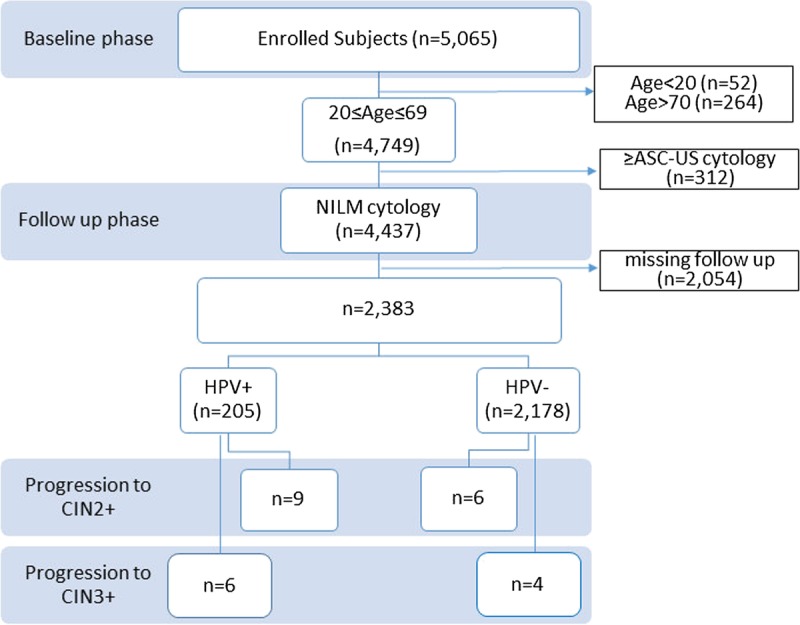
In total, 5065 women who underwent primary screening with cytology and HPV between January 2005 and December 2006 were enrolled. In the baseline phase, these women were stratified by age, and the rates of HPV-positive and abnormal cytology were compared between women younger than and older than 30 years. In the follow-up phase, women aged 20 to 69 years and cytology negative for intraepithelial lesions or malignancy at baseline were followed up until December 2011 (n = 2383). Progression to grade 2/3 cervical intraepithelial neoplasia or worse (CIN2+/CIN3+) was compared between the HPV-positive and HPV-negative groups.
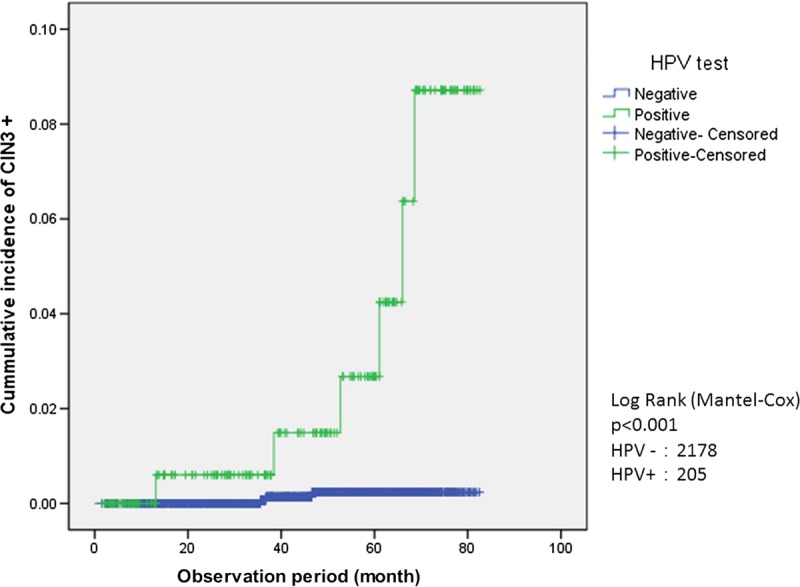
In the baseline phase, HPV-positive rates were significantly higher in women younger than 30 years at 20.7% (95% confidence interval [CI], 18.4-22.9; 255/1234) compared with women 30 years or older at 7.2% (95% CI, 6.4%-8.0%; 275/3831; P < 0.001). However, there was no statistical difference for high-grade squamous intraepithelial lesion or worse rates between them, at 2.7% (95% CI, 1.8%-3.6%; 33/1234) and 2.4% (95% CI, 1.9%-2.9%; 91/3831), respectively, P = 0.55. In the follow-up phase, the rate of progression to CIN2+/CIN3+ was significantly higher in the HPV-positive group than in the HPV-negative group (P < 0.001). Moreover, relative risk of progression to CIN2+ was 15.9 times higher in the HPV-positive group, and that of progression to CIN3+ was 16.1 times higher in the HPV-positive group.
Human papillomavirus testing is a useful test for predicting progression to CIN and is recommended as a primary screening tool. However, screening with cytology alone is still appropriate for younger women, younger than 30 years, because HPV testing yields more false-positive results in younger women.
本研究旨在确定人乳头瘤病毒(HPV)检测在日本原发性宫颈癌筛查中的价值。
总共纳入了2005年1月至2006年12月期间接受细胞学和HPV初筛的5065名女性。在基线阶段,这些女性按年龄分层,比较30岁以下和30岁及以上女性中HPV阳性率和异常细胞学率。在随访阶段,对年龄在20至69岁且基线时上皮内病变或恶性肿瘤细胞学检查为阴性的女性进行随访,直至2011年12月(n = 2383)。比较HPV阳性组和HPV阴性组进展为2/3级宫颈上皮内瘤变或更严重病变(CIN2+/CIN3+)的情况。
在基线阶段,30岁以下女性的HPV阳性率显著高于30岁及以上女性,分别为20.7%(95%置信区间[CI],18.4 - 22.9;255/1234)和7.2%(95% CI,6.4% - 8.0%;275/3831;P < 0.001)。然而,它们之间高级别鳞状上皮内病变或更严重病变率无统计学差异,分别为2.7%(95% CI,1.8% - 3.6%;33/1234)和2.4%(95% CI,1.9% - 2.9%;91/3831),P = 0.55。在随访阶段,HPV阳性组进展为CIN2+/CIN3+的比率显著高于HPV阴性组(P < 0.001)。此外,HPV阳性组进展为CIN2+的相对风险高15.9倍,进展为CIN3+的相对风险高16.1倍。
人乳头瘤病毒检测是预测进展为CIN的有用检测方法,推荐作为初筛工具。然而,对于30岁以下的年轻女性,单独进行细胞学筛查仍然合适,因为HPV检测在年轻女性中会产生更多假阳性结果。