Liu Xinning, Wang Decai, Yu Cuixiang, Li Tao, Liu Jianqiao, Sun Shujuan
Department of Clinical Pharmacy, Taishan Medical University Taian, China.
Respiration Medicine, Qianfoshan Hospital Affiliated to Shandong University Jinan, China.
Front Microbiol. 2016 Dec 6;7:1925. doi: 10.3389/fmicb.2016.01925. eCollection 2016.
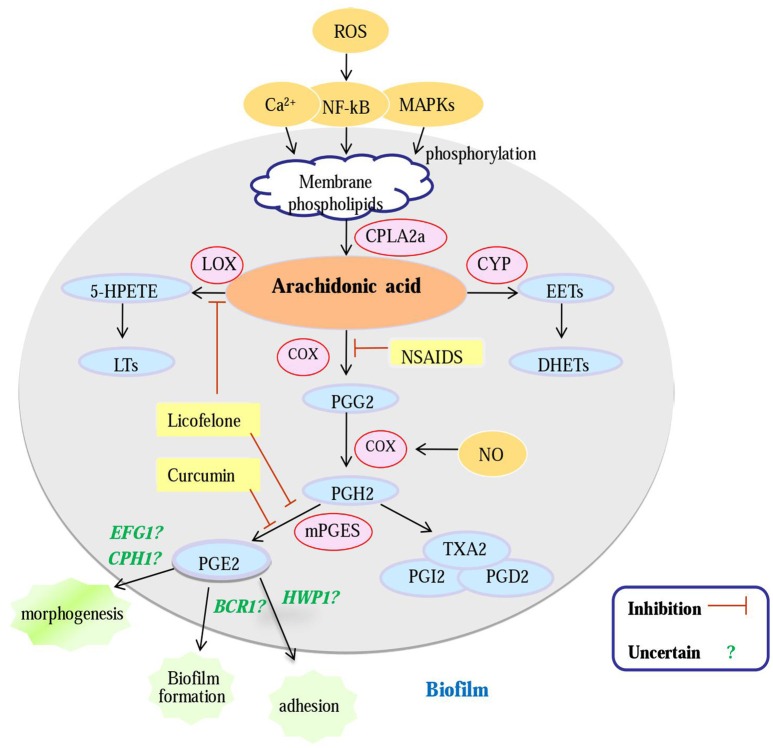
Candida is an important opportunistic fungal pathogen, especially in biofilm associated infections. The formation of a Candida biofilm can decrease Candida sensitivity to antifungal drugs and cause drug resistance. Although many effective antifungal drugs are available, their applications are limited due to their high toxicity and cost. Seeking new antifungal agents that are effective against biofilm-associated infection is an urgent need. Many research efforts are underway, and some progress has been made in this field. It has been shown that the arachidonic acid cascade plays an important role in fungal morphogenesis and pathogenicity. Notably, prostaglandin E2 (PGE) can promote the formation of a Candida biofilm. Recently, the inhibition of PGE has received much attention. Studies have shown that cyclooxygenase (COX) inhibitors, such as aspirin, ibuprofen, and indomethacin, combined with fluconazole can significantly reduce Candida adhesion and biofilm development and increase fluconazole susceptibility; the MIC of fluconazole can be decrease from 64 to 2 μg/ml when used in combination with ibuprofen. In addition, studies have also confirmed the antifungal activities of these inhibitors. In this article, we mainly review the relationship between PGE and Candida biofilm, summarize the antifungal activities of COX inhibitors and analyze the possible antifungal activity of microsomal prostaglandin E synthase-1 (MPGES-1) inhibitors; additionally, other factors that influence PGE production are also discussed. Hopefully this review can disclose potential antifungal targets based on the arachidonic acid cascade and provide a prevailing strategy to alleviate biofilm formation.
念珠菌是一种重要的机会性真菌病原体,尤其是在生物膜相关感染中。念珠菌生物膜的形成会降低念珠菌对抗真菌药物的敏感性并导致耐药性。尽管有许多有效的抗真菌药物,但由于其高毒性和高成本,它们的应用受到限制。寻找对生物膜相关感染有效的新型抗真菌药物迫在眉睫。目前正在进行许多研究工作,并且在该领域已经取得了一些进展。研究表明,花生四烯酸级联反应在真菌形态发生和致病性中起重要作用。值得注意的是,前列腺素E2(PGE)可以促进念珠菌生物膜的形成。最近,对PGE的抑制受到了广泛关注。研究表明,环氧合酶(COX)抑制剂,如阿司匹林、布洛芬和吲哚美辛,与氟康唑联合使用可显著降低念珠菌的黏附及生物膜形成,并增加氟康唑的敏感性;与布洛芬联合使用时,氟康唑的最低抑菌浓度(MIC)可从64μg/ml降至2μg/ml。此外,研究还证实了这些抑制剂的抗真菌活性。在本文中,我们主要综述PGE与念珠菌生物膜之间的关系,总结COX抑制剂的抗真菌活性,并分析微粒体前列腺素E合酶-1(MPGES-1)抑制剂可能的抗真菌活性;此外,还讨论了影响PGE产生的其他因素。希望这篇综述能够揭示基于花生四烯酸级联反应的潜在抗真菌靶点,并提供一种减轻生物膜形成的通用策略。