Gopal Murali, Gupta Alka
Microbiology Section, ICAR-Central Plantation Crops Research Institute Kasaragod, India.
Front Microbiol. 2016 Dec 7;7:1971. doi: 10.3389/fmicb.2016.01971. eCollection 2016.
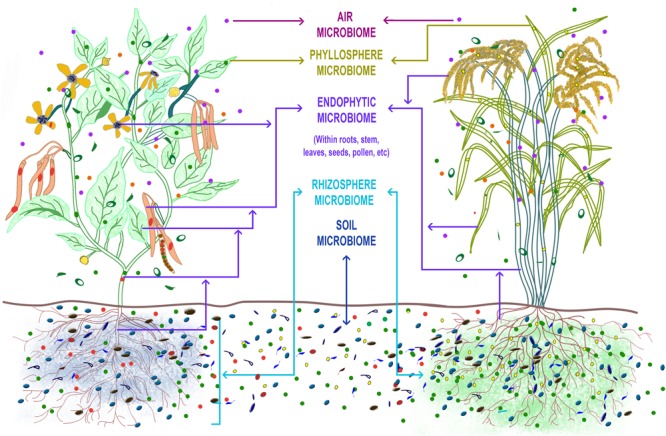
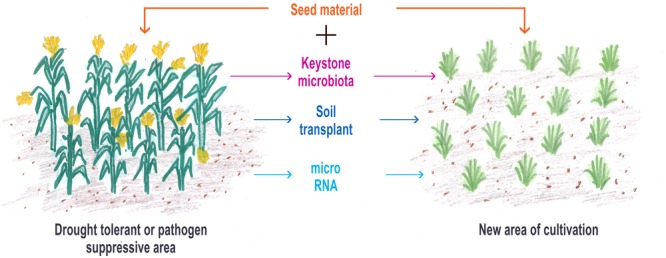
"…" Plants, though sessile, have developed a unique strategy to counter biotic and abiotic stresses by symbiotically co-evolving with microorganisms and tapping into their genome for this purpose. Soil is the bank of microbial diversity from which a plant selectively sources its microbiome to suit its needs. Besides soil, seeds, which carry the genetic blueprint of plants during trans-generational propagation, are home to diverse microbiota that acts as the principal source of microbial inoculum in crop cultivation. Overall, a plant is ensconced both on the outside and inside with a diverse assemblage of microbiota. Together, the plant genome and the genes of the microbiota that the plant harbors in different plant tissues, i.e., the 'plant microbiome,' form the holobiome which is now considered as unit of selection: 'the holobiont.' The 'plant microbiome' not only helps plants to remain fit but also offers critical genetic variability, hitherto, not employed in the breeding strategy by plant breeders, who traditionally have exploited the genetic variability of the host for developing high yielding or disease tolerant or drought resistant varieties. This fresh knowledge of the microbiome, particularly of the rhizosphere, offering genetic variability to plants, opens up new horizons for breeding that could usher in cultivation of next-generation crops depending less on inorganic inputs, resistant to insect pest and diseases and resilient to climatic perturbations. We surmise, from ever increasing evidences, that plants and their microbial symbionts need to be co-propagated as life-long partners in future strategies for plant breeding. In this perspective, we propose bottom-up approach to co-propagate the co-evolved, the plant along with the target microbiome, through - (i) reciprocal soil transplantation method, or (ii) artificial ecosystem selection method of synthetic microbiome inocula, or (iii) by exploration of microRNA transfer method - for realizing this next-generation plant breeding approach. Our aim, thus, is to bring closer the information accrued through the advanced nucleotide sequencing and bioinformatics in conjunction with conventional culture-dependent isolation method for practical application in plant breeding and overall agriculture.
“……”植物虽然固着生长,但通过与微生物共生共同进化并利用其基因组来应对生物和非生物胁迫,从而形成了一种独特的策略。土壤是微生物多样性的宝库,植物从中选择性地获取微生物群落以满足自身需求。除了土壤,种子在跨代繁殖过程中携带植物的遗传蓝图,也是多种微生物的家园,这些微生物是作物种植中微生物接种体的主要来源。总体而言,植物的内外都栖息着各种各样的微生物群落。植物基因组与植物在不同组织中所携带的微生物群落的基因,即“植物微生物组”,共同构成了全基因组生物,现在被视为选择单位:“共生功能体”。“植物微生物组”不仅有助于植物保持健康,还提供了关键的遗传变异性,而这种遗传变异性迄今为止尚未被植物育种者用于育种策略中,传统上植物育种者利用宿主的遗传变异性来培育高产、抗病或抗旱品种。关于微生物组,特别是根际微生物组为植物提供遗传变异性的新知识,为育种开辟了新的前景,有望带来下一代作物的种植方式,减少对无机投入的依赖,抗虫害和病害,并能抵御气候干扰。我们从越来越多的证据中推测,在未来的植物育种策略中,植物及其微生物共生体需要作为终生伙伴共同繁殖。从这个角度出发,我们提出自下而上的方法来共同繁殖共同进化的植物及其目标微生物组,具体方法包括:(i)相互土壤移植法,或(ii)合成微生物接种体的人工生态系统选择法,或(iii)探索 microRNA 转移法,以实现这种下一代植物育种方法。因此,我们的目标是将通过先进的核苷酸测序和生物信息学积累的信息与传统的依赖培养的分离方法相结合,以便在植物育种和整个农业中实际应用。