Renal Division, Brigham and Women's Hospital, Boston, Massachusetts, USA.
Department of Medicine, Harvard Medical School, Boston, Massachusetts, USA.
Nat Protoc. 2017 Jan;12(1):195-207. doi: 10.1038/nprot.2016.170. Epub 2016 Dec 22.
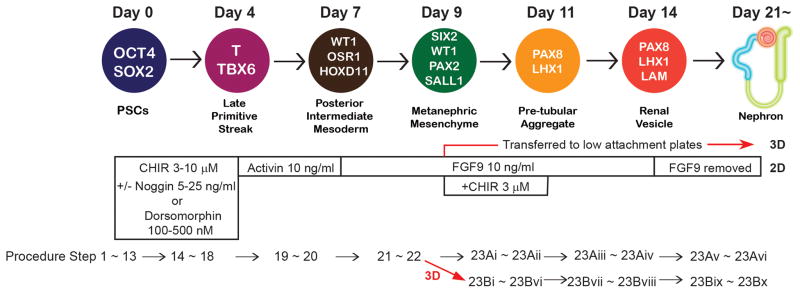
A variety of protocols have been developed that demonstrate the capability to differentiate human pluripotent stem cells (hPSCs) into kidney structures. Our goal was to develop a high-efficiency protocol to generate nephron progenitor cells (NPCs) and kidney organoids to facilitate applications for tissue engineering, disease modeling and chemical screening. Here, we describe a detailed protocol resulting in high-efficiency production (80-90%) of NPCs from hPSCs within 9 d of differentiation. Kidney organoids were generated from NPCs within 12 d with high reproducibility using 96-well plates suitable for chemical screening. The protocol requires skills for culturing hPSCs and careful attention to morphological changes indicative of differentiation. This kidney organoid system provides a platform for studies of human kidney development, modeling of kidney diseases, nephrotoxicity and kidney regeneration. The system provides a model for in vitro study of kidney intracellular and intercompartmental interactions using differentiated human cells in an appropriate nephron and stromal context.
已经开发出多种方案,证明其能够将人类多能干细胞(hPSC)分化为肾脏结构。我们的目标是开发一种高效的方案来生成肾祖细胞(NPC)和肾类器官,以促进组织工程、疾病建模和化学筛选的应用。在这里,我们描述了一种详细的方案,该方案可在分化的 9 天内高效产生(80-90%)的 hPSC 来源 NPC。使用适合化学筛选的 96 孔板,从 NPC 中在 12 天内生成具有高重现性的肾类器官。该方案需要 hPSC 培养的技能,并需要仔细注意分化指示的形态变化。该肾类器官系统为人类肾脏发育研究、肾脏疾病建模、肾毒性和肾脏再生提供了一个平台。该系统为使用适当肾单位和基质环境中的分化人细胞在体外研究肾脏细胞内和细胞间相互作用提供了一个模型。