Tugume Arthur K, Mukasa Settumba B, Valkonen Jari P T
Department of Agricultural Sciences, Faculty of Agriculture and Forestry, University of Helsinki, Helsinki, Finland.
Department of Plant Sciences, Microbiology and Biotechnology, School of Biosciences, College of Natural Sciences, Makerere University, Kampala, Uganda.
PLoS One. 2016 Dec 22;11(12):e0167769. doi: 10.1371/journal.pone.0167769. eCollection 2016.
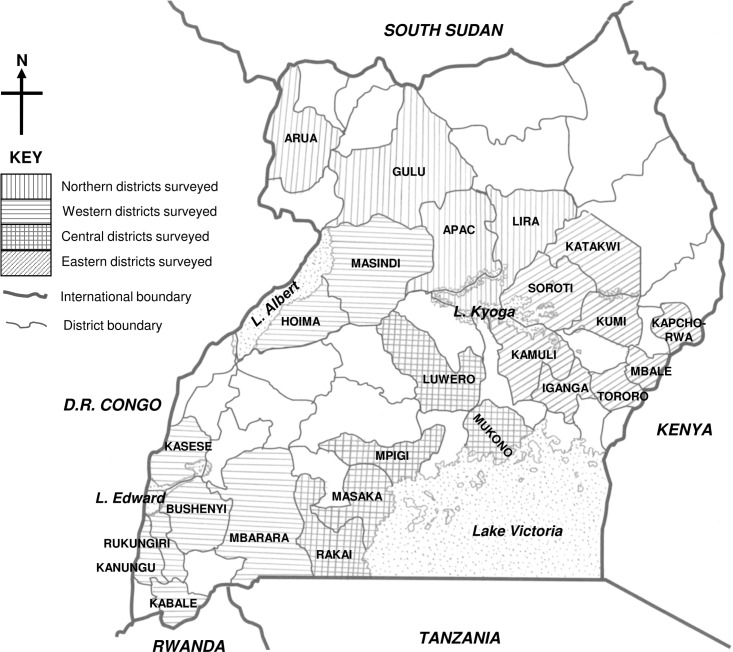
Viruses infecting wild flora may have a significant negative impact on nearby crops, and vice-versa. Only limited information is available on wild species able to host economically important viruses that infect sweetpotatoes (Ipomoea batatas). In this study, Sweet potato chlorotic fleck virus (SPCFV; Carlavirus, Betaflexiviridae) and Sweet potato chlorotic stunt virus (SPCSV; Crinivirus, Closteroviridae) were surveyed in wild plants of family Convolvulaceae (genera Astripomoea, Ipomoea, Hewittia and Lepistemon) in Uganda. Plants belonging to 26 wild species, including annuals, biannuals and perennials from four agro-ecological zones, were observed for virus-like symptoms in 2004 and 2007 and sampled for virus testing. SPCFV was detected in 84 (2.9%) of 2864 plants tested from 17 species. SPCSV was detected in 66 (5.4%) of the 1224 plants from 12 species sampled in 2007. Some SPCSV-infected plants were also infected with Sweet potato feathery mottle virus (SPFMV; Potyvirus, Potyviridae; 1.3%), Sweet potato mild mottle virus (SPMMV; Ipomovirus, Potyviridae; 0.5%) or both (0.4%), but none of these three viruses were detected in SPCFV-infected plants. Co-infection of SPFMV with SPMMV was detected in 1.2% of plants sampled. Virus-like symptoms were observed in 367 wild plants (12.8%), of which 42 plants (11.4%) were negative for the viruses tested. Almost all (92.4%) the 419 sweetpotato plants sampled from fields close to the tested wild plants displayed virus-like symptoms, and 87.1% were infected with one or more of the four viruses. Phylogenetic and evolutionary analyses of the 3'-proximal genomic region of SPCFV, including the silencing suppressor (NaBP)- and coat protein (CP)-coding regions implicated strong purifying selection on the CP and NaBP, and that the SPCFV strains from East Africa are distinguishable from those from other continents. However, the strains from wild species and sweetpotato were indistinguishable, suggesting reciprocal movement of SPCFV between wild and cultivated Convolvulaceae plants in the field.
感染野生植物的病毒可能会对附近的农作物产生重大负面影响,反之亦然。关于能够携带感染甘薯(Ipomoea batatas)的具有经济重要性病毒的野生物种,目前仅有有限的信息。在本研究中,对乌干达旋花科(Astripomoea、Ipomoea、Hewittia和Lepistemon属)野生植物中的甘薯褪绿斑点病毒(SPCFV;香石竹潜隐病毒属,长线形病毒科)和甘薯褪绿矮化病毒(SPCSV;毛形病毒属,长线形病毒科)进行了调查。2004年和2007年,观察了来自四个农业生态区的26种野生植物(包括一年生、二年生和多年生植物)是否有类病毒症状,并采集样本进行病毒检测。在从17个物种中检测的2864株植物中,有84株(2.9%)检测到SPCFV。在2007年从12个物种中采集的1224株植物中,有66株(5.4%)检测到SPCSV。一些感染SPCSV的植物还感染了甘薯羽状斑驳病毒(SPFMV;马铃薯Y病毒属,马铃薯Y病毒科;1.3%)、甘薯轻斑驳病毒(SPMMV;甘薯潜隐病毒属,马铃薯Y病毒科;0.5%)或两者(0.4%),但在感染SPCFV的植物中未检测到这三种病毒中的任何一种。在1.2%的采样植物中检测到SPFMV与SPMMV的共同感染。在367株野生植物(12.8%)中观察到类病毒症状,其中42株(11.4%)对所检测的病毒呈阴性。从靠近受试野生植物的田地中采集的419株甘薯植株中,几乎所有(92.4%)都表现出类病毒症状,87.1%感染了四种病毒中的一种或多种。对SPCFV 3'-近端基因组区域进行系统发育和进化分析,包括沉默抑制子(NaBP)和衣壳蛋白(CP)编码区域,结果表明对CP和NaBP有强烈的纯化选择,并且来自东非的SPCFV毒株与来自其他大陆的毒株不同。然而,来自野生物种和甘薯的毒株无法区分,这表明SPCFV在田间野生和栽培的旋花科植物之间相互传播。