Levallet Guénaëlle, Dubois Fatéméh, Fouret Pierre, Antoine Martine, Brosseau Solenn, Bergot Emmanuel, Beau-Faller Michèle, Gounant Valérie, Brambilla Elisabeth, Debieuvre Didier, Molinier Olivier, Galateau-Sallé Françoise, Mazieres Julien, Quoix Elisabeth, Pujol Jean-Louis, Moro-Sibilot Denis, Langlais Alexandra, Morin Franck, Westeel Virginie, Zalcman Gérard
Service d'Anatomie et Cytologie Pathologique, Centre Hospitalier Universitaire de Caen, Normandie Université, Caen, France.
Normandie Université; UMR 1086 INSERM, Caen, France.
Oncotarget. 2017 Jan 17;8(3):4313-4329. doi: 10.18632/oncotarget.14025.
DNA repair is a double-edged sword in lung carcinogenesis. When defective, it promotes genetic instability and accumulated genetic alterations. Conversely these defects could sensitize cancer cells to therapeutic agents inducing DNA breaks.
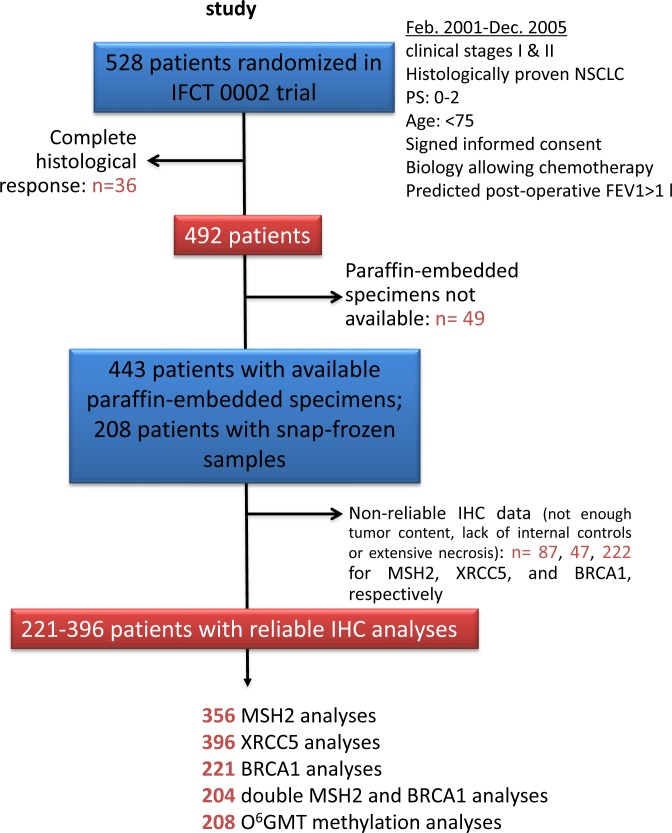
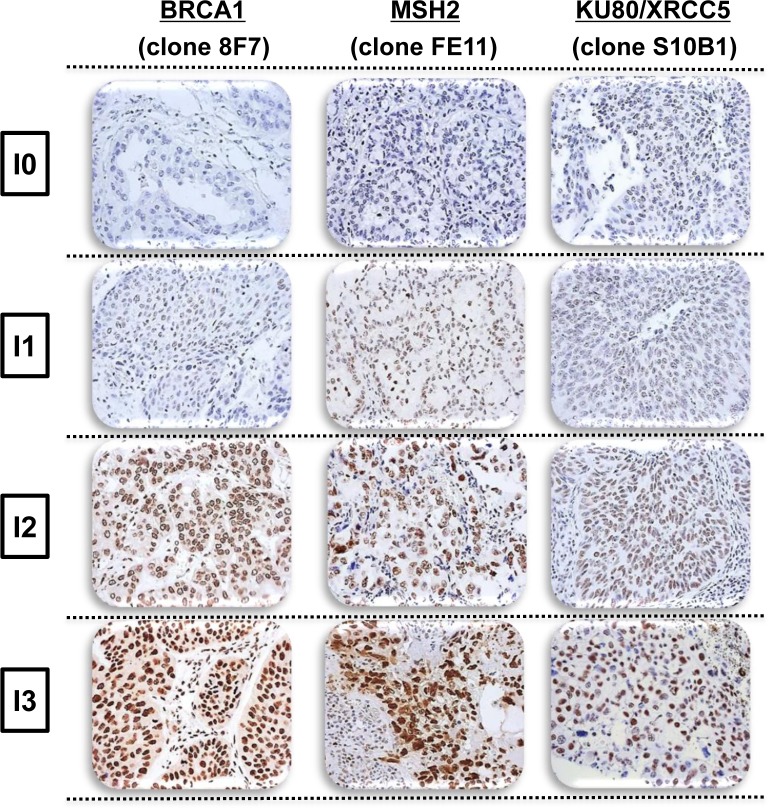
We used immunohistochemistry (IHC) to assess MSH2, XRCC5, and BRCA1 expression in 443 post-chemotherapy specimens from patients randomized in a Phase 3 trial, comparing two neoadjuvant regimens in 528 Stage I-II non-small cell lung cancer (NSCLC) patients (IFCT-0002). O6MGMT promoter gene methylation was analyzed in a subset of 208 patients of the same trial with available snap-frozen specimens.
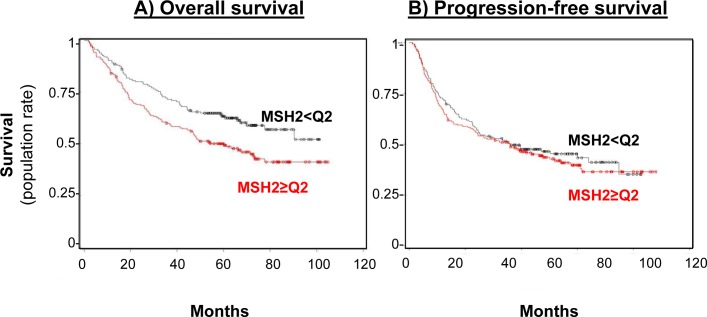
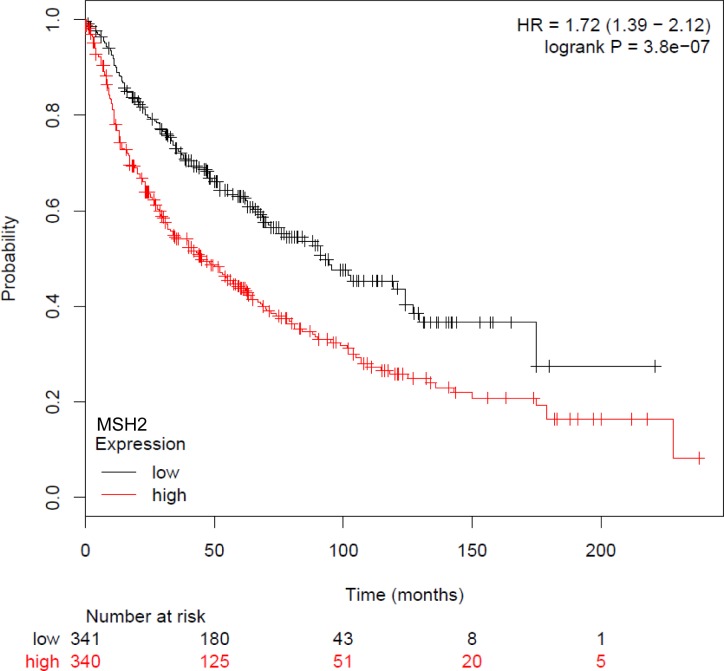
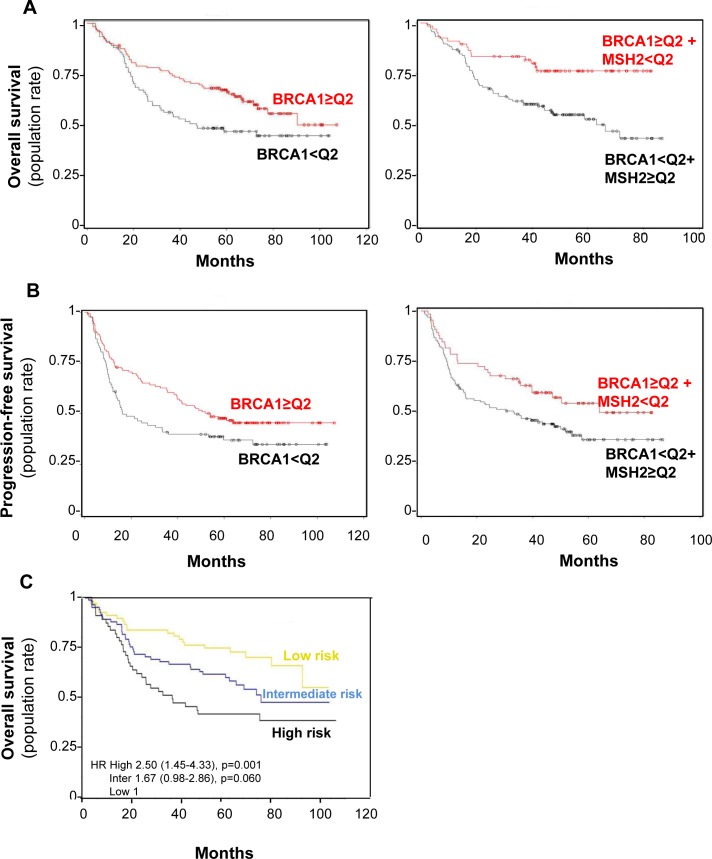
Median follow-up was from 90 months onwards. Only high BRCA1 (n = 221, hazard ratio [HR] = 1.58, 95% confidence interval [CI] [1.07-2.34], p = 0.02) and low MSH2 expression (n = 356, HR = 1.52, 95% CI [1.11-2.08], p = 0.008) significantly predicted better overall survival (OS) in univariate and multivariate analysis. A bootstrap re-sampling strategy distinguished three patient groups at high (n = 55, low BRCA1 and high MSH2, median OS >96 months, HR = 2.5, 95% CI [1.45-4.33], p = 0.001), intermediate (n = 82, median OS = 73.4 p = 0.0596), and low (high BRCA1 and low MSH2, n = 67, median OS = ND, HR = 0.51, 95% CI [0.31-0.83], p = 0.006) risk of death.
DNA repair protein expression assessment identified three different groups of risk of death in early-stage lung cancer patients, according to their tumor MSH2 and BRCA1 expression levels. These results deserve prospective evaluation of MSH2/BRCA1 theranostic value in lung cancer patients treated with combinations of DNA-damaging chemotherapy and drugs targeting DNA repair, such as Poly(ADP-ribose) polymerase (PARP) inhibitors.
DNA修复在肺癌发生过程中是一把双刃剑。当存在缺陷时,它会促进基因不稳定和累积的基因改变。相反,这些缺陷可能会使癌细胞对诱导DNA断裂的治疗药物敏感。
我们使用免疫组织化学(IHC)来评估443例来自一项3期试验中随机分组患者的化疗后标本中MSH2、XRCC5和BRCA1的表达,该试验比较了528例I-II期非小细胞肺癌(NSCLC)患者(IFCT-0002)的两种新辅助治疗方案。在同一试验中208例有可用速冻标本的患者亚组中分析了O6MGMT启动子基因甲基化情况。
中位随访时间从90个月起。在单变量和多变量分析中,只有高BRCA1表达(n = 221,风险比[HR] = 1.58,95%置信区间[CI][1.07 - 2.34],p = 0.02)和低MSH2表达(n = 356,HR = 1.52,95% CI [1.11 - 2.08],p = 0.008)显著预测了更好的总生存期(OS)。一种自助重采样策略区分出了三个患者组,高风险组(n = 55,低BRCA1和高MSH2,中位OS>96个月,HR = 2.5,95% CI [1.45 - 4.33],p = 0.001)、中风险组(n = 82,中位OS = 73.4,p = 0.0596)和低风险组(高BRCA1和低MSH2,n = 67,中位OS = 未确定,HR = 0.51,95% CI [0.31 - 0.83],p = 0.006)。
根据肿瘤MSH2和BRCA1表达水平,DNA修复蛋白表达评估在早期肺癌患者中识别出了三组不同的死亡风险。这些结果值得对接受DNA损伤化疗与靶向DNA修复药物(如聚(ADP - 核糖)聚合酶(PARP)抑制剂)联合治疗的肺癌患者中MSH2/BRCA1的诊疗价值进行前瞻性评估。