Zeng Zhi, Li Dan, Yu Tao, Huang Yabing, Yan Honglin, Gu Lijuan, Yuan Jingping
Department of Pathology, Renmin Hospital of Wuhan University, Wuhan, Hubei 430060, P.R. China.
Department of Pharmacy, Renmin Hospital of Wuhan University, Wuhan, Hubei 430060, P.R. China.
Oncol Lett. 2019 Jan;17(1):1128-1138. doi: 10.3892/ol.2018.9702. Epub 2018 Nov 15.
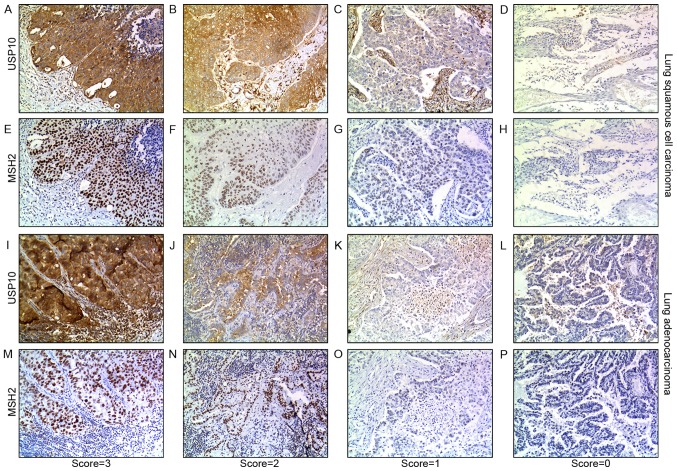
Ubiquitin-specific protease 10 (USP10) is involved in a number of biological processes by stabilizing several proteins, which have been implicated in multiple stages of tumorigenesis and progression. Previous studies have indicated that USP10 stabilizes and deubiquitinates MutS homolog 2 (MSH2) in and models. The level of MSH2 protein has been positively correlated with that of the USP10 protein in a panel of lung cancer cell lines. Furthermore, depletion of USP10 in lung cancer cells causes decreased apoptosis and increased cell survival upon treatment with DNA-damaging agents. However, the expression and clinical implication of USP10 protein in lung cancer tissues is not clear. Additionally, whether the level of MSH2 protein is positively correlated with that of the USP10 protein in lung cancer tissues also remains unresolved. Therefore, USP10 protein expression was detected in 148 human non-small cell lung cancer (NSCLC) and 139 non-cancerous lung tissues using immunohistochemistry, whereas mRNA was investigated by Gene Expression Omnibus dataset and The Cancer Genome Atlas database analyses. It was identified that USP10 protein expression was significantly downregulated in NSCLC tissues compared with in normal lung tissues (P<0.05). However, no significant difference in USP10 mRNA expression between the two tissues was identified. In addition, a positive correlation was observed between the USP10 and MSH2 proteins in NSCLC tissues (P<0.05). However, the clinicopathological features and survival analysis indicated that the USP10 and MSH2 proteins were not associated with clinical features, including age, sex, tumor size, Tumor-Node-Metastasis stage and tumor cell differentiation, along with the prognosis of NSCLC. Collectively, these results suggest that downregulation of USP10 protein serves an important function in the tumorigenesis of NSCLC, and the level of USP10 protein is positively correlated with that of MSH2 protein in NSCLC tissues, which may indicate that USP10 also stabilizes the MSH2 protein in patients with lung cancer.
泛素特异性蛋白酶10(USP10)通过稳定多种蛋白质参与多个生物学过程,这些蛋白质与肿瘤发生和进展的多个阶段有关。先前的研究表明,在[具体模型1]和[具体模型2]模型中,USP10可稳定MutS同源蛋白2(MSH2)并使其去泛素化。在一组肺癌细胞系中,MSH2蛋白水平与USP10蛋白水平呈正相关。此外,肺癌细胞中USP10的缺失会导致DNA损伤剂处理后细胞凋亡减少和细胞存活率增加。然而,USP10蛋白在肺癌组织中的表达及临床意义尚不清楚。此外,肺癌组织中MSH2蛋白水平是否与USP10蛋白水平呈正相关也尚未明确。因此,采用免疫组织化学方法检测了148例人非小细胞肺癌(NSCLC)组织和139例癌旁肺组织中USP10蛋白的表达,同时通过基因表达综合数据集和癌症基因组图谱数据库分析研究了USP10 mRNA的表达情况。结果发现,与正常肺组织相比,NSCLC组织中USP10蛋白表达明显下调(P<0.05)。然而,未发现两种组织之间USP10 mRNA表达有显著差异。此外,在NSCLC组织中观察到USP10和MSH2蛋白之间呈正相关(P<0.05)。然而,临床病理特征和生存分析表明,USP10和MSH2蛋白与包括年龄、性别、肿瘤大小、肿瘤-淋巴结-转移分期和肿瘤细胞分化在内的临床特征以及NSCLC的预后均无关。总体而言,这些结果表明,USP10蛋白的下调在NSCLC肿瘤发生中起重要作用,且NSCLC组织中USP10蛋白水平与MSH2蛋白水平呈正相关,这可能表明USP10在肺癌患者中也能稳定MSH2蛋白。