Institut des Sciences et Ingéniérie Chimiques, Ecole Polytechnique Fédérale de Lausanne, 1015 Lausanne, Switzerland.
Département de Chimie, Ecole Normale Superieure, PSL Research University, UPMC Univ Paris 06, CNRS, Laboratoire des Biomolecules (LBM), 24 rue Lhomond, 75005 Paris, France.
Sci Rep. 2016 Dec 23;6:38492. doi: 10.1038/srep38492.
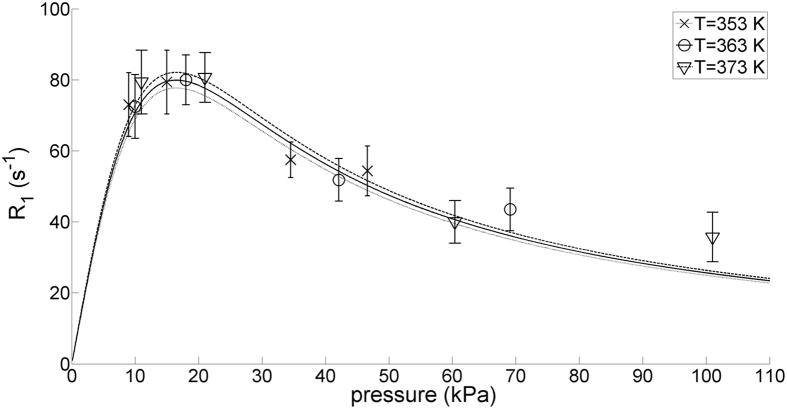
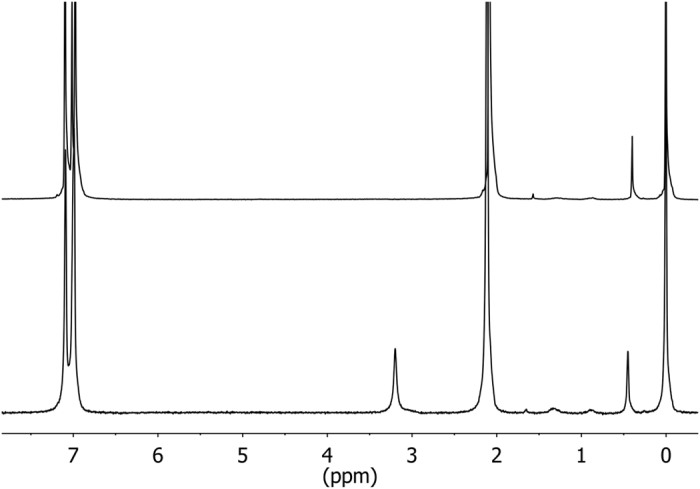
In gas phase, collisions that affect the rotational angular momentum lead to the return of the magnetization to its equilibrium (relaxation) in Nuclear Magnetic Resonance (NMR). To the best of our knowledge, the longitudinal relaxation rates R = 1/T of protons in HO and HDO have never been measured in gas phase. We report R in gas phase in a field of 18.8 T, i.e., at a proton Larmor frequency ν = 800 MHz, at temperatures between 353 and 373 K and pressures between 9 and 101 kPa. By assuming that spin rotation is the dominant relaxation mechanism, we estimated the effective cross-section σ for the transfer of angular momentum due to HO-HO and HDO-DO collisions. Our results allow one to test theoretical predictions of the intermolecular potential of water in gas phase.
在气相中,影响转动角动量的碰撞会导致核磁共振(NMR)中磁化强度返回到平衡(弛豫)状态。据我们所知,HO 和 HDO 中质子的纵向弛豫率 R = 1/T 在气相中从未被测量过。我们报告了在 18.8 T 的磁场中,即在质子拉莫尔频率 ν = 800 MHz、温度在 353 和 373 K 之间以及压力在 9 和 101 kPa 之间的气相中的 R。通过假设自旋旋转是主要的弛豫机制,我们估计了由于 HO-HO 和 HDO-DO 碰撞导致角动量传递的有效截面 σ。我们的结果可以用来检验气相中水的分子间势能的理论预测。