Ames Susan L, Xie Bin, Shono Yusuke, Stacy Alan W
School of Community and Global Health, Claremont Graduate University, Claremont, CA, USA.
Addiction. 2017 May;112(5):852-863. doi: 10.1111/add.13742. Epub 2017 Feb 3.
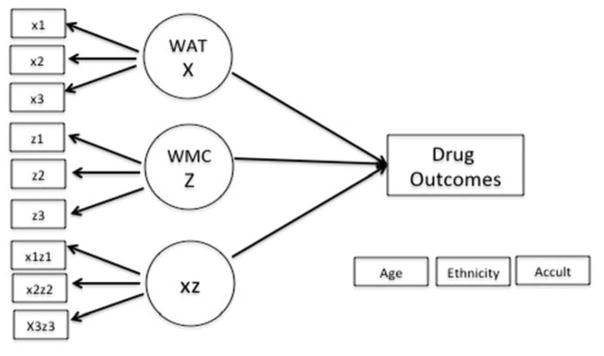
To test longitudinal additive and synergistic dual-process models in youth at documented risk for drug use. The specific dual-process approach examined suggests that engaging in drug use behaviors results from a dynamic interplay between automatically activated associative memory processes and executive reflective/control processes.
This 3-year, three-wave population-based prospective study used mobile computer-based assessments.
Self-directed computer assessments were completed in school settings in the Los Angeles metropolitan area, California, USA.
Seven hundred and twenty-five at-risk adolescents (44% female) in continuation high schools were recruited during 9th grade (age at recruitment, 14-16).
Key outcome measures included past year alcohol, marijuana and cigarette use at each assessment. Predictors included working memory capacity (WMC), associative memory, the interaction term WMC by associative memory, sex, age, ethnicity and acculturation.
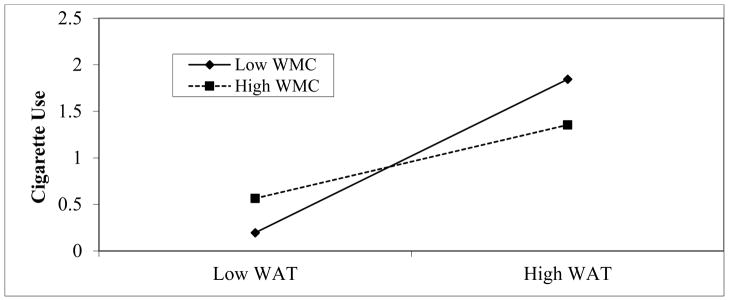
A significant cross-sectional interaction revealed tobacco-relevant associations were weaker predictors of cigarette use among males with higher WMC than among those with lower WMC (P < 0.004). Alternatively, drug-relevant associations were stronger predictors of past year alcohol (P < 0.001) and marijuana use (P = 0.02) among females with higher WMC than among those with lower WMC. Longitudinal analyses revealed no significant interactions after adjusting for predictive effects of previous drug use. With respect to WMC, females with higher WMC were less likely to use marijuana at 2-year follow-up (P = 0.03). First-order effects of drug-related associations predicted greater alcohol and marijuana use prospectively in males at 1- and 2-year follow up (P ≤ 0.03), and greater past year alcohol and marijuana use in females at 1-year follow up (P ≤ 0.03).
Drug-relevant memory associations play a key role in drug use behavior in at-risk youth.
在有吸毒记录风险的青少年中测试纵向相加和协同双过程模型。所检验的特定双过程方法表明,吸毒行为源于自动激活的联想记忆过程与执行性反思/控制过程之间的动态相互作用。
这项为期3年、分三波进行的基于人群的前瞻性研究采用了基于移动计算机的评估方法。
在美国加利福尼亚州洛杉矶大都市区的学校环境中完成自我指导的计算机评估。
在九年级(招募时年龄为14 - 16岁)期间,从继续高中招募了725名有风险的青少年(44%为女性)。
主要结局指标包括每次评估时过去一年的酒精、大麻和香烟使用情况。预测因素包括工作记忆容量(WMC)、联想记忆、WMC与联想记忆的交互项、性别、年龄、种族和文化适应情况。
显著的横断面交互作用显示,与烟草相关的关联在WMC较高的男性中对香烟使用的预测作用比WMC较低的男性弱(P < 0.004)。相反,与毒品相关的关联在WMC较高的女性中对过去一年酒精使用(P < 0.001)和大麻使用(P = 0.02)的预测作用比WMC较低的女性强。纵向分析显示,在调整了先前吸毒的预测作用后,没有显著的交互作用。关于WMC,WMC较高的女性在2年随访时使用大麻的可能性较小(P = 0.03)。与毒品相关关联的一阶效应预测,在1年和第2年随访时,男性未来酒精和大麻使用量会增加(P≤0.03),在1年随访时,女性过去一年酒精和大麻使用量会增加(P≤0.03)。
与毒品相关的记忆关联在有风险的青少年吸毒行为中起关键作用。